Economy
Group Lauds Kwara Government for Improving IGR
By Modupe Gbadeyanka
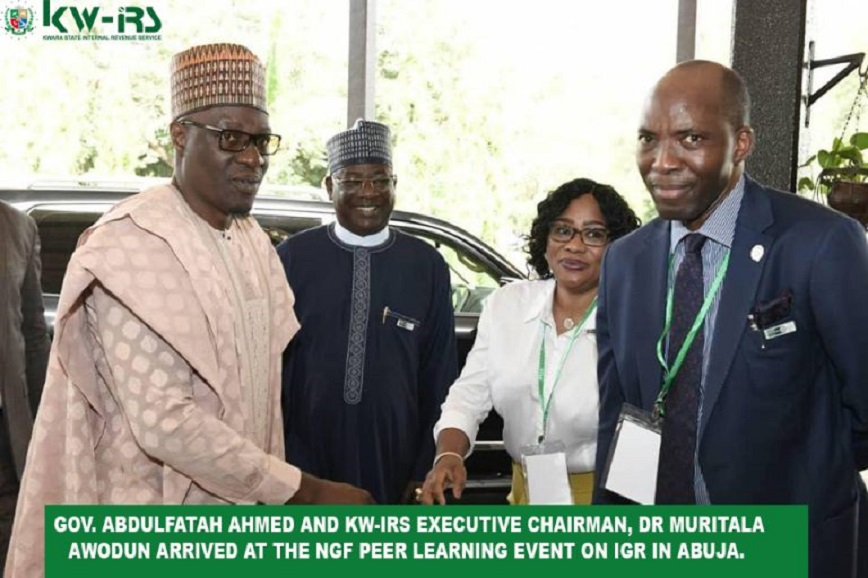
For improving the Internally Generated Revenue (IGR) of Kwara State, a group known Elites Network for Sustainable Development ENetSuD, has showered praises on the state government.
A statement issued by the coordinator of the Kwara-based civil society organization, Mr Alagbonsi Abdullateef, disclosed that the reform put in place by the administration of Governor Abdulfatah Ahmed was yielding results.
According to him, “IGR of Kwara State has commendably improved in recent times, which had greatly contributed to the total revenue of the state and has been sustaining it, especially at the period of dwindling FAAC allocation.”
“Year-by-year analysis of the Total revenue of Kwara state since 2012 showed a significant decline since 2015, which could be related to the dwindling FAAC allocation caused by recession and oil price.
“Interestingly, FAAC has been gradually increasing since 2016 (though below pre-recession periods like 2013 and 2014), and there is a possibility that the total revenue at the end of 2018 will equate or even surpass that of 2013, considering the fact that the monthly net FAAC to Kwara state has averagely remained around 3.5 billion since December 2017,” the statement said.
The KWSG, in its efforts to increase and diversify its revenue base for financial freedom and bolster efficacy in governance, signed the Kwara State Revenue Administration Law (Law No. 6 of 2015) on 22nd June 2015, which made the old Board of Internal Revenue defunct and gave birth to the current Kwara State Internal Revenue Service (KW-IRS).
The current KW-IRS has significantly increased the State IGR compared to the periods that precede its formation. The impact of the current system of IGR in Kwara is evident from the percentage contribution of IGR to the annual total revenue in the state. For instance, between 2012 and 2015 when KW-IRS was formed, 2014 was the year with the highest percentage contribution of IGR to the total revenue of the state (22%), followed by 2013 (21.6%), while 2015 has the lowest (17.4%).
However, it is interesting to note that IGR has significantly contributed to the total revenue of the state since 2016. Specifically, the contributions of IGR to the State revenue in 2016 (40.1%), 2017 (37.2%) and 2018 (33.0%) are comparably higher than the years that precedes the creation of KW-IRS, even though the dwindling FAAC since 2016 could be an important confounder.
“Considering the unique importance of IGR to the economic viability of a state (especially in the era of unstable FAAC Allocation), responsible and patriotic citizens are expected to play their role in growing the economy by paying their taxes regularly. We are appealing to the citizens and residents of Kwara State to pay their taxes accordingly,” the group added.
“We are of the conviction that Kwarans will voluntarily continue to cooperate with Government on payment of taxes if the State Infrastructural Development commensurate with the taxes that are being paid. We therefore urge the KWSG to provide value for the tax-payers money,” ENetSuD said.
The group further said, “Many aspects of the economy in the state, including Education, Health, Road infrastructure, Environment, etc, need urgent attention of KWSG. For instance, we have repeatedly called the attention of KWSG to the pitiable condition of school infrastructure across the state.
“Many of the school buildings are dilapidated, and need urgent attention of the government. On health, the creation of State Health Insurance Scheme, and the commitment of 1% of the State Annual Consolidated Revenue Fund to the Scheme is commendable.
“However, the sector needs improvement in terms of manpower and facilities. The uncountable numbers of bad roads in the state also need the quick intervention of the government within the limit of the available resources,” it said further.
“Advising the KWSG on the need to improve IGR outside tax payment by citizens is of interest to us. The government should explore all the possible ways to attract investors to Kwara state, which will boost its economy. Investing in the agricultural sector to diversify the economy is also sacrosanct.
“While the practice of removing 500 million naira monthly as Kwara Infrastructure Development Fund (IF-K) from the IGR is good, KWSG is again urged to be prudent in spending, and make more savings from the available resources,” the statement said.
Economy
Naira Crashes to N1,362.05/$1 at Official Window After N1.50 Loss
By Adedapo Adesanya
The Naira fell against the United States Dollar by N1.50 or 0.11 per cent in the Nigerian Autonomous Foreign Exchange Market (NAFEX) to sell at N1,362.05/$1 on Wednesday, June 10, compared with the N1,360.55/$1 it traded on Tuesday.
Also, the local currency lost N4.33 against the Pound Sterling in the official window yesterday to trade at N1,827.33/£1 versus the preceding day’s N1,823.00/£1, and depreciated against the Euro by N1.74 to quote at N1,575.35/€1, in contrast to N1,573.61/€1 of the previous session.
However, at the GTBank forex desk, the Naira gained N3 against the US Dollar to sell at N1,370/$1 versus N1,373/$1, and at the parallel market, it remained unchanged at N1,380/$1.
Updated data from the Central Bank of Nigeria (CBN) showed that foreign reserves surged further due to additional inflows from various sources. Nigeria’s gross external reserves increased to $50.439 billion, its highest level since March 2026, reflecting sustained inflows from oil revenue and other FX sources.
Also, the International Monetary Fund (IMF) has said increased confidence in the Naira, supported by lower and more stable inflation, would encourage households, businesses and investors to hold more local currency assets and reduce reliance on foreign currencies.
The global lender, in a recent assessment, stressed the importance of strengthening the CBN’s operational framework and aligning liquidity management operations more closely with monetary policy objectives.
In the cryptocurrency market, there were recoveries from recent losses as US headline inflation rose an expected 0.5 per cent in May, but the beat on the core rate — which cuts out food and energy costs — pleased markets. The core rate, though, rose just 0.2 per cent in May against forecasts for 0.3 per cent.
The print reinforces the view that the US Federal Reserve will keep interest rates at 350-375 basis points at its June 17 meeting, but is likely to increase rates by 25 basis points by the end of the year.
Cardano (ADA) went up by 2.4 per cent to $0.1647, Bitcoin (BTC) rose by 2.3 per cent to $62,794.09, Binance Coin (BNB) jumped 1.8 per cent to $596.23, Ethereum (ETH) grew by 1.7 per cent to $1,658.12, and Solana (SOL) also soared by 1.7 per cent to $65.23.
Further, Dogecoin (DOGE) appreciated by 1.5 per cent to $0.0849, Ripple (XRP) expanded by 0.4 per cent to $1.11, and TRON (TRX) increased by 0.05 per cent to $0.3218, while the US Dollar Tether (USDT) lost 0.10 per cent to close at $0.9989, and the US Dollar Coin (USDC) declined by 0.01 per cent to $0.9997.
Economy
Oil Prices Jump as Iran Shuts Down Strait of Hormuz
By Adedapo Adesanya
Oil prices jumped early on Thursday as Iran declared the critical energy chokepoint, the Strait of Hormuz, closed after the US launched additional strikes against the Middle East oil producer.
Brent futures rose $1.48 or 1.59 per cent to $94.58 per barrel, and the US West Texas Intermediate (WTI) crude climbed $1.71 or 1.90 per cent to $91.74 a barrel.
Iran’s top joint military command announced the closure of the Strait of Hormuz on Thursday, including oil tankers and commercial ships, saying any vessel attempting passage will be shot at.
Market analysts noted that the renewed escalation in fighting prompted oil prices to rally in early morning trading.
On Wednesday, the US military said on X that commercial ships continue to transit in and out of the strait. It also said no US warships have been struck in the strait, after Iran’s state media reported US ships near the waterway were targeted by missiles and drones.
US forces began launching additional strikes against multiple targets in Iran on Wednesday, the latest in an escalating exchange of attacks that threaten to reignite a full-scale war, which was paused in early April when the two sides agreed to a fragile ceasefire.
Defence Secretary Pete Hegseth held a press briefing announcing further attacks on Iran, saying, “If we need to negotiate with bombs, we’ll negotiate with bombs.” US Central Command later described those attacks as targeting “Iranian military surveillance capabilities, communication systems, and air defence sites across Iran.”
In response to the attacks, Iran’s top joint military command then announced that the Strait was closed to all shipping.
President Donald Trump said the strikes would stop shortly, but that they would continue if Iran’s leaders did not sign an agreement with the US immediately.
Iran’s months-long blockade of the strait, which normally carries a fifth of global oil and gas shipments, has kept oil prices elevated.
The latest exchange of strikes between the US and Iran marks the most significant escalation in the conflict since both countries agreed to a fragile ceasefire in April. Since then, oil inventories have drained dramatically, and no tangible breakthroughs have been announced.
Crude oil inventories in the US decreased by 7.2 million barrels during the week ending June 5, according to new data from the Energy Information Administration (EIA). The EIA’s data release follows figures that were released by the American Petroleum Institute (API) a day earlier, which reported that crude oil inventories saw a draw of 9.119 million barrels in the period.
Economy
Customs Street Rallies 0.06% Amid Weak Investor Sentiment
By Dipo Olowookere
A marginal 0.06 per cent was recorded by Customs Street at the close of business on Wednesday, extending the dominance of the bulls for another trading session.
The uptick printed by the Nigerian Exchange (NGX) Limited was despite weak investor sentiment after reporting 30 price gainers and 36 price losers, representing a positive market breadth index.
Livestock Feeds gained 10.00 per cent to close at N9.35, Deap Capital expanded by 9.86 per cent to N5.35, Abbey Mortgage Bank appreciated by 9.78 per cent to N12.35, Vitafoam grew by 8.25 per cent to N210.00, and FTN Cocoa chalked up 6.54 per cent to finish at N9.45.
On the flip side, Neimeth lost 10.00 per cent to trade at N9.00, International Energy Insurance slipped by 9.92 per cent to N7.90, John Holt shrank by 9.73 per cent to N13.45, Union Homes REIT declined by 8.56 per cent to N70.00, and eTranzact went down by 8.06 per cent to N16.55.
Though activity level contracted yesterday, it remained on the high side, as market participants transacted 1.2 billion equities worth N38.8 billion in 54,193 deals compared with the 1.3 billion equities valued at N57.9 billion traded in 59,956 deals on Tuesday, indicating a shortfall in the trading volume, value, and number of deals by 7.69 per cent, 32.99 per cent, and 9.61 per cent, respectively.
Sterling Holdings sold 565.3 million shares valued at N4.5 billion to emerge as the busiest during the session. FCMB transacted 122.1 million equities for N1.5 billion, Access Holdings sold 49.5 million stocks worth N1.3 billion, Jaiz Bank exchanged 34.9 million shares valued at N313.8 million, and Universal Insurance traded 32.4 million stocks worth N35.6 million.
Business Post reports that the banking and industrial goods sectors respectively lost 0.79 per cent and 0.09 per cent yesterday as a result of profit-taking.
However, the consumer goods index rose 0.42 per cent, the energy counter increased by 0.14 per cent, and the insurance segment improved by 0.03 per cent due to bargain-hunting.
As a result, the All-Share Index (ASI) went up by 154.59 points to 244,852.21 points from 244,697.62 points, and the market capitalisation soared by N99 billion to N157.043 trillion from N156.944 trillion.
-
Feature/OPED6 years agoDavos was Different this year
-
Travel/Tourism10 years ago
Lagos Seals Western Lodge Hotel In Ikorodu
-
Showbiz3 years agoEstranged Lover Releases Videos of Empress Njamah Bathing
-
Banking8 years agoSort Codes of GTBank Branches in Nigeria
-
Economy3 years agoSubsidy Removal: CNG at N130 Per Litre Cheaper Than Petrol—IPMAN
-
Banking3 years agoSort Codes of UBA Branches in Nigeria
-
Banking3 years agoFirst Bank Announces Planned Downtime
-
Sports3 years agoHighest Paid Nigerian Footballer – How Much Do Nigerian Footballers Earn