
Economy
Expanding Rural Participation in Nigeria’s Digital Economy


By Adeniyi Ogunfowoke
Nigeria’s digital economy is currently getting the much-needed attention from government and experts because of its endless potentials to cause a radical shift in the country’s economy. These can be backed by the statement of Okechukwu Enelamah, Minister of Industry, Trade and Investment who said recently that there are indications that investments in the digital economy will generate $88 billion and create three million jobs for Nigerians before the end of 2021.
From the Minister’s statement, it can be understood that the digital economy will be key to the growth of Nigeria’s economy.
However, a major concern or worry for some stakeholders is that the participation in the digital economy is largely concentrated in the urban areas. Meanwhile, in the rural areas, their participation is quite skeletal largely because of the low internet penetration. To be more factual, the Executive Vice Chairman, Nigerian Communications Commission (NCC), Prof. Umar Danbatta said recently that 53% of Nigerians lack internet access and many of them are inhabitants of rural areas.
Nigeria’s Digital economy
So, what is the digital economy? According to Deloitte, “It’s the economic activity that results from billions of everyday online connections among people, businesses, devices, data, and processes.”
What is exciting about the digital economy is that it is unrestricted and borderless as it can reach anyone in any part of the world.
In Nigeria, we have seen huge contributions in the digital economy from e-commerce, fintech, aggrotech, and healthtech among others. These businesses have deployed digital technologies like artificial intelligence, virtual reality and the internet of things to solve crucial social problems and improve their bottom line.
In relation to e-commerce, Jumia has played a key role in accelerating Nigeria’s digital economy. The platform has encouraged and convinced Nigerians to buy things online, created jobs and generally encouraged trust in the online space.
Increasing rural participation
Business in rural areas is basically offline. This is probably because of inadequate internet access. Nevertheless, these areas cannot be left behind in the digital economy march. It is a goldmine waiting to be explored.
The first and only thing that must be done is for the government through the Nigerian Communication Commission to work with the telecommunication companies to identify and provide telephony services to underserved or unserved communities. If this can be done, there will be a steady increase in rural participation in the digital economy because businesses will move into these communities to do business.
In the meantime, some painstaking efforts are been made to increase rural participation despite the limited internet access.
Jumia, Nigeria’s No 1 shopping destination, has expanded its delivery services beyond Lagos to include Ibadan, Abeokuta, Port Harcourt and Abuja. In all of these cities, there are pockets of rural communities and their inhabitants who buy items online through Jumia Force (JForce) agents and are delivered to their doorsteps. Also, if you are searching for a hotel, Jumia’s hotel and flight services have over 9,000 hotels across the country. Therefore, whether you are in a rural or urban area you do not need to worry about where to stay. This reveals that Jumia is ready to send foot soldiers to these rural areas to educate, enlighten and at the end empower them to be part of the digital economy.







By Dipo Olowookere
The last trading session of the week on the floor of the Nigerian Exchange (NGX) Limited ended on a positive note, as it rallied by 0.08 per cent on Friday.
This was buoyed by strong investor sentiment due to renewed buying pressure, which left 35 stocks on the gainers’ chart, as 33 stocks ended on the losers’ log, indicating a positive market breadth index.
According to data, Eterna gained 10.00 per cent to close at N42.35, Union Dicon appreciated by 9.70 per cent to N16.40, John Holt grew by 9.25 per cent to N9.45, Tantalizers rose by 8.41 per cent to N4.64, and Fidson expanded by 7.27 per cent to N88.50.
Conversely, RT Briscoe lost 10.00 per cent to finish at N12.06, SCOA Nigeria retreated by 9.96 per cent to N34.35, ABC Transport receded by 9.96 per cent to N6.25, Mecure crashed by 9.96 per cent to N61.50, and Berger Paints declined by 9.93 per cent to N66.65.
Business Post observed that the industrial goods space appreciated by 1.20 per cent yesterday, while the energy index improved by 0.19 per cent.
However, the insurance counter fell by 0.61 per cent, the consumer goods segment shed 0.56 per cent, and the banking industry depreciated by 0.11 per cent.
The All-Share Index (ASI) was down by 161.00 points on Friday to 196,968.15 points from 196,807.15 points on Thursday, while the market capitalisation went down by N119 billion to N126.437 trillion from N126.318 trillion.
A total of 586.2 million units of shares worth N30.6 billion were transacted in 62,699 deals during the trading day versus the 634.0 million shares valued at N29.1 billion traded in 66,286 deals a day earlier, showing a jump in the trading value by 5.16 per cent, and a decline in the trading volume and number of deals by 7.54 per cent and 5.41 per cent, respectively.
The activity chart was led by First Holdco with 43.9 million units worth N2.3 billion, Access Holdings exchange 43.2 million units valued at N1.1 billion, Zenith Bank transacted 40.0 million units for N3.7 billion, GTCO sold 38.9 million units worth N4.6 billion, and Jaiz Bank traded 31.5 million units valued at N323.4 million.


By Adedapo Adesanya
The NASD Over-the-Counter (OTC) Securities Exchange went up by 0.22 per cent on Friday, March 6, as a result of the rise in the share prices of five securities on the platform.
During the session, the market capitalisation of the bourse added N5.60 billion to close at N2.519 trillion versus the preceding session’s N2.513 trillion, and the NASD Unlisted Security Index (NSI) appreciated by 9.35 points to 4,256.41 points from 4,256.41 points.
The five price gainers were led by 11 Plc, which gained N29.02 to close at N319.25 per unit versus Thursday’s closing value of N290.23 per unit, Central Securities Clearing System (CSCS) Plc appreciated by N1.19 to N81.35 per share from N80.16 per share, Nipco Plc increased by N1.00 to N285.00 per unit from N284.00 per unit, FrieslandCampina Wamco Nigeria Plc rose by 72 Kobo to N125.20 per share from N124.48 per share, and UBN Property Plc improved by 19 Kobo to N2.17 per unit from N1.98 per unit.
On the flip side, Okitipupa Plc lost N20.00 to settle at N230.00 per share compared with the previous day’s N250.00 per share, NASD Plc declined by N5.21 to N51.00 per unit from N56.21 per unit, and First Trust Mortgage Bank Plc declined by 21 Kobo to N1.90 per share from N2.11 per share.
The volume of securities traded by market participants went down by 10.6 per cent yesterday to 3.4 million units from 3.8 million units, and the value of securities dropped 85.3 per cent to close at N62.4 million versus N423.3 million, while the number of deals jumped 4.8 per cent to 44 deals from 42 deals.
CSCS Plc remained the most traded stock by value (year-to-date) with 37.2 million units valued at N2.3 billion, followed by Okitipupa Plc with 6.3 million units worth N1.1 billion, and MRS Oil Plc with 3.4 million units sold for N506.8 million.
Resourcery Plc was the most traded stock by volume (year-to-date) with 1.05 billion units traded for N408.7 million, followed by Geo-Fluids Plc with 123.1 million units transacted for N481.6 million, and CSCS Plc with 37.2 million units worth N2.3 billion.
By Adedapo Adesanya
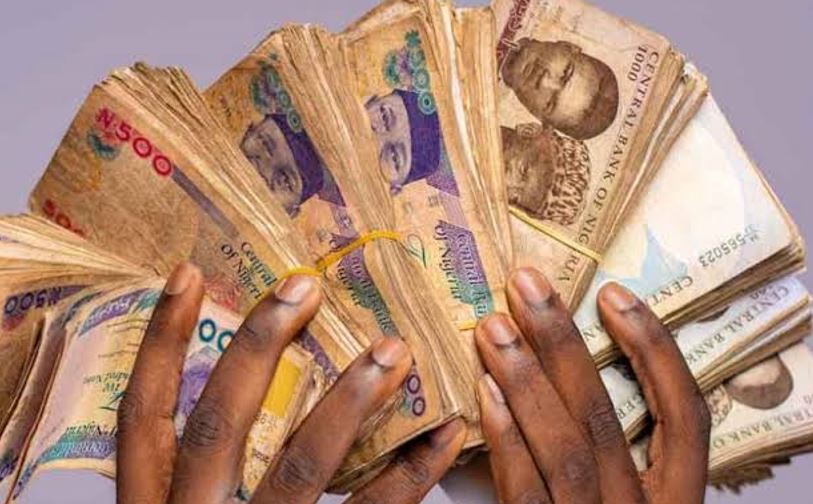
For another week, the Naira closed without recording a gain against the United States Dollar at the Nigerian Autonomous Foreign Exchange Market (NAFEX), as FX demand pressure continues to mount.
On Friday, the country’s legal tender further depreciated against the greenback by N5.82 or 0.42 per cent to trade at N1,393.26/$1 compared with the preceding day’s N1,387.45/$1.
Also, the local currency tumbled against the Pound Sterling in the official market segment yesterday by N7.61 to close at N1,859.99/£1 versus Thursday’s closing price of N1,852.38/£1, and crashed against the Euro by N1.58 to settle at N1,611.49/€1, in contrast to the N1,609.86/€1 it was traded a day earlier.
In the same vein, the Naira declined against the Dollar at the GTBank forex desk by N12 during the session to quote at N1,410/$1 versus the previous session’s rate of N1,398/$1, and at the parallel market, it lost N10 to sell for N1,415/$1 compared with the preceding day’s N1,405/$1.
The domestic currency continued its decline despite $300 million in FX intervention sales to banks by the Central Bank of Nigeria (CBN), indicating that the rising demand for foreign payments is outpacing supply. However, worries have heightened as the Naira is entering a threshold that has not previously created panic.
In the international market, the US Dollar held broadly steady and saw its steepest weekly gain in more than a year as the escalating conflict in the Middle East drove demand for safe-haven assets. This creates pressure on other currencies.
This also affected the cryptocurrency market. As tensions escalated in the Middle East last week, investors moved quickly to the safety of the US Dollar, which strengthened as markets began pricing in higher energy prices and reignited inflation fears, potentially delaying Federal Reserve rate cuts.
Ethereum (ETH) dipped by 4.9 per cent to $1,975.54, Solana (SOL) depreciated by 4.8 per cent to $84.08, Bitcoin (BTC) lost 4.3 per cent to sell for $67,725.27, Cardano (ADA) slumped 4.2 per cent to $0.2527, and Litecoin (LTC) shrank by 3.4 per cent to $53.55.
Further, Dogecoin (DOGE) declined by 3.2 per cent to $0.0906, Binance Coin (BNB) slipped 2.9 per cent to $626.32, and Ripple (XRP) went down by 2.6 per cent to $1.36, while the US Dollar Tether (USDT) and the US Dollar Coin (USDC) closed flat at $1.00 each.












-
 Feature/OPED6 years ago
Davos was Different this year
-
Travel/Tourism10 years ago
Lagos Seals Western Lodge Hotel In Ikorodu
-

 Showbiz3 years ago
Estranged Lover Releases Videos of Empress Njamah Bathing
-
 Banking8 years ago
Sort Codes of GTBank Branches in Nigeria
-

 Economy3 years ago
Subsidy Removal: CNG at N130 Per Litre Cheaper Than Petrol—IPMAN
-

 Banking3 years ago
Sort Codes of UBA Branches in Nigeria
-

 Banking3 years ago
First Bank Announces Planned Downtime
-

 Sports3 years ago
Highest Paid Nigerian Footballer – How Much Do Nigerian Footballers Earn