

General
Delta Got 988% More Revenue Than Osun in H1 2018—NEITI

By Modupe Gbadeyanka
A total of N3.95 trillion was shared among the federal, states and local government areas of the federation in the first half of 2018 from the Federation Account.
A statement from the Nigeria Extractive Industries Transparency Initiative (NEITI) signed by its Director of Communications and Advocacy, Dr Orji Ogbonnaya Orji, disclosed that the disbursements made by the Federation Accounts Allocation Committee (FAAC) represented an increase of 41 percent when compared to the N2.79 trillion disbursed in the first half of 2017 and a 95 percent increase in the N2 trillion disbursed in the first half of 2016.
According to the latest edition of the NEITI Quarterly Review, a breakdown of the disbursements showed that the federal government received N1.65 trillion, states received N1.38 trillion while local governments got the least share of N795 billion during the period under review.
The disparity in the revenues received by each of the three tiers of government was based on the revenue sharing formula of the federation as stipulated in the constitution.
The NEITI Quarterly Review shows that the lowest monthly figure of N635.6 billion disbursed in the first half of 2018 was N121.4 billion higher than the highest monthly figure (N514.2 billion) disbursed in the first half of 2017 and N218 billion higher than the highest monthly figure (N417 billion) for 2016.
“These figures clearly indicate that revenue accruing to the Federation in the first half of 2018 completely outstripped revenues in the previous two years,” stated the report.
The Quarterly Review further disclosed that total FAAC disbursements in the second quarter of this year was 46 percent higher than the figure for the same period last year and 127 percent higher than the figure for the same period in 2016.
The report noted that while N2 trillion was shared in the second quarter of this year, N1.38 trillion was disbursed during the same period last year and only N886.38 billion was shared in the second quarter of 2016.
“In fact, Q2, 2018 was the first time an amount in excess of N2trillion was disbursed since Q3 2014. This is a run of 14 consecutive quarters of disbursements below N2trillion,” it said.
The phenomenal increase of disbursements recorded in the second quarter of 2018, the report observed, was the highest to the Federation since the third quarter of 2014.
The report attributed the positive development to the rise in crude oil prices and similar increase in oil production.
“Average oil price in 2016 was $43.5 per barrel, while in 2017 oil price averaged $54.2 per barrel. However, in the first six months of 2018, average oil price was $70.6 per barrel. Thus, on the average, oil price increased by 62.2 percent between 2016 and the first half of 2018,” the NEITI Quarterly Review asserted.
“Total oil production in 2016 was 661.1 million barrels while the figure was 690 million barrels in 2017. In 2016, average monthly oil production was 55.1 million barrels while it was 57.5 million barrels in 2017. For the first two months of 2018 for which data is available, average production was 59 million barrels.”
On net FAAC disbursement to states, the review disclosed that during the first half of this year, “the highest receiving state was Delta State with N101.19 billion, while the lowest receiving state was Osun State with N10.24 billion. This implies that Delta State received 988 percent more than Osun State received.”
NEITI postulates that since “disbursements to all states as at June 2018 exceeded 60 percent of total disbursements in 2017, it is also likely that FAAC disbursements to all states in 2018 will exceed their 2017 values.”
The NEITI Quarterly Review also looked at the deductions made from the allocations to the states. The report identified five states with the lowest deductions as a percentage of disbursements as Anambra (2.89 percent), Yobe (2.93 percent), Jigawa (3.96 percent), Enugu (6.72 percent), Nassarawa (6.74 percent).
In the same direction, states with the highest deductions as percentage of disbursements were Plateau (33.48 percent), Ogun (38.43 percent), Zamfara (41.55 percent), Cross River (54.53 percent) and Osun (141.79 percent).
Another striking feature of the NEITI Report is the significant increase in VAT disbursements during the period under review.
VAT disbursements increased by 35 percent between the first quarter of 2015 and the second quarter of 2018.
The report remarked: “It is interesting that VAT has been generally increasing over time. This bodes well for the government’s efforts at increasing revenue from non-oil sources.”
The NEITI Quarterly Review expressed hope about increased revenues to governments from both oil and non-oil sectors, but cautions that the volatile and unpredictable nature of government revenues will continue to make planning difficult for all tiers of government, increasing difficulties in implementing their budgets.
It highlighted the need to place priority attention to internally generated revenues. The latest issue of the publication is based on data from the National Bureau of Statistics (NBS) and NEITI’s regular attendance at FAAC meetings.



By Adedapo Adesanya
The Socio-Economic Rights and Accountability Project (SERAP) has approached the court against the Independent National Electoral Commission (INEC) over an alleged N800 billion campaign fund diversion.
The organisation is seeking to compel the electoral body to investigate allegations that about N800 million from the Federation Account Allocation Committee (FAAC) allocations was diverted by governors elected on the platform of the All Progressives Congress (APC) to finance political and campaign activities.
The suit, marked FHC/ABJ/CS/1426/2026, was filed at the Federal High Court in Abuja last week, but no date has been fixed for the hearing of the suit.
SERAP is asking the court to issue an order of mandamus directing INEC to investigate the claims that the governors channelled public funds into a dedicated campaign account allegedly meant to support President Bola Tinubu’s 2027 re-election bid.
The organisation is also requesting an order compelling INEC to demand full disclosure from the governors and the APC on any contributions made to such a campaign fund, including the identities of donors and the lawful sources of the funds.
In addition, SERAP wants the electoral commission to commence a comprehensive review of compliance with Section 91 of the Electoral Act by political parties and candidates, particularly regarding campaign financing and the sources of political donations.
According to SERAP, the allegations raise fundamental concerns about transparency in political financing, electoral fairness and the constitutional rights of Nigerians to participate freely in democratic governance.
The organisation argued that opaque campaign financing remains a major avenue for corruption and weakens public confidence in democratic institutions.
It maintained that the alleged misuse of public funds for political purposes threatens the credibility of the 2027 general election and undermines public trust in the electoral process.
In the suit filed by its lawyers, Mr Kolawole Oluwadare and Ms Kehinde Oyewumi, SERAP argued that the reported diversion of public resources for campaign activities warrants immediate action by INEC under its constitutional and statutory responsibilities.
The group stated: “The abuse of state resources for electoral advantage undermines democratic integrity and public trust. Fairness, transparency, and accountability in political or campaign finance are essential safeguards against corruption, state capture, and undue influence in democratic processes.”
SERAP further argued: “The allegations of diversion or opaque use of public funds pose a grave risk to the integrity of the 2027 general elections.”
The organisation said large-scale public financial allocations, combined with weak oversight and limited transparency, provide sufficient grounds for INEC to activate its investigative powers.
Referring to Section 91 of the Electoral Act, SERAP noted that the law empowers INEC to regulate political donations, enforce contribution limits, demand disclosure of funding sources and impose sanctions where violations occur.
The organisation explained that political parties found to have exceeded donation limits risk fines of up to ₦10 million and forfeiture of excess funds, while individuals who exceed prescribed limits are liable to penalties amounting to five times the excess contribution.
SERAP also contended that campaign financing derived from public resources distorts electoral competition and violates constitutional principles guaranteeing free, fair and transparent elections.
According to SERAP, INEC has a constitutional duty to ensure compliance with campaign finance regulations and to investigate allegations that could compromise the integrity of the electoral process.
By Adedapo Adesanya
The Independent National Electoral Commission (INEC) has shifted the deadline for political parties to submit the names and credentials of candidates seeking to contest the 2027 presidential and National Assembly elections.
The electoral body announced that parties now have until midnight on Tuesday, July 14, to complete the process, extending the earlier deadline of Saturday, July 11.
Under INEC’s timetable for the 2027 general election, political parties were expected to upload the names and personal particulars of their presidential, Senate and House of Representatives candidates before the initial cut-off date.
Explaining the decision, INEC said the extension followed appeals from political parties that had encountered difficulties meeting the deadline.
In a statement issued on Sunday, the National Commissioner and Chairman of the Information and Voter Education Committee, Mr Mohammed Haruna, said the request was formally conveyed through the Inter-Party Advisory Council (IPAC).
According to him, IPAC sought additional time on behalf of parties that were yet to complete the submission of their candidates’ details through the commission’s portal.
“The decision to extend was based on an appeal by the Inter-Party Advisory Council, on behalf of political parties who were unable to upload the names and personal particulars of their candidates within the scheduled timeline,” Mr Haruna stated.
INEC noted that the extension is intended to give all eligible parties a fair opportunity to comply with the requirements of the electoral process while remaining within the framework of the law.
The commission also urged political parties to utilise the extra period to finalise and upload all required information ahead of the revised deadline.
“The commission enjoins political parties to take advantage of this window of opportunity and ensure that all necessary details are uploaded before the expiration of the new deadline,” the statement added.

By Dipo Olowookere
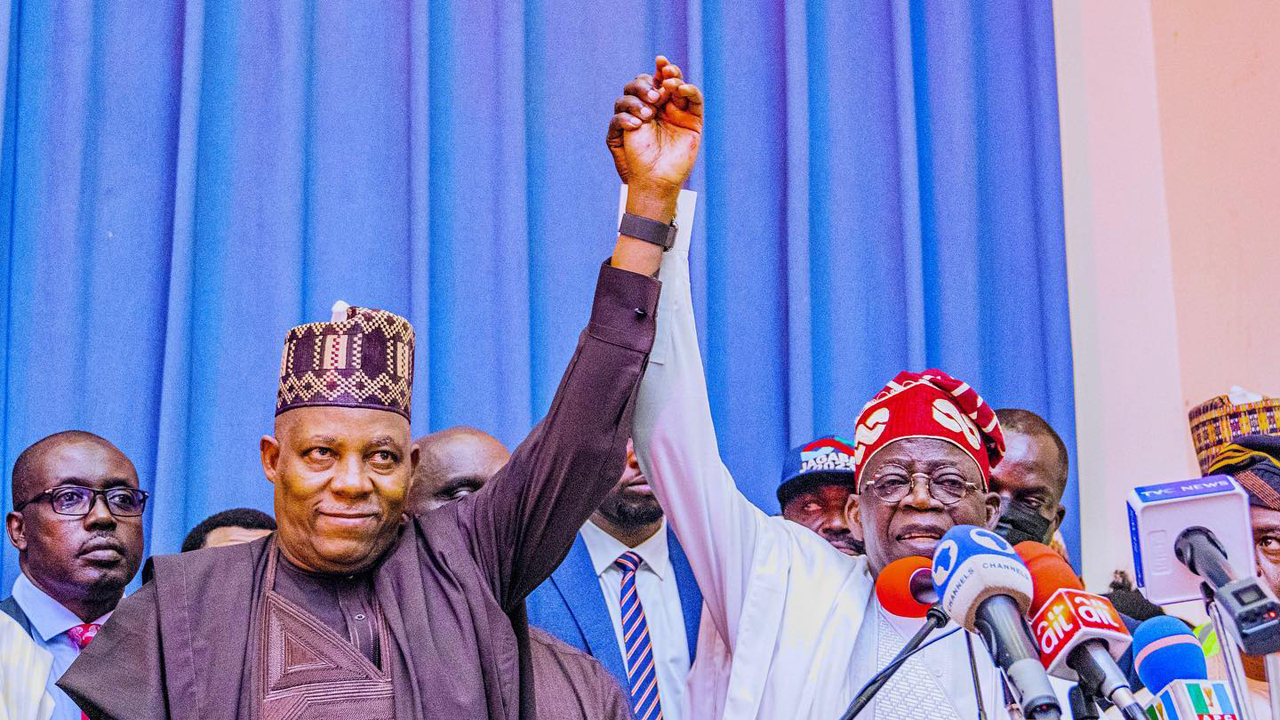
Nigeria’s Vice President, Mr Kashim Shettima, will run as the vice-presidential candidate of the All Progressives Congress (APC) in the 2027 presidential election.
President Bola Tinubu retained Mr Shettima as his running mate for re-election next year, according to the National Chairman of the APC, Mr Nentawe Yilwatda.
In a post on Friday on X, the ruling party chairman described this as “another significant milestone in the journey of our great party.”
He also said it reaffirms the party’s collective resolve to sustain the Renewed Hope Agenda and deepen the progress already being recorded across the country.
It was gathered that Mr Tinubu submitted his presidential nomination forms today through his Special Adviser on Political and Other Matters, Mr Ibrahim Masari.
The submission was done ceremony at the Continental Hotel, Abuja, attended by several party chieftains, including The event brought together an impressive array of leaders of our great party, including the Chairman of the Progressive Governors’ Forum and Governor of Imo State, Mr Hope Uzodimma; Governor Mai Mala Buni of Yobe State, Governor Nasir Idris of Kebbi State, Governor Abba Kabir Yusuf of Kano State, Governor Uba Sani of Kaduna State, Governor Babagana Umara Zulum of Borno State, Governor Ahmadu Umaru Fintiri of Adamawa State, as well as other governors, party executives and critical stakeholders from across the federation.
“The All Progressives Congress remains focused on strengthening its grassroots support, consolidating the achievements of the Renewed Hope Agenda and working together to build a more prosperous, secure and inclusive Nigeria for all,” the party leader stated.
