

Economy
Nigeria May Not Improve Ability to Generate Revenue—Moody’s


By Modupe Gbadeyanka
Renowned rating agency, Moody’s, has expressed fears that Nigeria may find it difficult to improve its ability to generate revenue.
In 2016, when the prices of crude oil in the global market fell, Nigeria, which relied on oil for revenue, went into recession.
However, as prices of the commodity picked up last year, the Africa’s largest market exited recession, though the economy still remains very fragile.
In a report released on Monday, Moody’s Investors Service emphasised that although Nigeria (B2 stable) and Angola’s (B3 stable) economies, external positions and public finances are expected to stabilise, their continued dependence on oil and gas means they will both face a range of challenges in the coming years.
Moody’s pointed out that for Angola, the key issue will be managing its liquidity pressures and higher debt burden alongside further currency devaluation, while for Nigeria, it will be improving its ability to generate revenue.
“Both Nigeria and Angola have seen their credit profiles come under pressure following the oil price shock in 2014,” said Aurélien Mali, a Moody’s Vice President – Senior Credit Officer and co-author of the report. “The rise in hydrocarbon production will support growth in both countries and will help to stabilise their deficits. But revenue generation remains a key weakness for Nigeria, while Angola will find it hard to cut its already sizeable debt load as its kwanza currency continues to depreciate.”
The report, titled ‘Governments of Nigeria and Angola: Angola’s intensifying liquidity risks and rising debt burden underpin weaker credit profile compared to Nigeria,’ disclosed that Nigeria and Angola are two of Sub-Saharan Africa’s largest economies, accounting for close to 40 percent of the nominal GDP of the sovereigns that Moody’s rates in the region.
While increased oil production will support a pick-up in growth in both countries in 2018, they face challenges in attracting more investment in a low oil price environment.
Nigeria has struggled to reform its oil sector, improve the regulatory environment and increase transparency. However, the Angolan authorities have created a predictable and transparent environment for the oil sector compared to Nigeria and other regional peers.
Angola’s main production challenge is its higher costs, meaning higher oil prices are crucial to unlocking future investment.
In 2018, Moody’s expects the higher oil price and fiscal consolidation efforts to contain budget deficits at around 2.6 percent of GDP for Nigeria and around 2 percent for Angola.
Increasing non-oil tax intake remains one of the biggest challenges both countries face in the coming years. The Nigerian authorities’ efforts to increase non-oil revenue since late 2015 have been largely unsuccessful.
Angola’s new administration is also increasing attempts to improve non-oil revenues, for instance, with a new property tax and a planned VAT tax from 2019 onwards.
Nevertheless, Moody’s expects revenues to remain at similar or only slightly higher levels in 2018-19, averaging 7.7 percent of GDP for Nigeria and 19.9 percent for Angola.
Moody’s expects the ongoing currency adjustment will increase Angola’s debt burden to almost 73 percent of GDP by the end 2018, much higher than the B2 median of 41 percent of GDP (2018F). The debt trend is then expected to gradually improve, supported by a combination of average nominal GDP growth between 2018 and 2021 of around 19 percent and the relatively small fiscal deficits.
By contrast, the increase in Nigeria’s debt burden was much slower in recent years and Moody’s expects it to stabilize at around 20 percent of GDP (2018F).
Angola’s largest credit challenges are its sizeable borrowing requirements and liquidity risks. The country’s general government gross borrowing requirements will be 20 percent of GDP in 2018, a significantly higher level than previously thought.
Nigeria’s gross borrowing requirements are lower, estimated at 6.2 percent of GDP in 2018, of which 4 percent of GDP will be funded in the domestic market.






By Adedapo Adesanya
Three bellwether stocks lifted the NASD Over-the-Counter (OTC) Securities Exchange by 0.62 per cent on Friday, December 12 with the NASD Unlisted Security Index (NSI) jumping by 22.20 points to 3,600.43 points from 3,578.23 points.
In the same vein, the market capitalisation of the trading platform increased by N13.28 billion to close at N2.154 trillion from the previous day’s N2.140 trillion.
During the session, Central Securities Clearing System (CSCS) Plc went up by N2.53 to close at N39.71 per share compared with the previous day’s N37.18 per share, Geo-Fluids Plc added 35 Kobo to its price to finish at N5.00 per unit versus Thursday’s closing price of N4.65 per unit, and FrieslandCampina Wamco Nigeria Plc appreciated by 23 Kobo appreciation to sell at N60.23 per share versus N60.00 per share.
It was observed that yesterday, the price of Golden Capital Plc went down by N1.05 to N9.45 per unit from N10.50 per unit, and UBN Propertiy Plc declined by 21 Kobo to N2.01 per share from the N2.22 per share it was traded a day earlier.
There was a significant improvement in the level of activity for the day, as the volume of transactions increased by 6.2 per cent to 37.4 million units from the previous day’s 35.2 million units, the value of trades went up by 265.1 per cent to N4.9 billion from N1.4 billion, and the number of deals soared by 13.80 per cent to 33 deals from 29 deals.
Infrastructure Credit Guarantee Company (InfraCredit) Plc ended the last trading day of this week as the most active stock by value on a year-to-date basis with 5.8 billion units valued at N16.4 billion, the second spot was taken by Okitipupa Plc with 178.9 million units traded for N9.5 billion, and third space was occupied by a new comer in MRS Oil Plc with 36.1 million units worth N4.9 billion.
InfraCredit Plc also finished the session as the most active stock by volume on a year-to-date basis with 5.8 billion units transacted for N16.4 billion, followed by Industrial and General Insurance (IGI) Plc with 1.2 billion units valued at N420.3 million, and Impresit Bakolori Plc with 537.0 million units sold for N524.9 million.

By Dipo Olowookere
The bullish run on the Nigerian Exchange (NGX) Limited continued on Friday with a further 1.00 per cent growth buoyed by gains recorded by Guinness Nigeria, Champion Breweries, and others.
Data showed that the consumer goods space expanded by 1.53 per cent during the last trading session of the week, as the insurance counter grew by 0.51 per cent, and the industrial goods sector marginally gained 0.01 per cent.
However, the banking index depreciated by 0.54 per cent due to a pocket of profit-taking, and the energy industry shrank by 0.09 per cent, while the commodity sector closed flat.
Guinness Nigeria gained 10.00 per cent to trade at N217.80, Morison Industries rose by 9.84 per cent to N4.69, Champion Breweries jumped by 9.69 per cent to N14.15, Austin Laz grew by 9.66 per cent to N2.27, and C&I Leasing appreciated by 9.62 per cent to N5.70.
Conversely, eTranzact lost 10.00 per cent to finish at N12.60, Chellarams slumped by 9.00 per cent to N13.20, Eunisell depleted by 9.89 per cent to N75.15, Africa Prudential moderated by 9.77 per cent to N12.00, and DAAR Communications decreased by 9.18 per cent to 89 Kobo.
The busiest stock on Friday was Access Holdings with 107.6 million units sold for N2.2 billion, Consolidated Hallmark traded 59.9 million units worth N245.8 million, Zenith Bank transacted 48.2 million units valued at N3.1 billion, Transcorp Power transacted 42.8 million units for N13.1 billion, and Champion Breweries exchanged 36.4 million units valued at N510.2 million.
At the close of business, a total of 602.8 million units worth N30.7 billion exchanged hands in 20,550 deals yesterday, in contrast to the 529.7 million units valued at N12.3 billion traded in 18,159 deals on Thursday, representing a surge in the trading volume, value, and number of deals by 13.80 per cent, 149.59 per cent, and 13.17 per cent apiece.
Business Post reports that the All-Share Index (ASI) soared during the session by 1,485.89 points to 149,436.48 points from 147,950.59 points and the market capitalisation moved up by N945 billion to N95.264 trillion from N94.319 trillion.
By Adedapo Adesanya
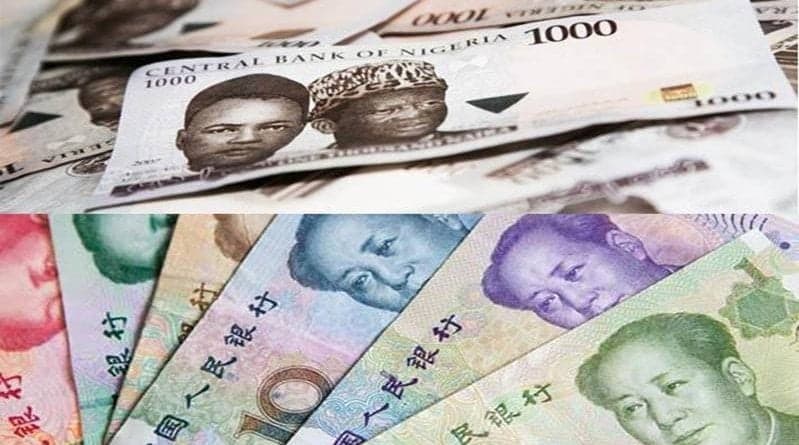
An intervention of the Central Bank of Nigeria (CBN) in the foreign exchange (FX) market eased the pressure on the Naira on Friday.
The apex bank sold forex to banks and other authorised dealers in the official window to defend the domestic currency, helping to calm the FX demand pressure, with the Nigerian currency appreciating against the US Dollar in the Nigerian Autonomous Foreign Exchange Market (NAFEM) by 0.11 per cent or N1.57 to sell at N1,454.50/$1 compared with Thursday’s closing price of N1,456.07/$1.
Also, the domestic currency improved its value against the Pound Sterling in the official market yesterday by N3.95 to close at N1,946.15/£1 versus the previous day’s N1,950.11/£1 but lost 10 Kobo on the Euro to quote at N1,706.46/€1 compared with the N1,706.36/€1 it was exchanged a day earlier.
At the black market segment, the Nigerian Naira maintained stability against the Dollar during the session at N1,470/$1 and also traded flat at N1,463/$1 at the GTBank forex counter.
Despite the sigh of relief, demand pressures outweighed the robust supply from the CBN and inflow from offshore players looking to participate at the OMO bills auction.
Gross FX reserves increased for the twenty fifth consecutive week, growing by a strong $396.84 million week-on-week to $45.44 billion.
As for the cryptocurrency market, it was down on Friday as pressure remained after Federal Reserve chair Jerome Powell’s speech on Wednesday, which hinted at a possible rate cut pause in January. As a result, markets now expect only two rate cuts in 2026 instead of three.
However, Chicago Federal Reserve President Austan Goolsbee, who was against a December rate cut, said he expects more in 2026 than the current median projection.
Ethereum (ETH) slumped by 5.1 per cent to $3,090.61, Solana (SOL) declined by 4.5 per cent to $132.79, Cardano (ADA) depreciated by 3.8 per cent to $0.4103, and Dogecoin (DOGE) dropped 2.5 per cent to trade at $0.1373.
In addition, Bitcoin (BTC) lost 2.4 per cent to sell at $90,342.74, Litecoin (LTC) tumbled by 1.9 per cent to $81.86, Binance Coin (BNB) fell by 0.6 per cent to $886.93, and Ripple (XRP) slipped by 0.5 per cent to $2.02, while the US Dollar Tether (USDT) and the US Dollar Coin (USDC) traded flat at $1.00 each.








-
 Feature/OPED6 years ago
Davos was Different this year
-
Travel/Tourism9 years ago
Lagos Seals Western Lodge Hotel In Ikorodu
-

 Showbiz3 years ago
Estranged Lover Releases Videos of Empress Njamah Bathing
-
 Banking7 years ago
Sort Codes of GTBank Branches in Nigeria
-

 Economy3 years ago
Subsidy Removal: CNG at N130 Per Litre Cheaper Than Petrol—IPMAN
-

 Banking3 years ago
First Bank Announces Planned Downtime
-

 Banking3 years ago
Sort Codes of UBA Branches in Nigeria
-

 Sports3 years ago
Highest Paid Nigerian Footballer – How Much Do Nigerian Footballers Earn