
Economy
Group Accuses Okomu Oil of Using Fake RSPO Certification


By Dipo Olowookere
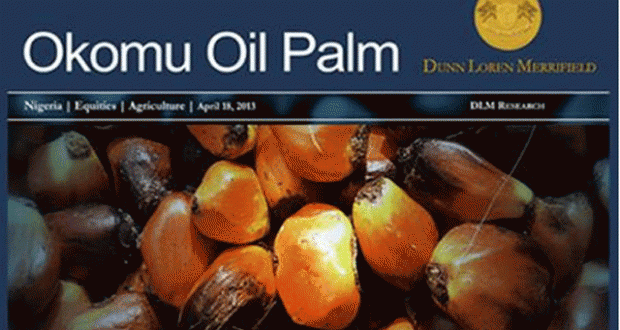
Nigeria-based company engaged in processing of oil palm, Okomu Oil Plc, has been accused of deceiving members of the public by falsely saying it has the Roundtable on Sustainable Palm Oil (RSPO) certificate.
RSPO certification is an assurance to the customer that the standard of palm oil production is sustainable.
Palm oil producers are certified through strict verification of the production process to the stringent RSPO Principles and Criteria for Sustainable Palm Oil Production by accredited Certifying Bodies, and can be withdrawn at any time in case of infringement of the rules and standards.
At a press briefing in Benin City, Edo State on Tuesday, a group known as the Environmental Rights Action/Friends of the Earth (ERA/FOEN) alleged that Okomu Oil Plc has not met the RSPO requirements and asked the firm to stop parading the certificate.
“Okomu Oil Plc, RSPO certification is a false solution because it does not address environmental and socio problems in a community. The oil firm should stop parading itself as having RSPO certified compliance.
“They are not meeting RSPO guidelines and standards yet they continued to enjoy the advertisement and putting this logo on their signpost. We called on them to remove the RSPO certification from their narrative forthwith,” the group told newsmen at the briefing.
According to the Executive Director of ERA/FOEN, Mr Godwin Uyi Ojo, who addressed the media, Okomu Oil Plc is not amongst the over 3,500 companies, who are worldwide members of RSPO.
He explained that the palm oil giant was not certified by RSPO, but pointed out that its mainstream shareholder firm, Socfin, which controls its major shares, is an RSPO member.
Recall that Okomu Oil Plc and other investors in the palm oil industry in the state last April presented and launched the Nigeria National Interpretation of Round table on Sustainable Palm Oil (RSPO) to the public in Benin-City.
The communities are located in Ovia South-West, Ovia North-East, Uhunmwode and Owan West local government areas.
“On Socfin’s website there are some certifications Okomu Plc has in Nigeria, but are not directly linked to RSPO certification, covering its acclaimed 36,000 hectares plantation. Okomu Plc is not known to have formally applied to be a member.
“Okomu Oil Plc has no RSPO certification. Still, it publicly claims to uphold RSPO certification procedures in its operations, whereas this does not amount to direct RSPO membership. It does not also suggest the certification of its plantations and socio-economic gauges. Evidently, the company was part of RSPO meeting. The company is not certified by the RSPO.
“Okomu Oil palm company Plc asserts to have been given some certification in the category of International Organization for Standardization (ISO), through a bureau Veritas. Nevertheless, Okomu Plc’s certification status with the main Roundtable on Sustainable Palm Oil (RSPO), is vague, but the company is hesitant declaring its true standing,” he informed journalists.
Mr Ojo noted that the RSPO categorically state that there shall be no deforestation in areas of oil palm, whether new or expanding plantation, stressing that from Odiguette community in Ovia North-East, Igbobazuwa, Okomu communities in Ovia South-West to Sabo-Gida community in Owan West and Uhunmwode local government deforestation has taken massively.
He maintained that with the continued deforestation, Okomu Oil Plc cannot parade itself as having RSPO certificate.
He further admonished Okomu Oil Plc to stop all forms of oil palm plantation expansion that are detrimental to community farmlands, biodiversity hotspots and historical sites, settle all outstanding cases of compensation arising from destroyed crops and farmlands, halt environmental and rights violations and evictions of communities in its areas of operation and halt using any form of armed military personnel to molest and intimidate the people among.
Meanwhile, efforts by Business Post to reach out to the management of Okomu Oil Plc proved abortive as at the time of filing this report.
However, we promise to intensify our efforts to reach the company to have their reaction to this issue.



By Adedapo Adesanya
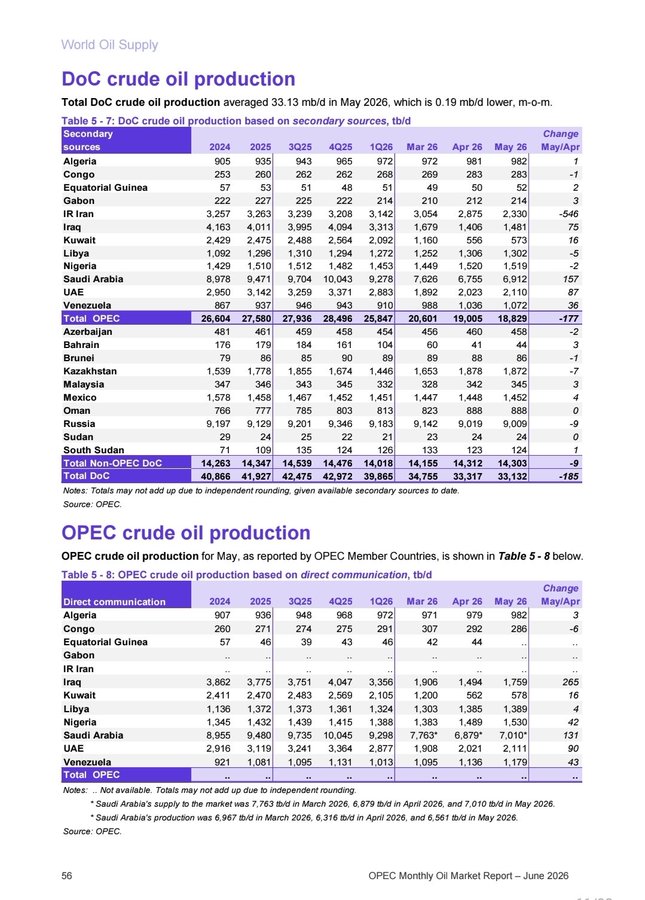
Nigeria produced about 1.530 million barrels of crude oil per day in May 2026, beating its Organisation of Petroleum Exporting Countries (OPEC) quota by 42,000 barrels per day. In the preceding month, the country only produced 1.489 million barrels per day.
In the latest OPEC’s Monthly Oil Market Report (MOMR), it was also revealed that Iraq in April supplied 1.494 million barrels per day while in May, it produced 1.759 million barrels per day, an increase 265,000 barrels per day; Saudi Arabia, 6.879 million barrels per day in April, 7.010 million barrels per day in May, an increase of 131,000 barrels per day; United Arab Emirate (UAE), 2.021 million barrels per day in April and in May 2.111 million barrels per day, an increase of 90,000 barrels per day while Venezuela, 1.136 million barrels per day in April and 1.179 million barrels per day in May, an increase of 43,000 barrels per day.
Using secondary sources, Nigeria’s production decreased from 1.520 million barrels per day in April to 1.519 million barrels per day; Saudi Arabia, 6.755 million barrels per day in April and 6.912 million barrels per day in May; UAE, 2.023 million barrels per day in April, 2.110 million barrels per day in May; and Venezuela, 1.036 million barrels per day in April and 1.072 million barrels per day in May.
Nigerian Upstream Petroleum Regulatory Commission (NUPRC), in a statement by its Head, Media and Corporate Communications, Mr Eniola Akinkuotu, confirmed that Nigeria, in May, met 102 per cent of OPEC quota as production hit an 11-month high.
According to it, Nigeria’s oil production witnessed an upswing in May 2026, averaging 1,530,354 barrels of crude oil and 170,446 barrels of condensates per day, bringing the total combined production to 1, 700, 800 barrels per day and consolidating Nigeria’s position as Africa’s largest oil producer.
It stated that the average crude oil production recorded in May represents 102 per cent of Nigeria’s 1.5mbpd of production quota allocated by OPEC.
It explained that production performance during the review period remained robust, with combined crude oil and condensate output ranging between a low of 1.51 million barrels per day and a peak of 1.86 million barrels per day.
The organisation added that the May 2026 production figures represented the highest recorded by Nigeria since July 2025, when output surged to 1,712,282.
NUPRC said: “In strict crude oil terms (excluding condensates), the 1.53 million barrels recorded in May 2026 represents the highest Nigeria has witnessed since January 2025 when crude oil production hit 1.538 mbpd.”
“On a month-on-month basis, production rose by 2.77 per cent in May 2026 as against 1.48mbpd in April. The broader production trend over the last five months has also remained positive.
“Combined crude oil and condensate output increased from 1.48 mbpd in February to 1.54 mbpd in March, 1.66 mbpd in April, and then 1.7 mbpd in May, underscoring sustained growth in Nigeria’s hydrocarbon production levels.
“Among production streams, Bonny Terminal led the pack with a total blend of 293,870 bpd, closely followed by Forcados Terminal at 289,900 bpd. Qua Iboe ranked third with 173,360 bpd, while Escravos Oil Terminal contributed 135,470 bpd. Odudu (Amenam Blend) completed the top five production streams, accounting for 63,250 bpd during the month under review.”
The commission attributed the rise in production to a sustained positive momentum as operations remained stable throughout the reporting period with no significant pipeline or facility outages recorded.

By Adedapo Adesanya
The NASD Over-the-Counter (OTC) Securities Exchange broke a three-day losing streak after it gained 1.04 per cent on Thursday, June 11, on the back of a strong showing by Central Securities Clearing System (CSCS) Plc.
The Nigerian securities depository company recorded a N5.61 growth during the session to finish at N83.93 per share compared with the previous day’s N78.32 per share.
The rise in the share price of the company overpowered the losses printed by three other securities at the close of business.
Consequently, the market capitalisation of the trading platform went up by N26.68 billion to N2.617 trillion from N2.590 trillion, and the NASD Unlisted Security Index (NSI) closed higher by 44.89 points to 4,375.01 points from 4,330.12 points.
Yesterday, Nitrox Industrial Gases Plc declined by N2.38 to N21.48 per unit from N23.80 per unit, UBN Property Plc went down by 13 Kobo to N1.98 per share from N2.11 per share, and MRS Oil Plc dropped 10 Kobo to close at N158.00 per unit, in contrast to Wednesday’s closing price of N158.10 per unit.
The volume of securities transacted by investors during the session significantly went up by 2,558.6 per cent to 3.1 million units from 117,374 units, and the value of securities traded improved by 463.1 per cent to N68.5 million from the preceding session’s N12.2 million, while the number of deals moderated by 37.2 per cent to 27 deals from 43 deals.
At the close of business, Great Nigeria Insurance (GNI) Plc was the most traded stock by value on a year-to-date basis, with 3.4 billion units traded for N8.4 billion, followed by Infrastructure Credit Guarantee (Infracredit) Plc with 2.3 billion units transacted for N6.5 billion, and CSCS Plc with 65.9 million units sold for N4.5 billion.
GNI Plc remained the most traded stock by volume on a year-to-date basis, with 3.4 billion units exchanged for N8.4 billion, followed by Infracredit Plc with 2.3 billion units valued at N6.5 billion, and Resourcery Plc with 1.1 billion units worth N415.7 million.

By Dipo Olowookere
The key performance indices of the Nigerian Exchange (NGX) Limited moderated by 0.05 per cent on Thursday as a result of selling pressure by investors.
The sell-offs were mainly from the consumer goods and banking sectors, which contracted by 0.23 per cent and 0.17 per cent, respectively.
It was observed that the insurance counter closed higher by 0.73 per cent, the energy index appreciated by 0.10 per cent, and the industrial goods space was up by 0.09 per cent.
However, they could not prevent the bourse from crumbling at the close of business.
As a result, the All-Share Index (ASI) shrank by 113.47 points to 244,738.74 points from 244,852.21 points, and the market capitalisation slipped by N73 billion to N156.970 trillion from N157.043 trillion.
International Energy Insurance crashed by 10.00 per cent to N7.11, May and Baker stumbled by 8.51 per cent to N43.00, Tripple Gee contracted by 8.47 per cent to N4.00, Abbey Mortgage Bank slumped by 7.69 per cent to N11.40, and AXA Mansard dipped by 6.67 per cent to N12.60.
Conversely, Consolidated Hallmark improved by 10.00 per cent to N8.25, Learn Africa surged by 10.00 per cent to N11.00, Nigerian Enamelware was elevated by 10.00 per cent to N40.70, University Press chalked up 10.00 per cent to finish at N5.50, and ABC Transport gained 8.25 per cent to end at N7.80.
A total of 31 stocks were on the gainers’ chart, and 33 stocks were on the losers’ table, indicating a negative market breadth index and bearish investor sentiment.
On the activity chart, market participants bought and sold 1.7 billion equities valued at N52.8 billion in 49,807 deals, in contrast to the 1.2 billion equities worth N38.8 billion traded in 54,193 deals at midweek. This showed that the trading volume was up by 41.67 per cent, the trading value was up by 36.08 per cent, and the number of deals was down by 8/09 per cent.
The most active stock yesterday was FCMB with a turnover of 584.7 million units worth N5.9 billion, Access Holdings sold 579.8 million units for N14.0 billion, UBA exchanged 107.0 million units valued at N4.6 billion, NGX Group transacted 49.1 million units worth N6.7 billion, and AIICO Insurance traded 30.1 million units for N134.2 million.
-
 Feature/OPED6 years ago
Davos was Different this year
-
Travel/Tourism10 years ago
Lagos Seals Western Lodge Hotel In Ikorodu
-

 Showbiz3 years ago
Estranged Lover Releases Videos of Empress Njamah Bathing
-
 Banking8 years ago
Sort Codes of GTBank Branches in Nigeria
-

 Economy3 years ago
Subsidy Removal: CNG at N130 Per Litre Cheaper Than Petrol—IPMAN
-

 Banking3 years ago
Sort Codes of UBA Branches in Nigeria
-

 Banking3 years ago
First Bank Announces Planned Downtime
-

 Sports3 years ago
Highest Paid Nigerian Footballer – How Much Do Nigerian Footballers Earn