

Economy
FG Lists ‘Resetting the Economy’ as Achievement of Buhari

By Dipo Olowookere
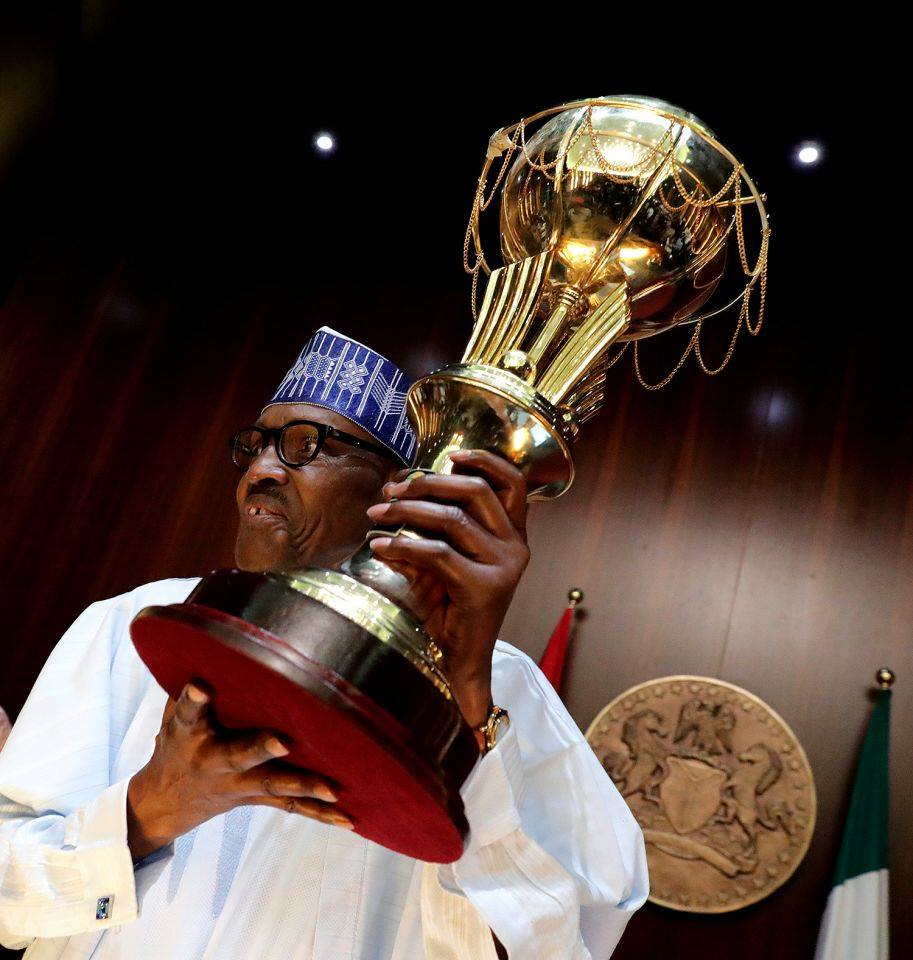
As President Muhammadu Buhari marks his third year in office on Tuesday, May 29, 2018, the Nigerian government has listed ‘resetting the economy’ as one of his achievements in three years.
In a post on its Twitter handle on Monday, the Nigerian government (@Aso Rock), it was said that since Mr Buhari took over from the past administration, he has also grown what people eat, made business work, plugged leakages, invested in people, secured the country, brought about reforms in the judiciary and come up with new vision for the Niger Delta.
According to the Federal Government, President Buhari reset the nation’s economy by coming up with the Economic Recovery and Growth Plan (ERGP), which was launched in April 2017.
The economic plan charts a course for the Nigerian economy over the next four years (2017–2020) with the vision to restore economic growth, invest in Nigerians, and to build a globally competitive economy.
Government aims to achieve these by focusing on five execution priorities: stabilizing the macroeconomic environment; achieving agriculture and food security; ensuring energy efficiency (especially in power and petroleum products); improving transportation infrastructure; and driving industrialization, primarily through SMEs.
To fast-track the implementation of the ERGP, the Federal Government launched the ERGP Focus Labs, as a targeted 6-week intervention (March to April 2018) bringing together all stakeholders to identify bureaucratic bottlenecks impacting medium-scale and large-scale investment projects in Nigeria, and then generate ideas and resources to resolve them.
Government said the just-concluded Phase 1 of the ERGP Focus Labs identified private-sector projects worth about $22.5billion and with a potential for 500,000 jobs (in Agriculture, transportation, manufacturing and processing, power and gas) for unlocking by 2020.
According to the Nigerian authorities, Mr Buhari returned the economy to the path of growth, after the recession of 2016-17 with the GDP recording 1.95 percent growth in the first quarter of 2018.
It was stated that the Buhari administration’s priority sectors of Agriculture and Solid Minerals maintained consistent growth throughout the recession.
“Inflation has fallen for the fifteenth (15th) consecutive month, from 18.7 percent in January 2017 to 12.5 percent as of April 2018.
“External Reserves of $47.5 billion are the highest in 5 years, and double the size as of October 2016.
“Total exports in 2017 were 59.47% higher than for 2016. In 2017, agriculture exports grew 180.7% above the value in 2016.
“In 2017, raw material exports grew 154.2% above the value in 2016. In 2017, solid minerals exports grew 565% above the value in 2016. In 2017, exports of manufactured goods grew 26.8% above the value in 2016. The first quarter of 2018 saw the fourth consecutive quarterly increase in capital importation since Q2 2017.
“The total value of capital imported in the quarter stood at $6.32 billion, which is a year-on-year increase of 594.03%, and a 17.11% growth over the figure reported in the previous quarter. The new FX Window introduced by the CBN in April 2017 now sees an average of $1 billion in weekly turnover, and has attracted about $25 billion in inflows in its first year (and a total turnover of $47.14 billion), signalling rising investor confidence in Nigeria.
“Nigeria’s stock market ended 2017 as one of the best-performing in the world, with returns in excess of 40 percent. Five (5) million new taxpayers added to the Tax Base since 2016, as part of efforts to diversify government revenues. Tax Revenue increased to N1.17 trillion in Q1 2018, a 51% increase on the Q1 2017 figure.
“N2.7 trillion spent on infrastructure in 2016 and 2017 fiscal years, an unprecedented allocation in Nigeria’s recent history. Fourteen (14) moribund Blending Plants revitalized so far under the Presidential Fertilizer Initiative (PFI); with a total capacity of 2.3 million MT of NPK fertilizer.
“The contribution of Solid Minerals’ to the Federation Account rose five-fold from N700 million in 2015 to N3.5 billion in 2017,” the Nigerian authorities said.



By Aduragbemi Omiyale
The Debt Management Office (DMO) on Monday allotted bonds worth N929.3 billion to investors from the N1.7 trillion bids it received from subscribers.
The exercise, which took place on Monday, July 20, 2026, was oversubscribed by market participants, reflecting the confidence investors have in the government’s ability to redeem the debt instrument on maturity.
On offer for sale for the July auction was N1.2 trillion worth of the FGN bonds, but the DMO allotted below this, despite receiving bids above the offer.
The papers were offered in 10-year, 15-year, and 20-year tenors, at N400 billion each.
For the decade-old note, investors staked N444.47 billion, but the debt office sold N245.73 billion at an 18.34 per cent coupon rate. For the one and a half-decade-old paper, bids valued at N518.00 billion were received by the DMO, with a non-competitive bid of N50.00 billion, with N302.13 billion allotted to investors at 18.40 per cent, and for the two-decade paper, the DMO got competitive bids of N665.19 billion and N381.46 billion was sold to bondholders at 18.35 per cent.


By Adedapo Adesanya
The Governor of the Central Bank of Nigeria (CBN), Mr Yemi Cardoso, disclosed that Nigeria’s external reserves had risen to $52.5 billion, enough to finance about nine months of imports.
He disclosed this on Tuesday at the end of the 306th meeting of the Monetary Policy Committee (MPC) held in Abuja, where the Monetary Policy Committee (MPC) retained the benchmark interest rate at 26.50 per cent as well as the standing facilities corridor at +50/-450 basis points around the MPR.
Similarly, the Cash Reserve Requirement (CRR) was maintained at 45 per cent for Deposit Money Banks, 16 per cent for Merchant Banks, and 75 per cent for non-Treasury Single Account (TSA) public sector deposits.
Speaking on FX developments, the central banker said at the $52 billion level, the country’s external reserves were significantly above the internationally recommended threshold of three months of import cover.
On the Naira exchange rate, Mr Cardoso said the foreign exchange market had deepened and was now operating on a transparent willing-buyer, willing-seller basis.
He said the apex bank remained committed to maintaining a liquid and functional foreign exchange market, adding that daily market turnover sometimes exceeded $1 billion.
According to him, the long-term stability of the naira would depend on key economic fundamentals, including increased oil exports, foreign direct investment, and improved domestic productivity to reduce dependence on imports.
He also added that the MPC welcomed the federal government’s renewed commitment to stronger policy coordination, particularly collaboration between fiscal and monetary authorities, which he said had helped reduce the impact of the Middle East crisis on the Nigerian economy.
Mr Cardoso said members of the committee also commended efforts to improve crude oil production and urged relevant agencies to intensify reforms in other sectors, including solid minerals, to boost government revenue.
On the regulatory forbearance granted to banks during the COVID-19 period, he reiterated that this had been discontinued because it had served its purpose.
According to him, the policy had “outlived its time” and was no longer necessary in assessing the health of the banking sector.
“Forbearance, we felt, had outlived its time. Many of you will recall this is something that came as a result of COVID. And now we are in 2026; we did not see the reason why that should continue to form part of the analysis of the banking system,” he said.
Mr Cardoso explained that banks had begun recalibrating their portfolios following the end of the policy, leading to a temporary reduction in outstanding risk assets.
He, however, assured that the development was part of a transition towards a stronger and more sustainable credit environment.
“It reflects a transition to a more sustainable and better quality credit environment, which is what we all want. We don’t want unanticipated shocks that come in a boom-and-bust fashion,” he said.

By Adedapo Adesanya
The NASD Over-the-Counter (OTC) Securities Exchange extended its recent positive run by 1.17 per cent on Tuesday, July 21, triggered by appreciation seen in four bellwethers.
Leading the pack was FrieslandCampina Wamco Nigeria Plc, which added N12.00 to its value to close at N153.15 per share compared with the previous day’s N141.15 per share. NASD Plc appreciated by N1.90 to N36.00 per unit from N34.10 per unit, Food Concepts Plc improved by 23 Kobo to N2.48 per share from N2.25 per share, and Afriland Properties Plc grew by a marginal 1 Kobo to N15.01 per unit from N15.00 per unit.
As a result, the market capitalisation of the bourse increased by N30.40 billion to N2.637 trillion from Monday’s N2.606 trillion, and the NASD Security Index (NSI) gained 50.70 points to finish at 4,393.97 points, in contrast to the 4,343.27 points it ended a day earlier.
The unlisted securities exchange recorded a price loser yesterday, and it was Geo-Fluids Plc, which shed 1 Kobo to settle at N2.30 per share versus N2.31 per share.
During the trading day, the volume of securities traded by market participants on Tuesday dropped 99.4 per cent to 322,147 units from the previous day’s 52.6 million units, the value of securities dipped by 89.8 per cent to N19.4 million from the preceding session’s N191.2 million, and the number of deals contracted by 3.6 per cent to 27 deals from 28 deals.
Great Nigeria Insurance (GNI) Plc ended the day as the most traded stock by value on a year-to-date basis, with 3.4 billion units traded for N8.4 billion, followed by Infrastructure Credit Guarantee (Infracredit) Plc with 2.3 billion units transacted for N6.5 billion, and Central Securities Clearing System (CSCS) Plc with 75.4 million units exchanged for N5.3 billion.
GNI Plc also closed the day as the most traded stock by volume on a year-to-date basis, with 3.4 billion units worth N8.4 billion, followed by Infracredit Plc with 2.3 billion units valued at N6.5 billion, and Resourcery Plc with 1.1 billion units sold for N415.7 million.
