
Economy
Consider These Critical Risks Before Investing in Stocks This Year


By Dipo Olowookere
Investing in stocks is a profitable business if you understand the market very well, but when you fail to know trends, you might bite your fingers very hard like some did in 2008 during the market crash.
Next year, Nigerians head to the polls to elect new leaders and representatives and the polity is already building up.
Already, happenings in the political scene have been hitting the stock market and as the year runs out, more effect would be felt by the market.
However, analysts at Zedcrest Research have highlighted some political risks that may have huge negative effect on the Nigerian stock market and they are presented below.
The Fixed Income market has been on a rally of late, hinged on renewed interests from both local and offshore clients, due to investors’ expectation of further moderation in inflation rates and a tilt to a more accommodative monetary stance by the CBN, with the recent reduction in its spate of OMO issuances.
Foreign investors have also been attracted by the broader stability in the country’s macro-economic environment, largely hinged on positive developments in oil prices and relative stability in its FX Market.
We however note that there exists some downside risk factors in the broader political and economic space which could spook the wheels of the recent momentum in the markets. The key risk being a possibility of capital reversals by FPI’s in reaction to political risk factors ahead of the 2019 General elections.
Major Risk Factors
1.) Delay in Budget Passage
The delay in the passage of the 2018 budget is being felt negatively as the budget is required by public and private sector stakeholders to plan and manage their economic activities. The 2018 budget which was put at N8.612 trillion and presented to the National Assembly by President Muhammadu Buhari on Nov. 7, 2017, was tagged “Budget of Consolidation’’, but the absence of a budget calendar and lack of coordination amongst the executive and legislature have been the major causes of the delay. While we expect the issues around the budget delay to be resolved soon, a continued delay would however send signals of instability and uncertainty to prospective local and offshore investors.
2.) Regional Conflicts
The Nigerian socio-political climate has been beset by several conflicts in recent times. Notable amongst these include the recent Shiite protests in which large number of supporters of the Shite Leader El-Zakzaky stormed the state capital to protest the continued detention of their Leader. We have also witnessed recent attacks by the Boko-haram sect in the north eastern region which has caused some angst amongst members of the International community.
Most Notable amongst these conflicts however remains the continued killings by rampaging herdsmen across most of the North central and some southern states of the country. We fear that if these conflicts are not properly handled by the Government, they may result in heightened levels of insecurity and an escalation of tensions ahead of the upcoming General elections.
a.) Shiite Protests
There has been escalating tensions in recent times from Members of the Islamic Movement of Nigeria (IMN) in protest of the continued detention of their leader, Ibrahim El-Zakzaky, whom the Nigerian government has kept in custody for over two years, without trial and despite court orders for his release. The protests, which started peacefully on Monday and Tuesday last week turned violent after police forcefully dispersed the protesters. We fear that if this situation is not carefully handled, it might degenerate into a more serious security concern.
b.) Boko-haram Insurgency
Despite claims by the Federal Government of a complete subjugation of the Boko-haram Militant Sect, we have witnessed recent spate of attacks from the terrorist group, which has once again renewed fears of a debilitating security situation in the North-eastern part of the country.
c.) Herdsmen Killings
The Seemingly intractable killings by Fulani herdsmen across most of the Middle belt and southern states, has been one of the most controversial issues facing the current administration, which has drawn a lot of criticisms from both local and foreign governments, politicians and human rights activists. Of utmost concern however is the Federal Government’s seeming inability to find a lasting solution to the menace. We fear that a lack of decisive action by the FGN may result in increased tensions as members of the affected communities may be forced to defend themselves from any future attacks.
3.) Inflationary Threats
Most experts have said that the inflation target of the Central Bank of Nigeria (CBN) would not be feasible, due to the downside risks occasioned by electioneering spending and implementation of minimum wage. Inflationary pressures are likely to resume in the third quarter of the year on the back of waning base effect, increased electioneering spending and the implementation of minimum wage by government.
RECOMMENDATION:
We believe the aforementioned risk factors should be critically monitored by investors, as they may portend for significant reversals in offshore capital flows and an uptrend in fixed income yields if they worsen or do crystallize. We consequently advise investors to exercise caution in their investments ahead of the 2019 General elections, whilst advising a tilt to the shorter end of the Naira yield curve for risk averse investors.









By Adedapo Adesanya
Brent crude prices fell by $3.05 or 3.37 per cent to $87.33 per barrel on Friday, the lowest level since early March, triggered by expectations of an imminent peace agreement between the United States and Iran.
Also, the US West Texas Intermediate (WTI) crude finished at $84.88 a barrel after it gave up $2.83 or 3.23 per cent. It was its lowest level since April 17.
Reuters reported that a memorandum between the US and Iran to halt the war in the Gulf could be signed as soon as Sunday, citing sources.
The sources indicate that the US would immediately begin releasing billions of Dollars in frozen Iranian assets and waive sanctions on its oil exports, in return for Iran opening the strait.
The proposals also include discussion of possible war reparations for Iran and dropping longstanding US demands for limits on Iran’s missile program, the sources were quoted as saying.
Meanwhile, Iranian Foreign Minister Abbas Araqchi said on Friday that a memorandum of understanding had not yet been signed and could still change.
He also said that management of the Strait of Hormuz would not return to the pre-war era, that sovereignty over the strait belonged to Iran and Oman, and that Iran would secure safe passage for ships through it.
US President Donald Trump called off threatened air strikes against Iran on Thursday, while it was reported that final negotiations on the memorandum would focus on nuclear and economic issues but would exclude discussions about Iran’s missile programme.
On Thursday, Iran announced a complete closure of the Strait of Hormuz, saying it would fire on any ship trying to pass through.
Traffic through the strait, which normally carries a fifth of global oil and liquefied natural gas shipments, has been extremely limited as a result of the war.
The US military, however, said on social media that commercial ships continued to transit the waterway.
Goldman Sachs lowered its 2027 average Brent forecast to $80 a barrel on higher supply and lower demand, but expects prices to exceed the 2025 average on stockpiling of OECD commercial oil stocks and a security premium for disruptions.
The Organisation of the Petroleum Exporting Countries (OPEC) on Thursday lowered its forecast for 2026 world oil demand growth to 970,000 barrels per day from a previous 1.17 million barrels per day, its second straight downward revision.


By Modupe Gbadeyanka
The Lagos-based Dangote Petroleum Refinery has been described by Standard Bank Group as a transformational industrial project with far-reaching implications for Nigeria and Africa.
The company, which is Africa’s largest financial institution, gave this description after a tour of the facility recently.
Standard Bank, the parent company of Stanbic IBTC Holdings, has promised to support the planned listing of the 650,000 barrels per day refinery and expressed readiness to finance future expansion projects across the continent.
The chief executive of the lender, Mr Sim Tshabalala, said, “We are here because the Dangote Group is a large and important global player and a significant force on the African continent.”
“Standard Bank is the largest financial institution in Africa, and we have partnered with Dangote on a variety of initiatives. We are here to lend support, to see this magnificent refinery and to discuss Vision 2030 and how we can continue supporting the Group’s growth ambitions,” he added.
Mr Tshabalala disclosed that Standard Bank intends to play a leading role in the refinery’s planned Initial Public Offering and future growth initiatives.
“As Dangote lists, there is an IPO coming up, and we are a leading player in that process,” he said, adding that, “As the group continues to expand in Nigeria and across Africa, there will be opportunities for financial advisory services and balance sheet support, and we stand ready to provide both.”
He further described the refinery as “a wonder of the world,” noting that its impact is already being felt through stronger foreign exchange earnings, improved balance-of-payments performance and enhanced energy security.
“This is a wonder to behold. It is massive, productive and transformative. It is already making a significant contribution to Nigeria’s economy through its impact on foreign reserves, the balance of payments and the lives of ordinary Nigerians,” he said.
The Group Vice President for Oil and Gas at Dangote Industries Limited, Mr Devakumar Edwin, said the visit represented a significant milestone in a partnership that began during the refinery’s construction phase.
“The bank visited us during construction and understood the scale of what we were building,” Mr Edwin said. “Today, the refinery is fully operational, and they can see what their support has helped to create. It is like nurturing a tree and eventually seeing it bear fruit.”
He added that both organisations are exploring opportunities to deepen collaboration as Dangote expands its industrial footprint across Africa.
Also speaking, the chief executive of Dangote Petroleum Refinery, Mr David Bird, said the visit highlighted the importance of long-term partnerships in delivering large-scale industrial projects.
“Standard Bank has been one of our strongest supporters throughout the history of the refinery and the broader Dangote Group.
“This visit was an opportunity to demonstrate what that support has enabled. Seeing is believing, and it allows our partners to appreciate the scale of what has been achieved,” Mr Bird stated.
The visit also coincided with a major operational milestone for the refinery, which has now exceeded its original design capacity.
Mr Bird disclosed that the refinery recently completed performance test runs at 700,000 barrels per day, above its nameplate capacity of 650,000 barrels per day.
“We have always believed there was engineering flexibility built into the design,” he said. “Achieving sustained production of 700,000 barrels per day is a testament to the technical capability of our people and the strength of the systems we have built.”
By Adedapo Adesanya
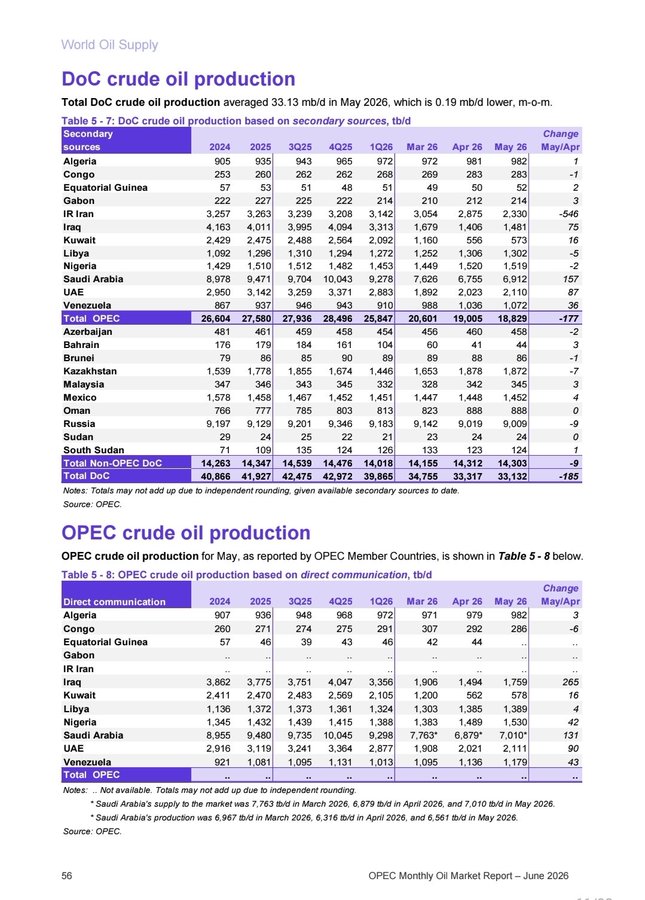
Nigeria produced about 1.530 million barrels of crude oil per day in May 2026, beating its Organisation of Petroleum Exporting Countries (OPEC) quota by 42,000 barrels per day. In the preceding month, the country only produced 1.489 million barrels per day.
In the latest OPEC’s Monthly Oil Market Report (MOMR), it was also revealed that Iraq in April supplied 1.494 million barrels per day while in May, it produced 1.759 million barrels per day, an increase 265,000 barrels per day; Saudi Arabia, 6.879 million barrels per day in April, 7.010 million barrels per day in May, an increase of 131,000 barrels per day; United Arab Emirate (UAE), 2.021 million barrels per day in April and in May 2.111 million barrels per day, an increase of 90,000 barrels per day while Venezuela, 1.136 million barrels per day in April and 1.179 million barrels per day in May, an increase of 43,000 barrels per day.
Using secondary sources, Nigeria’s production decreased from 1.520 million barrels per day in April to 1.519 million barrels per day; Saudi Arabia, 6.755 million barrels per day in April and 6.912 million barrels per day in May; UAE, 2.023 million barrels per day in April, 2.110 million barrels per day in May; and Venezuela, 1.036 million barrels per day in April and 1.072 million barrels per day in May.
Nigerian Upstream Petroleum Regulatory Commission (NUPRC), in a statement by its Head, Media and Corporate Communications, Mr Eniola Akinkuotu, confirmed that Nigeria, in May, met 102 per cent of OPEC quota as production hit an 11-month high.
According to it, Nigeria’s oil production witnessed an upswing in May 2026, averaging 1,530,354 barrels of crude oil and 170,446 barrels of condensates per day, bringing the total combined production to 1, 700, 800 barrels per day and consolidating Nigeria’s position as Africa’s largest oil producer.
It stated that the average crude oil production recorded in May represents 102 per cent of Nigeria’s 1.5mbpd of production quota allocated by OPEC.
It explained that production performance during the review period remained robust, with combined crude oil and condensate output ranging between a low of 1.51 million barrels per day and a peak of 1.86 million barrels per day.
The organisation added that the May 2026 production figures represented the highest recorded by Nigeria since July 2025, when output surged to 1,712,282.
NUPRC said: “In strict crude oil terms (excluding condensates), the 1.53 million barrels recorded in May 2026 represents the highest Nigeria has witnessed since January 2025 when crude oil production hit 1.538 mbpd.”
“On a month-on-month basis, production rose by 2.77 per cent in May 2026 as against 1.48mbpd in April. The broader production trend over the last five months has also remained positive.
“Combined crude oil and condensate output increased from 1.48 mbpd in February to 1.54 mbpd in March, 1.66 mbpd in April, and then 1.7 mbpd in May, underscoring sustained growth in Nigeria’s hydrocarbon production levels.
“Among production streams, Bonny Terminal led the pack with a total blend of 293,870 bpd, closely followed by Forcados Terminal at 289,900 bpd. Qua Iboe ranked third with 173,360 bpd, while Escravos Oil Terminal contributed 135,470 bpd. Odudu (Amenam Blend) completed the top five production streams, accounting for 63,250 bpd during the month under review.”
The commission attributed the rise in production to a sustained positive momentum as operations remained stable throughout the reporting period with no significant pipeline or facility outages recorded.
-
 Feature/OPED6 years ago
Davos was Different this year
-
Travel/Tourism10 years ago
Lagos Seals Western Lodge Hotel In Ikorodu
-

 Showbiz3 years ago
Estranged Lover Releases Videos of Empress Njamah Bathing
-
 Banking8 years ago
Sort Codes of GTBank Branches in Nigeria
-

 Economy3 years ago
Subsidy Removal: CNG at N130 Per Litre Cheaper Than Petrol—IPMAN
-

 Banking3 years ago
Sort Codes of UBA Branches in Nigeria
-

 Banking3 years ago
First Bank Announces Planned Downtime
-

 Sports3 years ago
Highest Paid Nigerian Footballer – How Much Do Nigerian Footballers Earn