Technology
Paystack, Truecaller Partner to Boost Online Payments in Africa
By Modupe Gbadeyanka
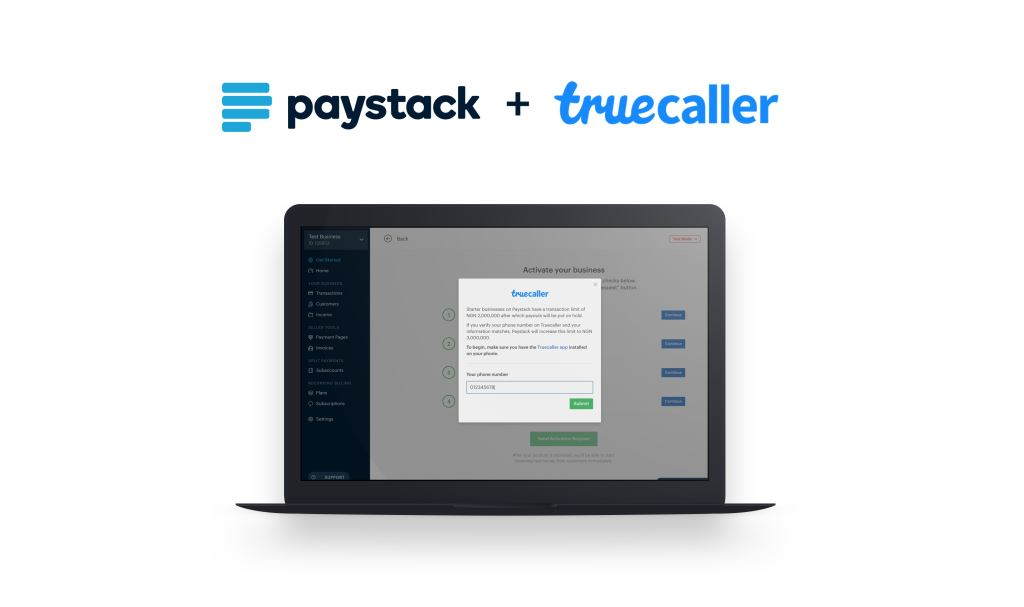
A deal has been struck between Paystack and Truecaller to allow more merchants across Africa accept payments online in a frictionless and secure manner by leveraging Truecaller’s mobile identity product, Truecaller SDK.
The partnership will also provide powerful tools that businesses and start-ups across Africa can use to verify the mobile identity of their customers, and in turn, further help in creating more trust in the online payments landscape on the continent.
Also, with the deal, unregistered local businesses can now receive online payments after being verified via Paystack’s in-house verification process, which now includes phone number identity verification powered by Truecaller
In addition, businesses and developers receiving payments via Paystack can now build customer verification tools on top of Paystack’s Truecaller phone number verification API.
Paystack is one of Nigeria’s largest payments startups, processing nearly 20 percent of all online transactions in Africa’s largest economy. The company (the first Nigerian startup to get into the celebrated Y Combinator Accelerator) aims to allow merchants in Africa accept payments from anyone, anywhere in the world.
Previously, all merchants who wanted to accept payments with Paystack had to be registered with various regulatory bodies. In Nigeria, where the vast majority of businesses are unregistered, the requirement to be registered prevented many legitimate offline businesses from realizing the benefits of online payments.
The Paystack-Truecaller partnership means that in addition to Paystack’s proprietary merchant risk assessment checks, merchants can now verify their mobile identity via Truecaller.
Integrating Truecaller’s mobile number identity product as a verification mechanism strengthens the Paystack platform’s merchant verification process and also makes it possible to open up Paystack to the millions of unregistered businesses who were previously unable to accept online payments with Paystack.
In the words of Paystack CEO, Shola Akinlade, “This partnership with Truecaller allows Paystack to deliver on our promise of trust as well as a frictionless experience. We want to be able to guarantee that all businesses paid via Paystack are thoroughly checked for legitimacy and credibility.
“In a low-trust environment like Nigeria where many people are paying online for the first time, it’s important to deliver a safe, fraud-free experience, and this is a responsibility that Paystack takes extremely seriously.”
Shola adds: “We needed to balance the strong desire to open Paystack up to unregistered business against the equally strong obligation to protect the interests of customers. Customers need the firm assurance that every Paystack merchant they pay is a vetted business, and our partnership with Truecaller ensures that we can continue to be worthy of customers’ trust.”
In addition to using Truecaller as part of the merchant verification flow, Paystack will also be introducing Truecaller as a verification option for local developers and startups who want to verify the identity of their own customers on Paystack’s developer platform.
Paystack already makes three verification options available to developers – the ability to verify the Bank Verification Number (BVN) of customers (BVN is an identifying number issued by Nigerian regulators), the ability to verify bank account details, and the ability to verify card details. Truecaller will be a fourth, new verification option, and the impact of this will be to create more trust in the payments flow for African businesses.
A typical use case would be a micro-lending app. In addition to their in-house customer verification steps and use of Paystack’s proprietary verification tools, the Paystack-Truecaller partnership now allows the makers of the lending app to verify the true identity of borrowers by their mobile identity, i.e. with their phone number.
Over 50 million Africans use Truecaller, and the app has helped helped Nigerian users block over 13 million calls and 25 million spam SMS, monthly.
In November 2017, Truecaller announced plans to deepen the collaboration with the business, startup and developer ecosystem in Africa, and the partnership with Paystack represents a strong move towards helping African businesses leverage the power of Truecaller’s mobile identity platform.
Truecaller Head of Global Developer & Startup Relations, Priyam Bose, underscored the importance of this ground-breaking partnership: “Paystack is enabling the growth of a vibrant online payment ecosystem and the digitization of businesses for Nigerian economy. Truecaller is excited to play a strong role in this vision by enabling tools that increase trust and enable frictionless payments across Africa, powered by Paystack.”
Technology
Zoho Launches Nathu La Server
By Modupe Gbadeyanka
A designed-in-house server known as Nathu La has been launched by a global technology company, Zoho Corporation.
Nathu La is engineered with hardware-rooted security at every layer of the stack. Its indigenous IP-driven approach reduces dependency on external entities for security audits, firmware updates, and licensing continuity.
The solution aligns with open-source software principles and reflects Zoho’s broader commitment to building sustainable, secure, and scalable digital infrastructure. It also supports the growing global focus on digital sovereignty, local innovation ecosystems, and high-performance computing capabilities.
The platform was introduced by the company as part of a pivotal step in its journey towards building its full technology stack, from the hardware layer to software applications.
With Nathu La, Zoho has achieved equivalent performance with 12-18 per cent lower power consumption and 20-30 per cent lower total cost of ownership (TCO), thereby reducing inference costs.
The Nathu La server, comprising Intel® Xeon® 6 processors, was developed collaboratively with Intel, leveraging their enablement capabilities and technical expertise.
The design philosophy behind Nathu La is rooted in the Open Compute Project (OCP), emphasising modularity, thermal efficiency, and ease of maintenance. This enables Zoho’s data centres to significantly reduce total cost of ownership and power consumption.
Zoho plans to host its applications on the Nathu La server platform, enabling the company to optimise the full software-hardware stack for its specific workloads, reduce costs, improve performance, and strengthen data governance for its global customers. This will also help bring down inference costs for Zoho’s AI usage.
The Nathu La server motherboard and chassis platform is the result of five years of R&D across hardware, firmware, and systems management. Based on Intel® Xeon® 6 Processors, the server is designed to optimise performance for virtualisation (VM), High Performance Computing (HPC), AI inference, and storage applications. This results in improved performance of Zoho applications for end users.
The server features customised power delivery subsystems, an in-house DC-SCM (Data Centre Secure Control Module) design, and modular chassis options compatible with diverse end-user environments, offering flexibility across deployment types.
All modular components – including the DC-SCM and NIC (Network Interface Card) – were designed in-house by Zoho’s hardware engineering team and assembled through electronics manufacturing partners, enabling tighter integration and quality control across the platform. Over five patents have been filed covering advanced thermal management and cost-optimised server architecture designs.
“Zoho Corporation has invested in building its own technology stack from the ground up over the last three decades. The Nathu La server launch is in line with that goal.
“With our strategy of using contextual, right-sized models, running on our own platform, on our own servers, in our own data centres, we are compounding the benefits accrued from owning and operating our entire technology stack. This ensures that our solutions are more sustainable and accessible for businesses.
“These long-term R&D investments we are making at every layer of the stack are aimed at delivering customer value,” the Country Head for Zoho Nigeria, Mr Kehinde Ogundare, stated.
In 2020, Zoho established a small R&D team in Nagpur, a Tier 2 town in India, focused on projects such as server design and systems engineering.
Members of the Nathu La R&D team include hires from SETU – short for Students’ Engagement for Transformative Upskilling – an initiative designed to build a pipeline of industry-ready engineers, with a focus on advanced learning in Electronics System Design and Manufacturing (ESDM).
Technology
MTN Fintech Targets Credit Market With Direct Lending Plans
By Adedapo Adesanya
The financial technology arm of MTN is mulling a direct shift into lending after bringing on its parent company, MTN Group, as a major investor to help cushion against losses that have plagued the business.
According to MTN Group Fintech chief executive, Mr Serigne Dioum, the company wants to move beyond helping customers access loans through partners.
He said in markets where regulators allow it, MTN wants to lend directly and use its own balance sheet.
“We’ve expanded access to credit for more people, but we also want to move further up the lending value chain,” Mr Dioum told investors at the company’s capital markets day.
“Where appropriate, we will seek licences that allow us not only to facilitate loans but also to lend directly to customers and deploy our own balance sheet.”
This development is expected to create a shift in its current fintech model which provides financial services, including deposits, payments, transfers and digital wallets to individuals and small businesses via digital and mobile‑based platforms.
The company has applied for Payment Solution Service Provider and Payment Terminal Service Provider licences through MoMo PSB, its Nigerian fintech subsidiary. If approved, the licences would allow MTN to handle more payment processing, build merchant payment tools, deploy and manage POS terminals, and reduce its dependence on third-party processors.
Despite the opportunities present in the credit market, direct lending could give MTN a larger share of revenue, but it would also expose the company to credit risk, regulation and tougher competition with banks and digital lenders.
Mr Dioum said only about 4 per cent to 5 per cent of adults have access to formal credit across the African continent. In Nigeria, the funding problem is especially severe.
A 2025 report by the National Credit Guarantee Company said nearly 80 per cent of Nigerian MSMEs lack access to formal credit, while Stears has estimated the country’s MSME financing gap at about $236 billion.
For traders, small shop owners, transport operators and households, access to small loans can determine whether they restock inventory, pay suppliers, cover emergencies or expand a business.
In April, MTN Nigeria announced that its parent firm, based in South Africa, would acquire a 60 per cent stake in MoMo Payment Service Bank Limited (MoMo PSB) and Y’ello Digital Financial Services (YDFS) Limited.
The fintech units are currently loss-making, and this move will help MTN Nigeria to reduce financial risk and share future losses and investment burden. However, it will still keep a significant minority stake (40 per cent).
Technology
Meta Expands Business Agent to Instagram, WhatsApp, Messenger
By Aduragbemi Omiyale
The reach of the Meta Business Agent is being expanded to Instagram and other platforms of the social media giant.
Meta Business Agent is an artificial intelligence (AI) that allows business owners to attend to customers’ needs with ease.
Customers expect instant responses, but no team can be everywhere at once. This innovation handles such without hassles.
It helps businesses to answer questions specific to the business, makes product recommendations from the catalogue, books appointments, qualifies incoming leads, and closes sales.
More than one million businesses are already using a Meta Business Agent on WhatsApp and Messenger to respond to customers around the clock.
“We’re now expanding our Business Agent to businesses big and small globally, so within minutes you can have yours up and running, responding in your customer’s local language using your tone,” Meta said in a statement.
“We’re also expanding these agents to Instagram since businesses connect with their customers there, too. Businesses can activate their Business Agent here. Getting started with the Business Agent is free. In the coming months, businesses will access the agent through our paid subscription offerings, with options for businesses of every size,” it added.
Meta also stated that it is making it simpler for people to discover businesses powered by a Meta Business Agent directly on WhatsApp. It noted that starting soon, people will be able to find businesses by typing their name in the Search bar, or by sharing their phone number or contact card in chats with friends and family. This way, when more customers reach out, they get a quick, helpful response.
-
Feature/OPED6 years agoDavos was Different this year
-
Travel/Tourism10 years ago
Lagos Seals Western Lodge Hotel In Ikorodu
-
Showbiz3 years agoEstranged Lover Releases Videos of Empress Njamah Bathing
-
Banking8 years agoSort Codes of GTBank Branches in Nigeria
-
Economy3 years agoSubsidy Removal: CNG at N130 Per Litre Cheaper Than Petrol—IPMAN
-
Banking3 years agoSort Codes of UBA Branches in Nigeria
-
Banking3 years agoFirst Bank Announces Planned Downtime
-
Sports3 years agoHighest Paid Nigerian Footballer – How Much Do Nigerian Footballers Earn