

Economy
Buhari Approves Tax Hike on Alcoholic Drinks, Cigarettes

By Dipo Olowookere
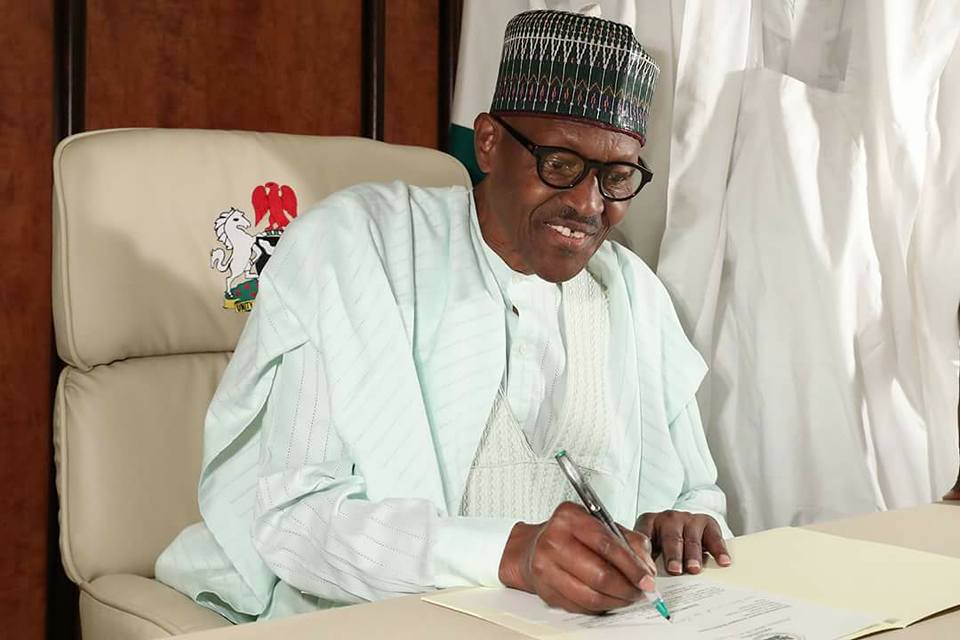
President Muhammadu Buhari has approved the upward review of excise duty rates on alcoholic beverages and tobacco.
It was gathered that the President has also granted a grace period of 90 days to all manufacturers before the commencement of the new excise duty regime.
This information was confirmed in a statement issued on Sunday in Abuja and it takes effect from Monday, June 4, 2018.
A statement signed by Oluyinka Akintunde, Special Adviser on Media and Communication to Minister of Finance, Mrs Kemi Adeosun, explained that the new excise duty rates were spread over a three-year period from 2018 to 2020 in order to moderate the impact on prices of the products.
However, there is no increase in excise duty of other locally excisable products.
It was explained that the new excise duty regimes followed all-inclusive stakeholder engagements by the Tariff Technical Committee of the Ministry of Finance with key industry stakeholders.
According to the Minister, the upward review of the excise duty rates for alcoholic beverages and tobacco was to achieve a dual benefit of raising the Federal Government’s fiscal revenues and reducing the health hazards associated with tobacco-related diseases and alcohol abuse.
The TCC recommended the slight adjustment in the excise duty charges after cautious considerations of the government’s Fiscal Policy Measures for 2018 and the reports of the World Bank and the International Monetary Fund Technical Assistance Mission on Nigeria’s Fiscal Policy
The effect of the excise duty rates adjustment on trade and investment was also assessed by the Federal Ministry of Trade and Investment and it adopted the recommendations of the TTC, the statement explained.
Furthermore, peer country comparisons were also carried out showing Nigeria as being behind the curve in the review of excise duty rates on alcoholic beverages and tobacco.
Following the President’s approval, the new excise duty rate on tobacco was now a combination of the existing ad-valorem base rate and specific rate while the ad-valorem rate was replaced with a specific rate for alcoholic beverages.
For Alcoholic Beverages, the current ad-valorem rate will be replaced with specific rates and spread over three years to moderate the impact on prices. This will curb the discretion in the Unit Cost Analysis (UCA) for determining the ad-valorem rate & prevent revenue leakages.
For Tobacco, government said it will maintain the current ad-valorem rate of 20 percent and introduce additional specific rates with the implementation to be spread over a three-year period to also reasonably reduce the impact on prices.
Under the newly approved excise duty rates for tobacco in addition to the 20 percent ad-valorem rate, each stick of cigarette will attract a N1 specific rate per stick (N20 per pack of 20 sticks) in 2018 with N2 specific rate per stick (N40 per pack of 20 sticks) in 2019 and N2.90k specific rate per stick (N58 per pack of 20 sticks) in 2020.
Nigeria’s cumulative specific excise duty rate for tobacco was 23.2 percent of the price of the most sold brand, as against 38.14 percent in Algeria, 36.52 percent in South Africa and 30 percent in Gambia.
The new specific excise duty rate for alcoholic beverages cuts across Beer & Stout, Wines and Spirits for the three years 2018 to 2020.
Under the new regime, Beer & Stout would attract N0.30k per centiliter (Cl) in 2018 and N0.35k per Cl each in 2019 and 2020.
Wines would attract N1.25k per Cl in 2018 and N1.50k per Cl each in 2019 and 2020, while N1.50k per Cl was approved for Spirits in 2018, N1.75k per Cl in 2019 and N2.00k per Cl in 2020.
The Minister added that the new excise duty regimes are in line with the Economic Community of West African States (ECOWAS) directive on the harmonisation of member-states’ legislations on excise duties.
It would be recalled that the ECOWAS Council of Ministers had at its 62nd and 79th Ordinary Sessions in Abuja in May 2009 and December 2017, respectively, issued directives on the harmonisation of the ECOWAS Member States’ Legislations on Excise Duties.
The directives seek to harmonise member-states’ legislations on excise duties of non-oil products and also stipulate the scope of application, rate of taxation, taxable event and amount.




By Adedapo Adesanya
Three stocks stretched the bearish run of the NASD Over-the-Counter (OTC) Securities Exchange by 1.21 per cent on Friday, December 19, with the market capitalisation giving up N26.01 billion to close at N2.121 billion compared with the N2.147 trillion it ended a day earlier, and the NASD Unlisted Security Index (NSI) dropping 43.47 points to 3,546.41 points from 3,589.88 points.
The trio of FrieslandCampina Wamco Nigeria Plc, Central Securities Clearing System (CSCS) Plc, and NASD Plc overpowered the gains printed by four other securities.
FrieslandCampina Wamco Nigeria Plc lost N6.00 to sell at N54.00 per unit versus N60.00 per unit, NASD Plc shrank by N3.50 to N58.50 per share from N55.00 per share, and CSCS Plc depleted by N2.91 to N33.87 per unit from N36.78 per unit.
On the flip side, Air Liquide Plc gained N1.01 to close at N13.00 per share versus N11.99 per share, Golden Capital Plc appreciated by 70 Kobo to N7.68 per unit from N6.98 per unit, Geo-Fluids Plc added 39 Kobo to sell at N5.50 per share versus N5.11 per share, and IPWA Plc rose by 8 Kobo to 85 Kobo per unit from 77 Kobo per unit.
During the trading day, market participants traded 1.9 million securities versus the previous day’s 30.5 million securities showing a decline of 49.3 per cent. The value of trades went down by 64.3 per cent to N80.3 million from N225.1 million, but the number of deals jumped by 32.1 per cent to 37 deals from 28 deals.
Infrastructure Credit Guarantee Company (InfraCredit) Plc finished the session as the most active stock by value on a year-to-date basis with 5.8 billion units valued at N16.4 billion, followed by Okitipupa Plc with 178.9 million units transacted for N9.5 billion, and MRS Oil Plc with 36.1 million units traded for N4.9 billion.
The most active stock by volume on a year-to-date basis was still InfraCredit Plc with 5.8 billion units worth N16.4 billion, trailed by Industrial and General Insurance (IGI) Plc with 1.2 billion units sold for N420.7 million, and Impresit Bakolori Plc with 536.9 million units traded for N524.9 million.
By Adedapo Adesanya
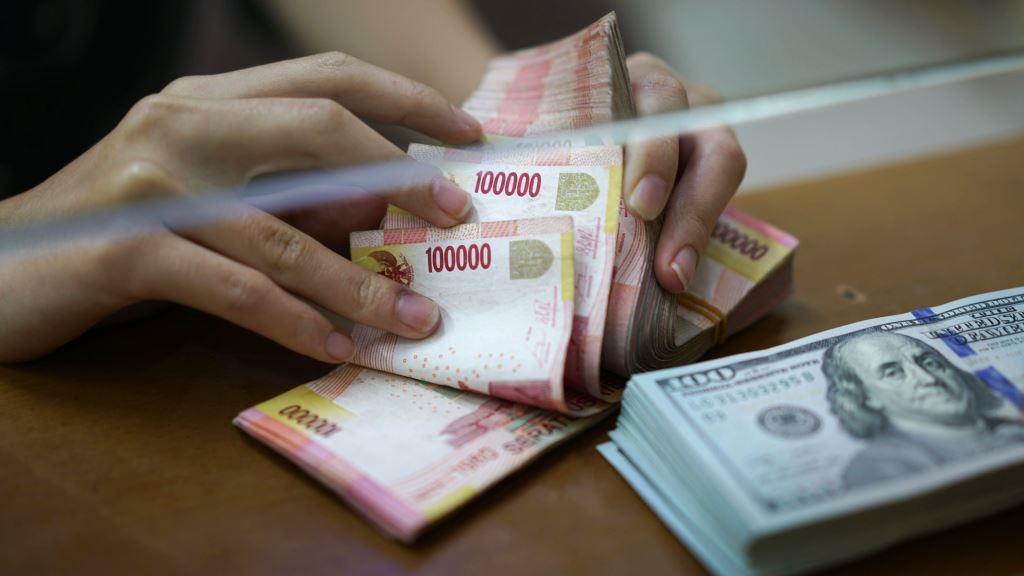
It was not a good day for the Nigerian Naira at the two major foreign exchange (FX) market on Friday as it suffered a heavy loss against the United States Dollar at the close of transactions.
In the black market segment, the Naira weakened against its American counterpart yesterday by N10 to quote at N1,485/$1, in contrast to the N1,475/$1 it was traded a day earlier, and at the GTBank forex counter, it depreciated by N2 to settle at N1,467/$1 versus Thursday’s closing price of N1,465/$1.
In the Nigerian Autonomous Foreign Exchange Market (NAFEX) window, which is also the official market, the nation’s legal tender crashed against the greenback by N6.65 or 0.46 per cent to close at N1,464.49/$1 compared with the preceding session’s rate of N1,457.84/$1.
In the same vein, the local currency tumbled against the Euro in the spot market by N2.25 to sell for N1,714.63/€1 compared with the previous day’s N1,712.38/€1, but appreciated against the Pound Sterling by 73 Kobo to finish at N1,957.30/£1 compared with the N1,958.03/£1 it was traded in the preceding session.
The market continues to face seasonal pressure even as the Central Bank of Nigeria (CBN) is still conducting FX intervention sales, which have significantly reduced but not remove pressure from the Naira. Also, there seems to be reduced supply from exporters, foreign portfolio investors and non-bank corporate inflows.
President Bola Tinubu on Friday presented the government’s N58.47 trillion budget plan aimed at consolidating economic reforms and boosting growth.
The budget is based on a projected crude oil price of $64.85 a barrel and includes a target oil output of 1.84 million barrels a day. It also projects an exchange rate of N1,400 to the Dollar.
President Tinubu said inflation had plunged to an annual rate of 14.45 per cent in November from 24.23 per cent in March, while foreign reserves had surged to a seven-year high of $47 billion.
Meanwhile, the cryptocurrency market was dominated by the bulls but it continues to face increased pressure after million in liquidations in previous session over accelerating declines, with Dogecoin (DOGE) recovering 4.2 per cent to trade at $0.1309.
Further, Ripple (XRP) appreciated by 3.9 per cent to $1.90, Cardano (ADA) rose by 3.5 per cent to $0.3728, Solana (SOL) jumped by 3.4 per cent to $126.23, Ethereum (ETH) climbed by 2.9 per cent to $2,982.42, Binance Coin (BNB) gained 2.0 per cent to sell for $853.06, Bitcoin (BTC) improved by 1.7 per cent to $88,281.21, and Litecoin (LTC) soared by 1.2 per cent to $76.50, while the US Dollar Tether (USDT) and the US Dollar Coin (USDC) traded flat at $1.00 each.
By Adedapo Adesanya
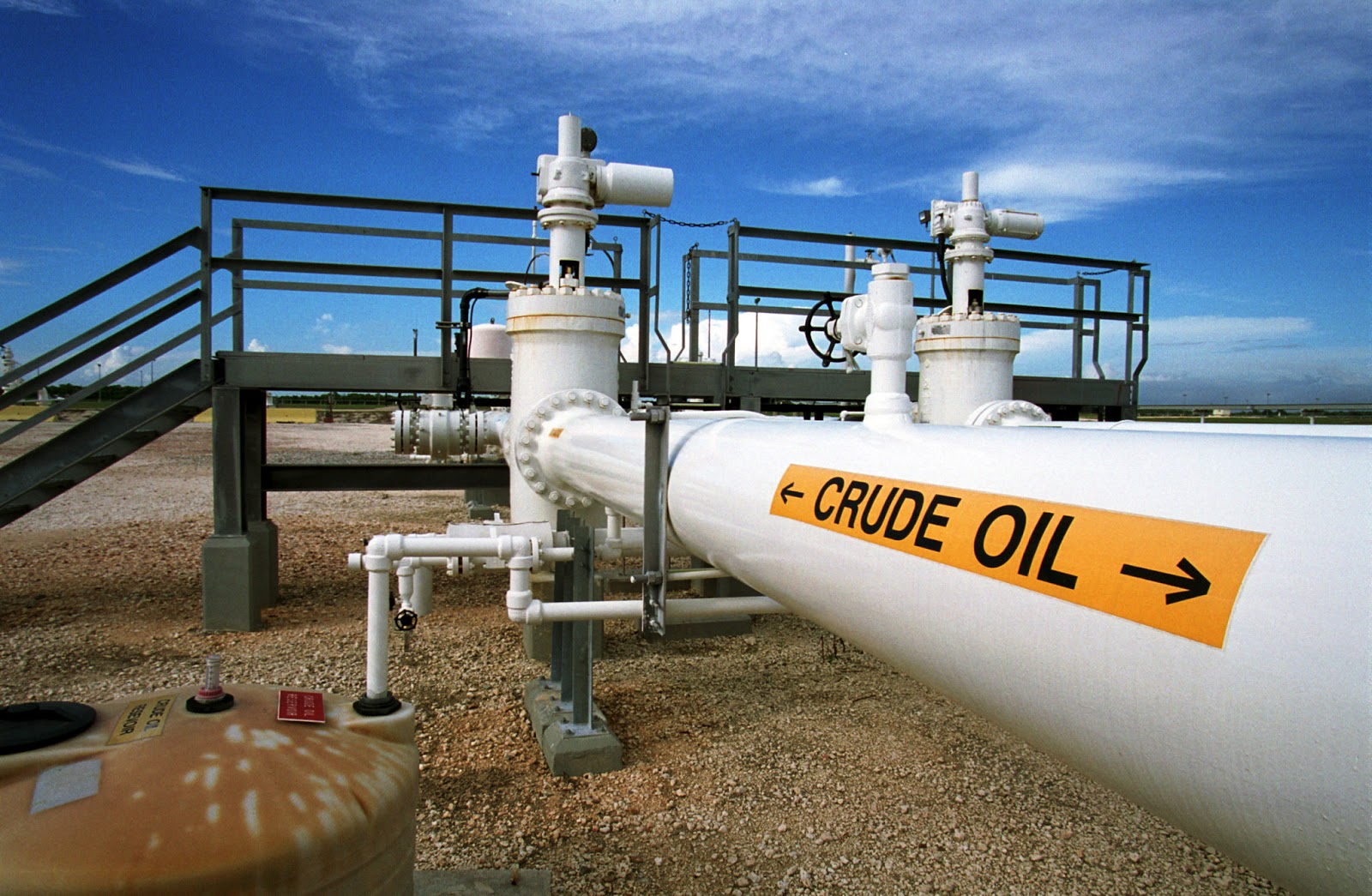
Crude oil prices edged up on possible disruptions from a US blockade of Venezuelan tankers as the market waits for news about a possible Russia-Ukraine peace deal.
Brent futures rose 65 cents or 1.1 per cent to $60.47 per barrel while the US West Texas Intermediate (WTI) futures expanded by 51 cents or 0.9 per cent to $56.66 per barrel. Both Brent and WTI were down about 1 per cent this week after both crude benchmarks fell about 4 per cent last week.
US President Donald Trump said he was leaving the possibility of war with Venezuela on the table, noting that there would be additional seizures of oil tankers near Venezuelan waters after the US seized a sanctioned oil tanker off the coast of Venezuela last week.
The American President this week ordered a “blockade” of all sanctioned oil tankers entering and leaving Venezuela, in the US’ latest move to increase pressure on Nicolas Maduro’s government, targeting its main source of income. The pressure campaign on President Maduro has included a ramped-up military presence in the region and more than two dozen military strikes on vessels in the Pacific Ocean and Caribbean Sea near Venezuela, which have killed at least 90 people.
President Trump has also previously said that US land strikes on the South American country will soon start.
Meanwhile, US Secretary of State Marco Rubio on Friday said that the US is not concerned about an escalation with Russia when it comes to Venezuela, as the Trump administration builds up military forces in the Caribbean.
This development comes as President Trump seeks an end to the unending war between Ukraine and Russia that is heading towards its fourth year.
European Union leaders decided on Friday to borrow cash to loan 90 billion Euros to Ukraine to fund its defense against Russia for the next two years as Russian President Vladimir Putin offered no compromise on Friday on his terms for ending the war in Ukraine and accused the European Union of attempting “daylight robbery” of Russian assets.
Ukraine, meanwhile, struck a Russian “shadow fleet” oil tanker in the Mediterranean Sea with aerial drones for the first time.
Earlier this week, the US and Ukraine both signaled progress in negotiations about a peace agreement during talks in German capital city of Berlin. The US is now reportedly offering Ukraine security guarantees modeled on NATO’s Article 5 mutual defense pledge.







-
 Feature/OPED6 years ago
Davos was Different this year
-
Travel/Tourism9 years ago
Lagos Seals Western Lodge Hotel In Ikorodu
-

 Showbiz3 years ago
Estranged Lover Releases Videos of Empress Njamah Bathing
-
 Banking7 years ago
Sort Codes of GTBank Branches in Nigeria
-

 Economy3 years ago
Subsidy Removal: CNG at N130 Per Litre Cheaper Than Petrol—IPMAN
-

 Banking3 years ago
First Bank Announces Planned Downtime
-

 Banking3 years ago
Sort Codes of UBA Branches in Nigeria
-

 Sports3 years ago
Highest Paid Nigerian Footballer – How Much Do Nigerian Footballers Earn