
Economy
Fitch Rates Seplat Proposed Dollar-Denominated Bond Issuance

By Dipo Olowookere
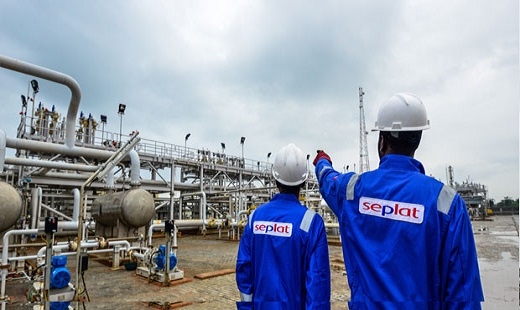
Last week, one of the companies listed on the Nigerian Stock Exchange (NSE), Seplat Petroleum Development Company Plc (Seplat) announced its intention to issue five or seven-year Dollar denominated bonds to foreign investors.
The notes would be issue to refinance the company’s debts, a statement signed by the oil firm had disclosed.
With investors gearing up for the exercise, one of the renowned rating agencies in the world, Fitch Ratings, has assigned expected senior unsecured ‘B-(EXP)’/’RR4(EXP)’ ratings to the proposed bond issuance.
This information was made known in a statement issued by Fitch on Wednesday, February 28, 2018, which was obtained by Business Post.
Also in the statement, Fitch assigned an expected Long-Term Issuer Default Rating (IDR) of ‘B-(EXP)’ with a Positive Outlook to Seplat.
According to the rating firm, the expected IDR assumes a successful refinancing in 2018, i.e., issuance of USD-denominated senior notes and signing of a new long-term revolving credit facility (RCF).
The assignment of a final IDR is contingent upon the successful completion of the refinancing, with terms and conditions in line with our current assumptions.
The assignment of a final rating to the notes is contingent upon receipt of final documentation substantially in line with draft documentation reviewed.
The ‘B-(EXP)’ IDR reflects Seplat’s small scale by production and reserves, concentration of onshore exploration and production (E&P) assets in Nigeria (B+/Negative), and the cash flow volatility that has been associated with its operating environment.
Specifically, between February 2016 and June 2017, Seplat’s performance was severely impacted by a militant attack and subsequent prolonged downtime at the Forcados oil pipeline and export terminal. The company also has large, albeit declining, receivables from state-owned Nigerian Petroleum Development Company (NPDC).
The force majeure was lifted in June 2017 and Seplat has been ramping up production at its main asset.
Fitch said the Positive Outlook assigned to Seplat reflects its view that the Amukpe-Escravos oil pipeline, which Seplat anticipates to be fully commissioned and operational in Q318, will somewhat mitigate cash flow volatility by providing a viable alternative export route to Seplat.
The successful completion and start of operations of the Escravos oil pipeline coupled with continued production ramp-up across Seplat’s upstream assets could result in an upgrade of the IDR to ‘B’.
Along with the post-restructuring capital structure, the rating captures Seplat’s financial profile over 2018-2020, with forecast funds from operations (FFO) net adjusted leverage expected to remain comfortably below the 3.5x negative sensitivity.
On the key rating drivers, Fitch said Seplat, as a small E&P company with onshore oil and gas assets in Nigeria, had its full year 2017 working interest (WI) production around 37 thousand barrels of oil equivalent per day (kboepd), split nearly equally between liquids and natural gas.
Its main assets are the Oil Mining Leases (OMLs) 4, 38 and 41, production at which was severely constrained in 2016-1H17 due to the closure of the Forcados oil pipeline and export terminal following an attack.
Fitch forecasts that Seplat will continue ramping up its daily oil and gas output to 68kboepd in 2021, which incorporates our conservative estimate of a 20 percent additional downtime on the management forecasts.
It also believes that even following Seplat’s expected production ramp-up in 2018-2021 it will remain a small E&P company with a significant onshore asset concentration in one country. Its WI production and reserves (end-2016 – 241mmboe of proved or 1P reserves) remain commensurate with the ‘B’ category rating for an E&P company.
Fitch said to avoid a repetition of a prolonged downtime experienced when force majeure was declared on the Forcados oil pipeline and export terminal, Seplat and the Nigerian authorities have been working on a number of security options and alternative export routes.
The Nigerian government has prioritised the completion of the 160kbopd Amukpe-Escravos oil pipeline. Seplat currently expects the pipeline to be fully commissioned and operational in 3Q18.
In addition to the Escravos pipeline, two jetties at the domestic Warri oil refinery have been upgraded to allow exports of 30kbopd gross.
However, this is a more expensive option as barging of crude is required and Seplat plans to use Escravos as the primary crude export route, supported by Forcados and the Warri refinery routes.
“We believe that these measures when fully operational should provide adequate flexible cover for Seplat’s export transportation needs, but nonetheless conservatively model additional downtime of 20% in our forecasts for 2018-2020,” the rating agency said in its report.
It noted that following the resumption of production at OLMs 4, 38 and 41 in June 2017, Seplat’s financial profile has improved materially.
“Our 2017 base case forecasts FFO at $134 million vs. negative $11 million in 2016 and FFO net adjusted leverage of 2.5x vs. 8.5x at end-2016.
“We expect that Seplat will maintain a conservative financial profile over 2018-2020, with positive free cash flow (FCF), FFO adjusted net leverage under 2.5x and interest coverage of at least 3x,” it said.
Seplat’s 2017 gas revenues of $124 million were up 18 percent year-on-year and its daily gas sales averaged 293MMscfd (gross, not WI) in 4Q17. Seplat aims to increase gas supply to the domestic Nigerian market. Its gas processing capacity stands at 525MMscfd, while current wells can deliver around 400MMscfd (gross).
Nigerian gas prices are largely de-linked from oil prices, e.g. while average realised oil prices dropped by 21 percent between 2015 and 2016, gas prices increased by 19 percent. Seplat projects a higher share of gas in its production volumes, from 50 percent in 2017 to 60 percent in 2021.
“We view positively the higher share of gas in the sales mix, as it provides a more stable source of revenues.
However, gas remains the smaller business and is projected to account for less than 25 percent of the company’s gross revenues in 2021. Gas sales are also subject to credit risks and FX risks, as USD-linked payments for gas are made in Naira,” Fitch stated.
The rating company said the senior notes and secured RCF are expected to be issued by Seplat and will benefit from pari-passu upstream guarantees from Seplat West Ltd (contributor to almost 100 percent of consolidated EBITDA in 2017), Newton Energy and Seplat East Swamp Ltd.
The RCF will further benefit from a security package including a pledge over the shares of Seplat West and Newton, thus ranking it ahead of senior notes under our recovery analysis.
The notes benefit from a standard high-yield covenant package including covenants on permitted payments, incurrence of indebtedness and issuance of preferred stock, merger, consolidation or sale of assets, investments, creation of certain liens, pari passu in right of payment, and contain no financial maintenance covenants.
On its key assumptions, Fitch said they were based on Brent price deck of $52.5/bbl in 2018, $55/bbl in 2019 and $57.5/bbl thereafter; successful renewal of licenses for OMLs 4, 38 and 41 that expire in June 2019; domestic gas prices of between $2.5/mscf and $3/mscf, in line with management forecasts; and daily oil and gas production volumes ramping up from about 37kboepd in 2017 to 68kboepd in 2021, including a 20 percent additional downtime on the management forecasts.
Other were Opex (excluding royalties) improving from about $7.5/boe in 9M17 to about $6.5/boe in 2020-2021, 20 percent more conservative than management forecasts; average capex of about $105 million in 2017-2021, in line with management forecasts; and other cash inflows and outflows as projected plus $100 million additional outflows assumed by Fitch in each 2019-2021.
On the assumptions that relate to recovery estimates, Fitch its bespoke recovery analysis considered Seplat’s value on a going-concern basis in a distressed scenario and assumed that the company would keep its operating licenses and would be restructured rather than liquidated.
Fitch also applied a 25 percent discount to the 2017 EBITDA reflecting its view of a sustainable, post-reorganisation level upon which it based the valuation of the company. The discount reflects risks associated with the oil price volatility, potential unplanned downtime and other adverse factors.
In addition, the 4.5x multiple was used to calculate a post-reorganisation enterprise value (EV), reflecting a mid-cycle multiple for oil & gas and metals & mining companies in the EMEA region. This considered that Seplat does not have any unique characteristic that would allow for a higher multiple, such as significant market share, or undervalued assets.
As per Fitch’s criteria, the new and prior ranking RCF is assumed to be fully drawn and it has also taken 10 percent off the EV to account for administrative claims.
The waterfall results in a 100 percent recovery corresponding to a ‘RR1’ Recovery Rating for the RCF. The noteholders could achieve a recovery of 70% (RR3) but are capped at ‘RR4’ (soft cap), in line with Fitch’s criteria as Seplat’s physical assets are located in Nigeria.
Fitch said it expects Seplat’s liquidity to improve post refinancing, supported by positive FCF generation and a manageable maturity profile.
Fitch-projected FCF is around $125 million in 2018 and $66 million in 2019 because as at December 31, 2017, Seplat had the equivalent of $437 million in cash.




By Adedapo Adesanya
Six securities led by FrieslandCampina Wamco Nigeria Plc further weakened the NASD Over-the-Counter (OTC) Securities Exchange by 0.48 per cent on Tuesday, June 9.
The notable dairy firm lost N7.87 during the trading day to close at N173.81 per unit compared with the previous session’s N181.68 per unit, Nitrox Industrial Gases Plc depreciated by N2.42 to N21.88 per share from N24.30 per share, Afriland Properties Plc dipped by N1.25 to N15.55 per unit from N16.80 per unit, Food Concepts Plc stumbled by 27 Kobo to N2.48 per share from N2.75 per share, UBN Property Plc dropped 9 Kobo to settle at N2.11 per unit versus N2.20 per unit, and Industrial and General Insurance (IGI) Plc crashed by 4 Kobo to 50 Kobo per share from 54 Kobo per share.
As a result of these losses, the market capitalisation went down by N12.50 billion to N2.593 trillion from N2.606 trillion, and the NASD Unlisted Security Index (NSI) declined by 20.89 points to 4,335.31 points from 4,356.20 points.
Business Post reports that there was a price gainer yesterday, and this was Central Securities Clearing System (CSCS) Plc, which improved its value by N2.65 to N81.13 per unit from N78.48 per unit.
The volume of transactions soared on Tuesday by 644.3 per cent to 1.6 million units from 213,188 units, the value of trades increased by 208.6 per cent to N62.3 million from N20.2 million, and the number of deals surged by 64 per cent to 41 deals from 25 deals.
The most active stock by value on a year-to-date basis remained Great Nigeria Insurance (GNI) Plc, with 3.4 billion units worth N8.4 billion, trailed by Infrastructure Credit Guarantee (Infracredit) Plc with 2.3 billion units transacted for N6.5 billion, and CSCS Plc with 65.1 million units sold for N4.4 billion.
GNI Plc was also the most traded stock by volume on a year-to-date basis, with 3.4 billion units valued at N8.4 billion, followed by Infracredit Plc with 2.3 billion units exchanged for N6.5 billion, and Resourcery Plc with 1.1 billion units traded for N415.7 million.

By Adedapo Adesanya
The Naira was exchanged at N1,360.55/$1 in the Nigerian Autonomous Foreign Exchange Market (NAFEX) on Tuesday, June 9, compared with the N1,362.84/$1 it was exchanged a day earlier, indicating an appreciation of N2.29 or 0.17 per cent against the United States Dollar.
It also gained 74 Kobo against the Euro in the same market segment to quote at N1,573.61/€1, in contrast to Monday’s closing price of N1,574.35/€1, but lost N1.71 against the Pound Sterling to trade at N1,823.00/£1 versus the preceding day’s N1,821.29/£1.
At the black market window, the Nigerian currency maintained stability against the greenback during the session at N1,380/$1, and also traded flat at the GTBank FX counter at N1,373/$1.
Market analysts say the ongoing implementation of the fourth edition of the Foreign Exchange Manual by the Central Bank of Nigeria (CBN) since June 1 has strengthened the Naira and the country’s foreign reserves, bolstering confidence in the market.
The new manual is expected to deepen FX transparency, improve liquidity and strengthen market confidence and liquidity, as it aligns with the apex bank’s broader vision of ensuring that businesses and individuals have equal access to FX in a transparent and liquid market.
The gross external reserves have climbed to a record $50.04 billion, reinforcing investor confidence and boosting the CBN’s capacity to support the local currency.
As for the cryptocurrency market, expectations for higher interest rates sapped demand for non-yielding assets. The latest crypto pullback appears driven by a short squeeze rather than fresh buying, as more than $500 million in bearish bets were liquidated and spot demand.
Cardano (ADA) depreciated by 5.5 per cent to $0.1603, Ripple (XRP) declined by 5.2 per cent to $1.11, Solana (SOL) fell by 4.6 per cent to $64.05, Ethereum (ETH) tumbled by 3.5 per cent to $1,626.51, Dogecoin (DOGE) crashed by 3.6 per cent to $0.0835, Bitcoin (BTC) dropped 3.2 per cent to trade at $61,292.98, Binance Coin (BNB) slumped by 2.9 per cent to $585.26, and TRON (TRX) slipped by 0.9 per cent to $0.3220, while the US Dollar Tether (USDT) and the US Dollar Coin (USDC) remained unchanged at $0.9997 and $0.9998, respectively.


By Aduragbemi Omiyale
A bill to regulate the cryptocurrency ecosystem in Nigeria passed second reading at the Senate during a plenary on Tuesday presided over by the Deputy Senate President, Mr Jibrin Barau.
Mr Barau, who sponsored the bill titled Virtual Asset Service Providers Regulation Bill, 2026, said that when passed into law, the piece of legislation would protect stakeholders from exploitation and promote confidence.
According to him, it will also place Nigeria among African countries such as Kenya, South Africa and Ghana that have adopted formal regulatory frameworks for cryptocurrency and digital asset transactions, while empowering regulators to license operators and combat fraud, money laundering and terrorism financing.
The Kano lawmaker noted that he pushed for this because of the absence of a comprehensive regulatory and supervisory framework for virtual assets, digital assets and Virtual Asset Service Providers (VASPs) in the country.
But he said that with this, the nation’s digital economy would become robust, with investors having the confidence to explore opportunities in the market.
One of the Senators who spoke on the bill, Mrs Natasha Akpoti-Uduaghan, threw her weight behind it, noting that her son, who operates a gaming platform with a large global user base, is having a tough time getting partners to set up operations in Nigeria due to the lack of a robust regulatory environment.
She stated that billions of dollars in potential investments and job opportunities could be lost if the country fails to create the necessary legal framework for emerging digital industries.
According to her, many young innovators are being forced to take their businesses abroad, lauding the sponsor of the bill.
Others who commented on the bill emphasised that virtual assets remain an inevitable feature of the modern global economy, warning that continued regulatory gaps could drive investments and business activities into unregulated channels.
They argued that effective regulation would protect millions of Nigerians, particularly young entrepreneurs and traders, who depend on cryptocurrency and related technologies for employment and income.
After deliberations, the lawmakers passed the bill for second reading and referred it to the Senate Committee on Capital Market for further legislative scrutiny. The team is expected to submit its report within four weeks.
-
 Feature/OPED6 years ago
Davos was Different this year
-
Travel/Tourism10 years ago
Lagos Seals Western Lodge Hotel In Ikorodu
-

 Showbiz3 years ago
Estranged Lover Releases Videos of Empress Njamah Bathing
-
 Banking8 years ago
Sort Codes of GTBank Branches in Nigeria
-

 Economy3 years ago
Subsidy Removal: CNG at N130 Per Litre Cheaper Than Petrol—IPMAN
-

 Banking3 years ago
Sort Codes of UBA Branches in Nigeria
-

 Banking3 years ago
First Bank Announces Planned Downtime
-

 Sports3 years ago
Highest Paid Nigerian Footballer – How Much Do Nigerian Footballers Earn