

Economy
Shareholders Okays Delisting of 7up Bottling Company From NSE

**To Get N125 Per Share Payment
By Dipo Olowookere
The delisting of Seven Up Bottling Company Plc from the Nigerian Stock Exchange (NSE) has been approved by shareholders of the firm.
As a result of the approval, shareholders of the company will now be paid N125 per share instead of the N112.70 kobo earlier proposed by the board to shareholders.
They will likely begin to get paid from next Monday.
The decision to delist 7up Bottling Company Plc from the stock exchange was reached at an Extra Ordinary Meeting (EGM) of the firm held yesterday at the Grand Ball Room of Eko Hotel & Suites, Lagos.
The meeting was ordered by a court sitting in Lagos.
On December 5, 2017, a Federal High Court in Lagos directed that a meeting of the holders of the fully paid-up ordinary shares of Seven-Up Bottling Company Plc (SBC) be convened for the purpose of considering and if thought fit, approving (with or without modification) a Scheme of Arrangement between Seven Up Bottling Company Plc and the holders of its fully paid ordinary shares (the Scheme).
It was gathered that the delisting process of the firm started when the majority shareholders of Seven Up Bottling Company Plc, Affelka S.A, proposed to acquire all the outstanding and issued shares of the soft drink company not currently owned by Affelka.
It involved the transfer of 171,542,574 ordinary shares of 50 kobo each, with a nominal value of N85,771,287 comprising of the company’s issued and paid up share capital representing the minority shares.
Through the scheme, the shares would be transferred to Sparkplexi Limited, a subsidiary of Affelka S.A the majority shareholder.
At the conclusion of the process, Affelka and Sparkplexi would be the remaining shareholders of Seven Up Bottling Company Plc, with Affelka owning 73.22 percent and Sparkplexi owning 26.78 percent.
Following the scheme, the company will be re-registered as a private limited liability company pursuant to the relevant provision of the Company and Allied Matters Acts (CAMA).
However the company noted in the scheme of arrangement to shareholders that the financial performance of the company over the last couple of years has been predominantly negative, as a result of the myriad of challenges imposed by the unfavourable macro-economic environment, such as sharp currency devaluation resulting in a massive escalation in the cost of raw materials, distribution and other operating costs including overheads, high debt servicing costs due to increases in interest rates and borrowing expenses.
The company added that this is further exacerbated by the extremely competitive environment from existing and new privately owned entrants, flooding the market with cheaper products which makes the company unable to pass on the increased costs to the end consumer.
Accordingly, the board said it believes that the operating dynamics of the company were unlikely to improve in the foreseeable future and that, in the absence of a comprehensive corporate and financial restructuring, the company’s shareholder book value of equity, which lost 47 percent year on year in full year 2017, would be further eroded by the continued losses.
Going forward, Seven Up Bottling Company board said it believes that the current arrangement should create considerable benefits and opportunities’ for the employees and other stakeholders of the company; for instance protection of minority shareholders who experienced 47 percent erosion in shareholder book value of equity in the last financial year.
The restructuring will enable Affelka to provide the support required for Seven Up Bottling Company to shore up the balance sheet and capital required for maintaining and expanding the business. Enhance product portfolio which will enable the company to better compete with its industry competitors, both existing and new entrants and be better positioned to address consumers changing needs. And reinforcement of Affelka’s long term commitment to Seven Up Bottling Company as one of the leading manufacturing companies in Nigeria.
With the final approval given yesterday, shareholders of Seven Up Bottling Company would be paid a cash consideration (as defined in the Scheme Document) by Affelka and/or Sparkplexi, a wholly owned subsidiary of Affelka for the transfer of the said Scheme Shares.




By Adedapo Adesanya
Central Securities Clearing System (CSCS) Plc kept the NASD Over-the-Counter (OTC) Securities Exchange in the green territory by 0.04 per cent on Friday, July 16.
The securities depository company added N2.50 to its share price to settle at N95.14 per unit from the preceding session’s N92.64 per unit.
However, FrieslandCampina Wamco Nigeria Plc slid during the session by N5.85 to N141.81 per share from N147.66 per share.
But when the bourse closed for the day, the market capitalisation increased by N1.08 billion to N2.593 trillion from N2.592 trillion, while the NASD Security Index (NSI) appreciated by 1.80 points to 4,320.67 points from 4,318.87 points.
During the session, the value of securities slid by 38.9 per cent to N63.5 million from N104.1 million, the volume of securities went down by 34.5 per cent to 1.2 million units from 4.8 million units, and the number of deals declined by 15.4 per cent to 33 deals from 39 deals.
Great Nigeria Insurance (GNI) Plc was the most traded stock by value on a year-to-date basis, with 3.4 billion units valued at N8.4 billion, followed by Infrastructure Credit Guarantee (Infracredit) Plc with 2.3 billion units worth N6.5 billion, and CSCS Plc with 75.4 million units traded for N5.3 billion.
GNI Plc also ended the day as the most traded stock by volume on a year-to-date basis, with 3.4 billion units exchanged for N8.4 billion, followed by Infracredit Plc with 2.3 billion units sold for N6.5 billion, and Resourcery Plc with 1.1 billion units transacted for N415.7 million.
By Dipo Olowookere
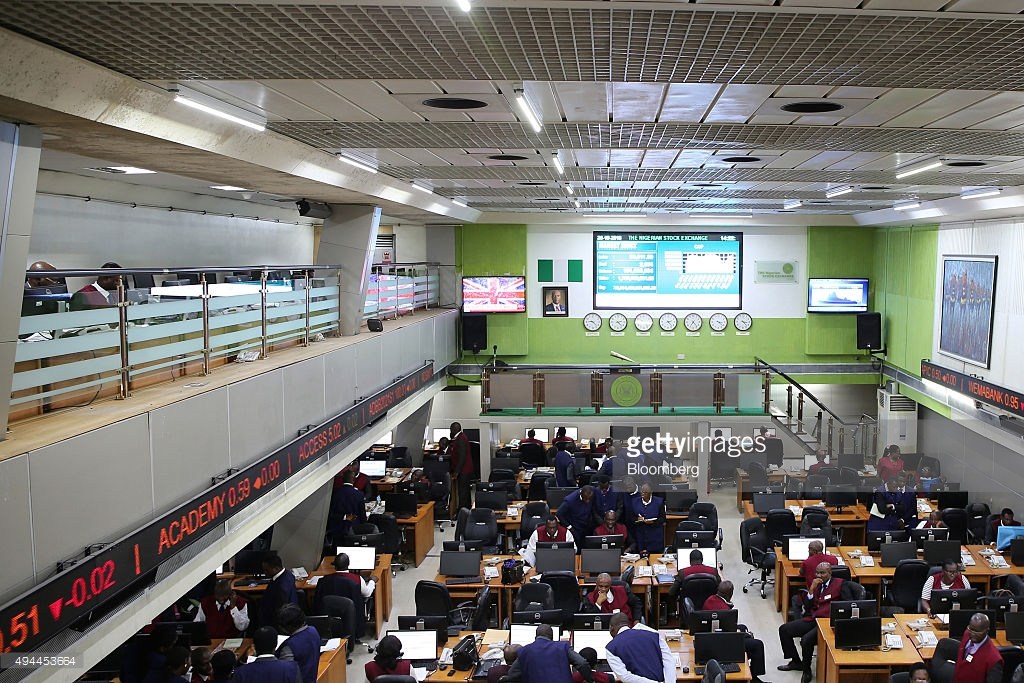
The bulls regained control of the Nigerian Exchange (NGX) Limited on Friday after surrendering power to the bears a day earlier as a result of mild selling pressure.
Yesterday, the Nigerian bourse rebounded by 0.54 per cent, mainly due to the gains recorded by First Holdco and others.
Data harvested by Business Post indicated that the industrial goods and energy sectors were flat, while the banking index chalked up 3.13 per cent. The insurance space expanded by 1.08 per cent, and the consumer goods counter rose by 0.21 per cent.
Consequently, the All-Share Index (ASI) went up by 1,316.52 points to 243,462.13 points from 242,145.61 points, and the market capitalisation grew by N850 billion to N157.057 trillion from N156.207 trillion.
The market breadth index was bullish during the last trading session of this week, printing 31 appreciating stocks and 23 depreciating stocks, representing strong investor sentiment.
First Holdco led the advancers’ log after it climbed 9.97 per cent to N95.95, Haldane McCall appreciated by 9.94 per cent to N3.65, LivingTrust Mortgage Bank soared by 9.73 per cent to N3.72, LASACO Assurance jumped by 5.26 per cent to N2.00, and Thomas Wyatt gained 5.10 per cent to quote at N3.09.
On the flip side, Red Star Express declined by 9.50 per cent to N20.00, Omatek slipped by 6.08 per cent to N1.70, C&I Leasing shrank by 5.93 per cent to N5.55, Jaiz Bank crashed by 5.03 per cent to N8.50, and Livestock Feed fell by 3.89 per cent to N8.65.
As for the activity chart, market participants bought and sold 685.9 million equities for N42.7 billion in 44,134 deals on Friday versus the 498.5 million equities worth N34.9 billion traded in 39,484 deals on Thursday, implying a rise in the trading volume, value, and number of deals by 37.59 per cent, 22.35 per cent, and 11.78 per cent, respectively.
Investors’ darling for the day was First Holdco, with a turnover of 225.9 billion units valued at N21.0 billion, Guinea Insurance sold 53.4 million units for N45.2 million, Zenith Bank traded 41.5 million units worth N4.7 billion, Access Holdings exchanged 29.1 million units valued at N720.6 million, and UBA exchanged 27.5 million units for N1.2 billion.


By Modupe Gbadeyanka
The Africa Association of Professional Freight Forwarders and Logistics of Nigeria (APFFLON) has appealed to the Nigeria Customs Service (NCS) to deepen its sensitisation on the newly introduced Green Tax Surcharge Policy.
The chairman of APFFLON, Mr Akeem Ayobiojo, made this plea on behalf of his colleagues on Tuesday, July 14, 2026, at the Customs House in Abuja, during a stakeholders’ engagement with the agency.
He also called for improvements in the administration of Pre-Arrival Assessment Reports and Post Clearance Audit and the African Continental Free Trade Area (AfCFTA).
Mr Ayobiojo stated that freight forwarders were happy to work with the customs, commending the organisation for implementing Chapter 99, describing it as a major relief for manufacturers.
He, however, emphasised that a deeper understanding of the new tax was necessary for his members, saying more predictable procedures would reduce delays and unexpected costs for importers and freight forwarders.
In his remarks, the Comptroller-General of Customs, Mr Adewale Adeniyi, assured manufacturers, freight forwarders and other players in the nation’s trade sector that the NCS would continue to engage them on fiscal policies affecting their businesses, saying sustained dialogue remains key to resolving implementation challenges and improving the country’s trading environment.
He also promised them the service’s resolve to enhance and facilitate trade, acknowledging that, “Your feedback is important because it helps us understand what is happening in the field, and where necessary, we will take your concerns to the Federal Ministry of Finance and other relevant government institutions.”
Speaking about Authorised Economic Operator (AEO), Mr Adeniyi further explained that Nigeria would not lower the standards required under the Authorised Economic Operator Programme as the initiative is guided by global benchmarks established by the World Customs Organisation (WCO).
On her part, the Deputy Comptroller-General of Customs for Tariff and Trade, Ms Caroline Niagwan, clarified that electric vehicles can be imported without payment of duty only by holders of Import Duty Exemption Certificate (IDEC) issued by the Federal Ministry of Finance.
She also urged importers facing classification disputes to take advantage of the Advance Ruling system, noting, “Once an Advance Ruling is issued based on genuine documentation, importers have certainty on classification, valuation or origin before the goods arrive, thereby reducing unnecessary disputes during clearance.”
