
Economy
Investors Panic as Lack of Quorum May Stall 2018 MPC Meeting

By Dipo Olowookere
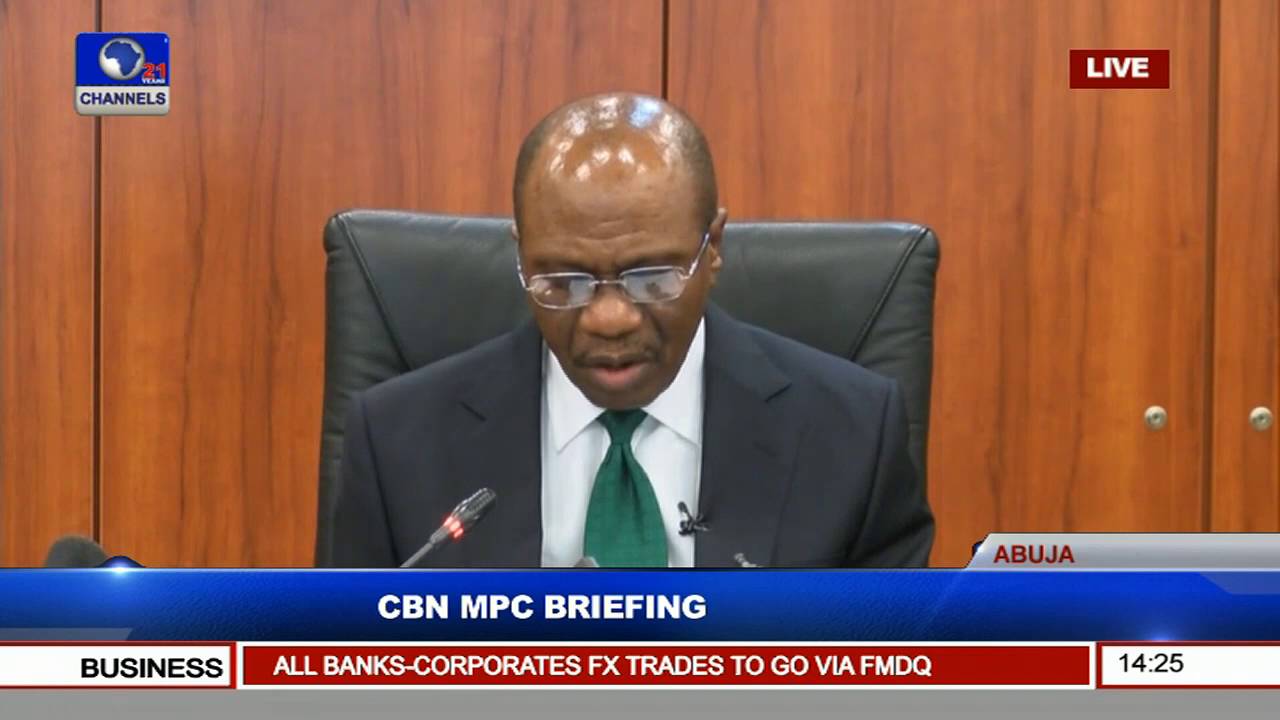
There is anxiety in the Nigerian business space as the first Monetary Policy Committee (MPC) meeting for 2018, scheduled for the third week of January, may not hold due to lack of quorum.
The MPC is a body set up to maintain price stability and support the economic policies of the federal government by formulating monetary and credit policies.
The committee has the Central Bank of Nigeria (CBN) Governor as Chairman; the four deputy governors of the apex bank; two members of the board of directors of the CBN; three members appointed by the President; and two members appointed by the Governor.
By the end of this year, eight positions in the 12-member committee would have become vacant, making it impossible for it to form the quorum required for it to meet.
In October 2017, President Muhammadu Buhari nominated Mrs Aisha Ahmad as a Deputy Governor of the CBN to replace Mrs Sarah Alade, who retired from the bank in June.
He also nominated Professor Adeola Festus Adenikinju, Dr Aliyu Rafindadi Sanusi, Dr Robert Chikwendu Asogwa and Dr Asheikh A. Maidugu as members to fill the positions of four others whose tenure would expire at the end of the year.
Meanwhile, Alhaji Suleiman Barau, another deputy governor of the central bank, who is also a member of the committee, retired recently. The President is yet to name a replacement for him.
But the President’s nominees sent to the Senate for confirmation have not been considered at all. The upper parliament has refused to consider the President’s nominees because of its resolution to suspend all executive confirmation requests for positions not listed in the 1999 Constitution as amended until the Acting Chairman of the Economic and Financial Crimes Commission (EFCC), Mr Ibrahim Magu, was removed.
The Senate last week adjourned to January 9 for its Christmas/New Year recess, while plenary session would begin on January 16.
This development has made uncertain the January meeting of the committee, which has operational independence in setting interest rate as well as designing monetary policy for the country.
Speaking in a chat with THISDAY, the Director General of the West African Institute for Financial and Economic Management (WAIFEM), Prof. Akpan Ekpo, expressed concern over the development.
According to Mr Ekpo, it would create uncertainty among investors.
He said: “There might not be an MPC meeting because they would not be able to form a quorum and if the MPC does not meet it would send a wrong signal to the international investors because it means that there is still uncertainty in the system.
“The way it is now, we are in a limbo and if MPC does not meet, it means that there won’t be decisive actions on monetary policy. The MPC is the engine room for monetary policy and so if they cannot meet to deliberate on the economy and relevant issues, you increase uncertainty in the system.
“The central bank’s mandate is price stability and it is very crucial in any economy. We have always argued that such delays would always cause problem for us.
“So, my advice is that they should stop this delay because it has adverse effect on the economy. So, even if they have to come back from recess and confirm the MPC members, they should do so.”
However, in his reaction, the chief executive of the Financial Derivatives Company Limited, Mr Bismarck Rewane, said there was no need for panic.
Mr Rewane expressed optimism that the new MPC members would be confirmed before the next meeting.
He said: “I don’t think that is a problem. There is still time between now and then. The meeting is not until third week in January for the MPC and I believe the Senate would be able to deal with it before then.”
Nevertheless, when reminded that the Senate would resume fully on January 16, Mr Rewane said: “They would postpone the MPC by one or two weeks! I don’t think it is something to panic about.
“In any case, what does the MPC do? Most of the changes in policy instruments have taken place outside the MPC meeting. So, the MPC has become a ritual. So, there is no need to panic.”












By Adedapo Adesanya
The duo of MRS Oil and FrieslandCampina Wamco Nigeria Plc weakened the NASD Over-the-Counter (OTC) Securities Exchange by 0.68 per cent on Friday, June 5.
MRS Plc lost N19.00 during the session to sell at N171.00 per share compared with Thursday’s value of N190.00 per share, and FrieslandCampina Wamco Nigeria Plc depreciated by N8.70 to finish at N181.68 per unit compared with the preceding session’s N190.38 per unit.
As a result, the market capitalisation further lost N22.59 billion to close at N2.607 trillion versus the N2.630 trillion it ended a day earlier, and the NASD Unlisted Security Index (NSI) dropped 37.76 points to settle at 4,358.32 points, in contrast to the previous day’s 4,396.08 points.
The alternative stock market closed the last trading day of this week with a price gainer, Central Securities Clearing System (CSCS) Plc, which gained 6 Kobo to quote at N78.40 per share compared with the preceding session’s N78.34 per share. However, it could not prevent the market from going down at the close of business.
Yesterday, the volume of securities bought and sold by investors went down by 50.0 per cent to 140,345 units from the preceding day’s 280,714 units, the value of stocks decreased by 16.5 per cent to N17.9 million from the previous session’s N21.5 million, and the number of deals carried out by market participants fell by 35.7 per cent to 27 deals from the 42 deals recorded on Thursday.
When trading activities closed for the day, Great Nigeria Insurance (GNI) Plc remained the most active stock by value on a year-to-date basis, with 3.4 billion units exchanged for N8.4 billion, trailed by Infrastructure Credit Guarantee (Infracredit) Plc with 2.3 billion units sold for N6.5 billion, and CSCS Plc with 64.7 million units traded for N4.4 billion.
GNI Plc also ended the session as the most traded stock by volume on a year-to-date basis, with 3.4 billion units worth N8.4 billion, followed by Infracredit Plc with 2.3 billion units transacted for N6.5 billion, and Resourcery Plc with 1.1 billion units valued at N415.7 million.

By Dipo Olowookere
Renewed interest in financial stocks and others lifted the Nigerian Exchange (NGX) Limited by 0.15 per cent on Friday.
Customs Street closed higher yesterday despite the 1.37 per cent loss recorded by the consumer goods sector as a result of profit-taking.
This was offset by gains in the other key sectors of the local bourse, as the insurance counter chalked up 1,14 per cent. The banking space appreciated by 0.90 per cent, the industrial goods segment grew by 0.46 per cent, and the energy sector expanded by 0.01 per cent.
Consequently, the All-Share Index (ASI) went up by 366.00 points to 242,593.31 points from 242,227.31 points, and the market capitalisation gained N235 billion to close at N155.594 trillion compared with the previous day’s N155.359 trillion.
The trio of International Energy Insurance, Abbey Mortgage Bank, and DAAR Communications improved by 10.00 per cent each yesterday to N7.26, N9.35, and N1.98, respectively, while Zichis advanced by 9.39 per cent to N32.38, with Sovereign Trust Insurance up by 8.70 per cent to N2.50.
On the flip side, Academy Press lost 9.84 per cent to quote at N8.25, University Press depreciated by 9.73 per cent to N5.10, Africa Prudential dipped by 2.63 per cent to N12.95, Chams crumbled by 2.44 per cent to N4.00, and International Breweries slipped by 1.59 per cent to N12.35.
Business Post reports that the market breadth index was positive during the session after recording 37 appreciating equities and 14 depreciating equities, implying strong investor sentiment.
Abbey Mortgage Bank led the activity chart with a turnover of 164.1 million units worth N1.5 billion, Ellah Lakes sold 76.7 million units for N767.2 million, Access Holdings transacted 44.8 million units valued at N1.1 billion, Linkage Assurance exchanged 23.0 million units worth N41.2 million, and The Initiates traded 20.2 million units for N562.1 million.
At the close of trades, market participants transacted 608.5 million units worth N32.0 billion in 53,826 deals versus the 588.5 million units valued at N27.9 billion executed in 57,352 deals in the previous session. This showed that the number of deals eased by 6.15 per cent, the volume of transactions rose by 3.40 per cent, and the value of transactions soared by 14.70 per cent.
By Adedapo Adesanya
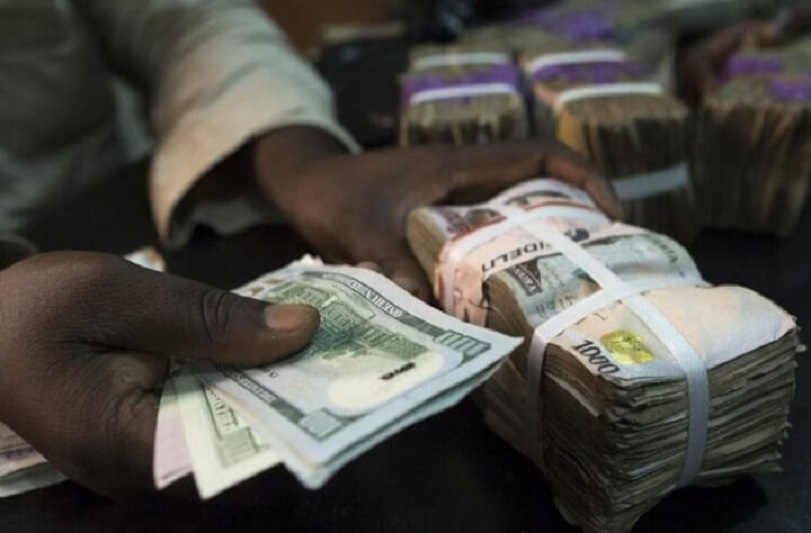
The Naira further depreciated against the United States Dollar by N3.46 or 0.25 per cent to N1,362.21/$1 from N1,358.75/$1 in the Nigerian Autonomous Foreign Exchange Market (NAFEX) on Friday, June 5.
However, it appreciated against the Pound Sterling in the same market window during the session by N4.47 to trade at N1,823.59/£1 compared with the previous day’s N1,828.06/£1, and gained N7.00 against the Euro to sell at N1,574.58/€1, in contrast to Thursday’s closing price of N1,581.58/€1.
For another trading session, the Nigerian Naira maintained stability against the Dollar in the parallel market and the GTBank forex counter on Friday at N1,375/$1 and N1,372/$1, respectively.
The Naira is expected to remain strong in the near term, backed by a rise in external reserves, which are nearing $50 billion, enhancing analysts’ confidence about its outlook in the second half of 2026.
Heightened global uncertainty has reduced the incentive for importers and corporates to demand FX, as cautious trade weighs on import needs. Analysts estimate a $40 billion net FX position for the year, a projection anchored in oil windfall gains.
As for the cryptocurrency market, prices remained depressed following a strong US jobs report that spurred markets to price in higher-for-longer interest rates, sending Treasury yields and the dollar up while hammering stocks, especially AI-related names. Crypto markets saw heavy leverage washouts with about $1.6 billion in positions liquidated over 24 hours.
Ethereum (ETH) gave up 4.9 per cent to trade at $1,584.68, Solana (SOL) fell by 3.3 per cent to $63.22, Bitcoin (BTC) crashed by 1.9 per cent to $61,333.23, Dogecoin (DOGE) slipped by 1.8 per cent to $0.0821, and Ripple (XRP) moderated by 1.8 per cent to $1.09.
Further, TRON (TRX) dropped 1.6 per cent to sell at $0.3197, Binance Coin (BNB) slumped by 1.0 per cent to $581.18, and Cardano (ADA) declined by 0.4 per cent to $0.1589, while the US Dollar Tether (USDT) gained 0.07 to sell at $0.9997, and US Dollar Coin (USDC) closed flat at $0.9998.
-
 Feature/OPED6 years ago
Davos was Different this year
-
Travel/Tourism10 years ago
Lagos Seals Western Lodge Hotel In Ikorodu
-

 Showbiz3 years ago
Estranged Lover Releases Videos of Empress Njamah Bathing
-
 Banking8 years ago
Sort Codes of GTBank Branches in Nigeria
-

 Economy3 years ago
Subsidy Removal: CNG at N130 Per Litre Cheaper Than Petrol—IPMAN
-

 Banking3 years ago
Sort Codes of UBA Branches in Nigeria
-

 Banking3 years ago
First Bank Announces Planned Downtime
-

 Sports3 years ago
Highest Paid Nigerian Footballer – How Much Do Nigerian Footballers Earn