

Economy
Oando Shareholders Beg Buhari to Sack Adeosun


By Dipo Olowookere
President Muhammadu Buhari has been urged to immediately sack Minister of Finance, Mrs Kemi Adeosun, for allegedly meddling in the forensic audit of Oando Plc.
South-South Coordinator of the Oando Shareholders Solidarity Group (OSSG), Mr Clement Ebitimi, made this plea in a statement issued on Monday in Port Harcourt, Rivers State.
The shareholders of Oando claimed that the alleged interference of the Minister in the audit of the oil firm was a bug stain on the anti-corruption campaign of Mr President, whose integrity could be marred by this action.
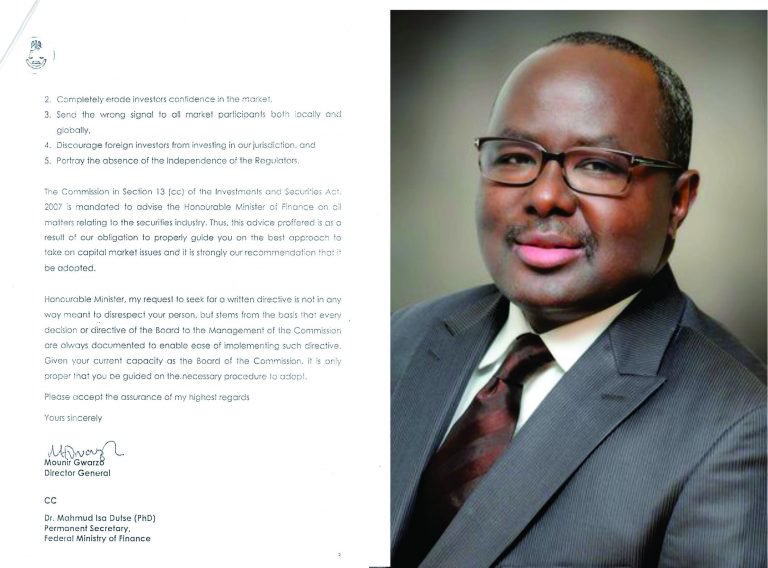
Last week, Director General of the Securities and Exchange Commission (SEC), Mr Mounir Gwarzo, was suspended by the Minister.
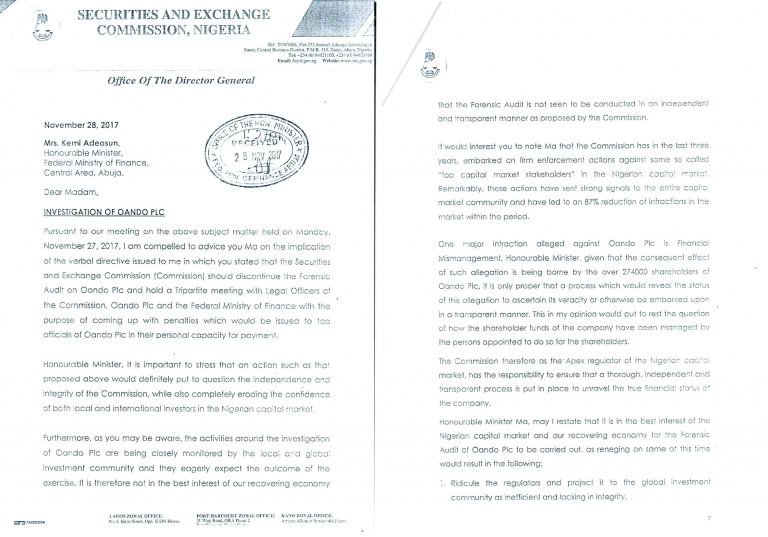
Reports later surfaced last week indicating that Mrs Adeosun told the suspended DG to drop the forensic audit of Oando.
In the statement on Monday, shareholders of Oando alleged that Mrs Adeosun has “lost the moral authority” to remain in President Buhari’s cabinet considering “her repugnant role in shielding the embattled management of Oando Plc from forensic audit in the face of the monumental abuse in the company”.
Mr Ebitimi, who led a group of shareholders to protest at Oando’s Annual General Meeting in Uyo, Akwa Ibom State in September, said, “We condemn in strongest terms the recent suspension of the Director-General of the Securities and Exchange Commission (SEC), Dr Mounir Gwarzo, by the Minister of Finance, Mrs Kemi Adeosun.
“Facts in the public space have revealed that Mrs Kemi Adeosun acted in her capacity as a federal minister to stall the impending forensic audit into Oando Nigeria Plc.
“This is a gross abuse of power and an embarrassment to our corporate existence as a nation. It is shameful, totally embarrassing and should be condemned by all well-meaning Nigerians.
“Dr Munir Gwarzo has demonstrated exemplary leadership as the Director-General of the Securities and Exchange Commission. He is a trusted helmsman that has earned the respect of stakeholders in the Nigerian capital market operations.
“Unlike the Minister of Finance who has brazenly abused her powers for personal gains, Dr Gwarzo has used his office to protect the interest of shareholders in the country’s capital market thereby boosting investment in the market.
“We consider the suspension as an abuse of public office, completely unexpected and unacceptable of a government official. There is nothing more definitive and exemplifying of corruption than the action by the Minister. She has personally and singly rendered the anti-corruption mantle of this government rudderless by this singular action. She is not fit to remain a part of the Buhari administration and no longer fit to be entrusted with any public assignment. The Minister has failed to act honourably on this matter and consequently made it difficult to bestow honour on her.”
The activist said Oando shareholders are deeply concerned about the plight of the company and strongly believe the only solution is for the intervention of the regulatory authorities as demonstrated by SEC under Gwarzo.
According to him, “The management of Oando has for so long relegated shareholders to nonentities; we no longer have a say in the company we invested in. The management has been mismanaging the company while they continue to buy the conscience of some powerful people to support the sustained mission of wrecking the company.
“As of today, every conscientious shareholder of Oando Nigeria Plc is angry. They are angry because of the way the company is being managed. We have held protests across the country starting with the Annual General Meeting dubiously held in Uyo; we have written petitions to the National Assembly and called on well-meaning Nigerians to intervene in the well-orchestrated mission to destroy shareholders’ value in Oando.
“Just when the Securities and Exchange Commission (SEC) intervened and sought to finally unravel the extent of the financial mismanagement and corporate governance abuse, Mrs Kemi Adeosun has thrown herself on the way as a stumbling block.
“Our questions to the Minister are: 1. What is your stake in Oando Nigeria Plc? 2. What is your relationship with Wale Tinubu? 3. How much are you being paid for this job and how much have you been promised? We need answers to these questions to clearly understand why the Minister would choose to provide the umbrella for corruption while Dr Gwarzo is bent on throwing light on the darkness that has engulfed Oando Nigeria Plc.
“We will not sit by and watch our investment go down the drain without giving a fight. Many of us bought the shares of Oando at N90, today the price has dropped to N5. The drop in price is not a result of natural events; it is not a result of the drop in crude oil price as the management is trying to make us believe. The drop in price is due to the mismanagement of the company by Wale Tinubu and co. The auditors of the company for three years consecutively have cast a doubt on the going concern of the company because its liabilities are more than its assets. In this dire situation the management of the company has continued to expend company resources on frivolous things that do not add value to the steadiness of the company.
“In fact, they have continued to increase remuneration of the board while shareholders are left to suffer. Whereas other oil companies are making progress and declaring profit, Oando Nigeria Plc has continued to dwindle, racing towards liquidation with no break in sight.
“Rather than join hands with SEC to save shareholders and rescue the company, Mrs Kemi Adeosun is bent on killing Oando Nigeria Plc by retaining the current incompetent management who lack depth and thoroughness in managing a company. What we need is the forensic audit of Oando to go on. And we clearly understand that the suspension of Dr. Gwarzo is to pave the way FOR another helmsman who will either suspend the forensic audit or ensure that the company only pays fine for the weighty allegations before it.
“This is a clear distraction aimed at suppressing the main issue, which is that Oando as a company cannot survive as a going concern because of the gross abuse of trust, and corporate governance abuse of the Tinubu-led management.
“In the 2016 annual report of the company, the auditors Ernst & Young stated: “We are drawing attention to note 45 in the financial statements, which indicates that the company reported a comprehensive loss for the year of N33.9 billion (2015: loss N56.6 billion) and as at that date, it’s current assets exceeded current liabilities by N14.6 billion (2015: N32.8 billion net current liability).
“The group recorded a comprehensive income of N112.4 billion for the year ended December 31, 2016 (2015: loss N37.8 billion) and as at that date, its current liability exceeded current assets by N263.8 billion (2015: N260.4 billion).
“As stated in the notes, these conditions, along with other matters, indicate that a material uncertainty exist that may cast significant doubt on the company (and Group’s) ability to continue as a going concern. This is a major disturbing issue that must be addressed by relevant authorities and every concerned stakeholder.
“We all know that the only way to rescue Oando Nigeria Plc at this point in time is for the Wale Tinubu led management to resign and allow an unhindered forensic audit. We are well aware that there will be more discoveries at the end of the forensic audit. This needs to be done to sanitise our capital market and protect investors. To do otherwise is to show to the whole world that our capital market is populated by companies that have integrity questions. We should not allow the misdeeds of the people at Oando Nigerian Plc to become the image of our capital market. Our nation must purge itself of every untrustworthy individual and their abettors. We want the management of Oando Nigeria Plc to resign and we call on the Minister of Finance, Kemi Adeosun to resign her position for gross abuse of public office or be sacked by President Buhari who is not known to condone corrupt practices and abuse of public trust as brazenly exhibited by Adeosun.”



By Adedapo Adesanya
The Central Securities Clearing System (CSCS) Plc has declared the first interim dividend in its history after posting its financial results for the first half of 2026, reflecting robust earnings growth, improved operating efficiency and stronger capital market activity.
The board approved an interim dividend of N1.00 per ordinary share for the six months ended June 30, 2026, citing the company’s strong cash generation, resilient balance sheet and confidence in the sustainability of its earnings.
The interim payout represents about 56 per cent of the total dividend of N1.78 per share paid for the 2025 financial year, underscoring its strong earnings momentum while preserving financial flexibility to invest in technology, innovation and future growth.
CSCS recorded one of the strongest financial performances in its history during the review period, with total operating income rising by 92 per cent to N18.51 billion from the corresponding period of 2025.
The growth was driven by higher transaction fee income as capital market activity strengthened, continued expansion in depository services, increased collateral management revenues and stronger contributions from data and technology-enabled services. Investment income also improved as the company optimised its investment portfolio.
Despite the sharp rise in revenue, operating expenses increased by only 38 per cent, reflecting disciplined cost management and the scalability of the company’s business model.
As a result, operating profit surged by 186 per cent to N10.11 billion, while profit before tax climbed by 115 per cent to N13.21 billion. Earnings per share also rose significantly to 190.1 kobo from 109.1 kobo in the corresponding period of 2025.
The organisation also recorded improvements in operating efficiency. Its cost-to-income ratio declined to 45.4 per cent from 63.2 per cent a year earlier, while operating profit margin improved to 54.6 per cent from 36.8 per cent.
According to the company, the results demonstrate not only the benefits of stronger market activity but also the resilience of its operating model and its ability to convert revenue growth into higher profitability, improved shareholder returns and sustainable long-term value creation.
Commenting on the interim dividend, the Chairman of CSCS Plc, Mr Temi Popoola, said the board’s decision reflected confidence in the firm’s financial strength, earnings quality and long-term strategic direction.
He said the strong performance was driven not only by increased market activity but also by sustained improvements in operational efficiency, disciplined cost management and the continued diversification of revenue streams.
Mr Popoola noted that the Board remained committed to balancing shareholder returns with investments in technology, innovation, resilience and new growth opportunities that would strengthen CSCS’ position as Nigeria’s leading financial market infrastructure and one of Africa’s foremost post-trade institutions.
The chief executive of CSCS Plc, Mr Shehu Yahaya Shantali, attributed the strong performance to the resilience of the entity’s business model, the dedication of its workforce and the confidence of market participants.
He said the first-ever interim dividend demonstrated the company’s ability to translate strong earnings growth and improved operating efficiency into enhanced shareholder value.
Mr Shantali added that CSCS would continue to strengthen its core market infrastructure, invest in technology and innovation, diversify its revenue base and enhance value creation for stakeholders while supporting the development of Nigeria’s capital market.


By Aduragbemi Omiyale
The national scale long-term issuer rating of Axxela Limited has been upgraded by GCR Rating to A+(NG), just as its short-term issuer rating was affirmed with a stable outlook.
The rating firm upgraded the long-term issue rating for Axxela Funding 1 Plc’s N16.4 billion series 1 senior unsecured bond to A+(NG), while the N11.5 billion series 1 senior secured bond was lifted to A+(NG)(EL).
GCR noted in a note that the actions reflect the leading gas and power portfolio company’s robust business model, strong earnings performance, and sustained financial profile, reinforcing its ability to deliver long-term value while maintaining financial discipline.
Axxela’s recent achievements have been driven by its continued focus on responsible growth, customer satisfaction, and creating lasting value for national development.
“The ratings upgrade by GCR is a strong endorsement of Axxela’s disciplined approach to business. Beyond recognising our financial strength, it reflects the resilience of our business model and the confidence in our strategic direction.
“Over the past few years, we have continued to make significant strides across the business by expanding our natural gas infrastructure, strengthening our operational footprint, advancing our sustainability agenda, and maintaining an unwavering commitment to operational excellence and safety,” the chief executive of Axxela, Mr Moshood Olajide, commented on the development.
As the company continues to advance its long-term growth strategy, the upgraded ratings reinforce confidence in Axxela’s credit profile, financial resilience, and ability to create enduring value for investors, customers and other stakeholders.

By Adedapo Adesanya
The Ministry of Solid Minerals Development and the National Identity Management Commission (NIMC) have strengthened their partnership to deploy digital identity technology, aiming to combat illegal mining and enhance security in Nigeria’s mining sector.
Speaking while receiving the Director-General and management of NIMC on a courtesy visit to his office in Abuja, the Minister of Solid Minerals Development, Mr Dele Alake, described the commission as a critical institution in Nigeria’s development architecture, stressing that effective governance could not be achieved without a credible identity management system.
“NIMC occupies a critical position in translating policy into reality. It is pivotal to the development of any nation because governance today is driven by data, technology and credible identity systems,” he added.
He noted that inadequate identification systems had weakened enforcement efforts over the years, allowing illegal mining activities to flourish in mineral-rich communities.
“Without identification, we cannot trace or track, and insecurity will flourish. In the solid minerals sector, we need effective monitoring of both legal and illegal operations.
“A credible identity ecosystem will strengthen regulation, improve enforcement and support our efforts to sanitise the sector,” Mr Alake said.
The minister identified technology, statistics, data gathering and digital identity as critical enablers for evidence-based policymaking, improved regulatory oversight, efficient licensing, investment promotion and national development.
On her part, the DG of NIMC, Mrs Abisoye Coker-Odusote, highlighted several opportunities for collaboration between both institutions, noting that the newly enacted NIMC Act has positioned Nigeria to fully embrace a digital governance ecosystem.
She explained that deeper integration of identity management into the solid minerals sector would facilitate database integration across government institutions, enhance regulatory compliance, strengthen security and law enforcement, improve monitoring of operators, and provide stronger support for the implementation of Community Development Agreements (CDAs) in mining host communities.
Mrs Coker-Odusote added that NIMC’s upgraded digital infrastructure is capable of supporting government institutions in building reliable databases, improving transparency and delivering more efficient public services.
Both institutions said they would immediately begin implementing technology-driven initiatives under the partnership, expressing confidence that expanding access to trusted digital identities for miners and other eligible residents would enhance accountability and strengthen governance in the solid minerals sector.
