
General
Elumelu Emerges First African to Win Dwight Eisenhower Award

By Dipo Olowookere
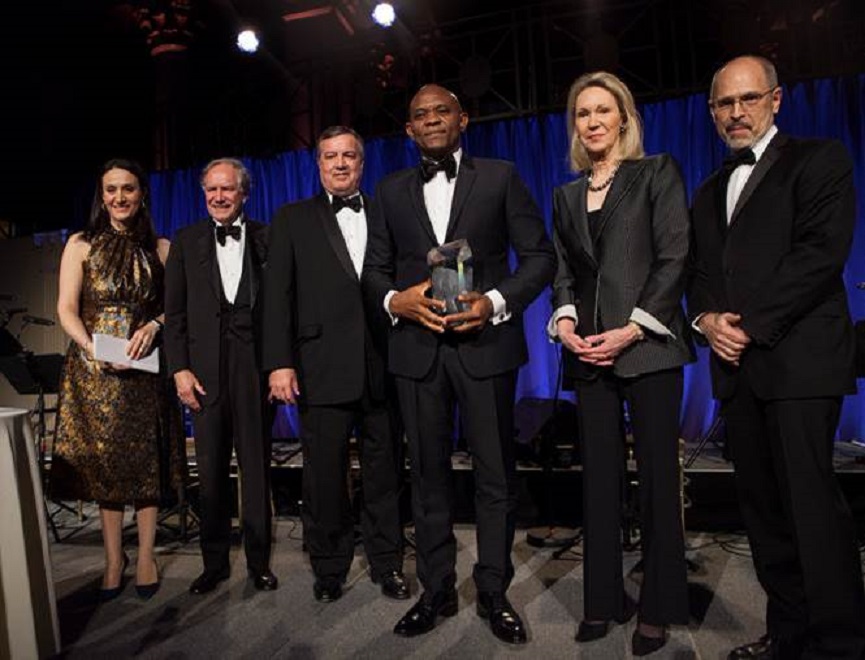
Group Chairman of United Bank for Africa Plc (UBA) and Founder, Tony Elumelu Foundation, has emerged winner of the prestigious Dwight D. Eisenhower Global Entrepreneurship Award.
With this, Mr Elumelu becomes first African to receive the coveted award.
The award was presented to the Nigerian business mogul by the Business council for International Understanding (BCIU), a non-profit US Business association dedicated to forging relationships and promoting dialogue between business and government communities across the globe.
The Dwight D. Eisenhower Global Entrepreneurship Award was given to both Mr Elumelu and Bill Marriott, Chairman, Marriott International Inc.
It was conferred on the Nigerian in recognition of his outstanding work in promoting entrepreneurship on the continent of Africa and across the globe.
Mr Elumelu, who himself is a serial entrepreneur, through his Tony Elumelu Foundation, has funded over 3,000 African entrepreneurs to date with his $100 million commitment to 10,000 entrepreneurs over a period of 10 years.
These entrepreneurs are expected to create a million new jobs and over $10 billion in revenue as a result of the initiative of Mr Elumelu’s Foundation.
At the award’s gala, former American President, Mr George W. Bush, acknowledged the efforts of the African entrepreneur saying, “I am impressed with Tony’s philanthropic initiatives which are powering job creation and entrepreneurship in a region (Africa) that is very dear to Laura and me.
“To receive an award founded by President Eisenhower has added meaning. Eisenhower provided example in leadership, which we can all learn from.
“Additionally, his belief in promoting international understanding is a vitally important responsibility.”
Speaking on the reason why Mr Elumelu was selected as the recipient of this prestigious award, Peter Tichansky, the CEO of BCIU said “Mr Elumelu’s bold approach and can-do mindset are exemplary characteristics of a visionary entrepreneur.
“He embodies the idea that companies must take the lead in bringing business and society together. His advocacy is proving that businesses, acting as businesses and not charitable donors, are the most powerful force for addressing social challenges and economic development.”
Indeed this is the philosophy of Mr Elumelu, founder of the concept of Africapitalism, which essentially states that Africa’s private sector must play a leading role in the development and growth of the continent as both governments and the private sector come together to make this happen.
Mr Elumelu, who was presented his award by Kip Forbes and Anne Eisenhower (the granddaughter of President Eisenhower), in his acceptance speech, stated that, “President Eisenhower was a man of many dimensions and most important is his leadership.
“Being recognized today as a recipient of the inaugural global entrepreneurship award is an honour that resonates with so many people in Africa. What our entrepreneurs in Africa need is powerful leadership to further energise, encourage and motivate them to transform the continent.’ He went on to say.
“I hope this will further spur on other Africans and friends of Africa, to make sure we work together for an inclusive prosperity.”
Mr Elumelu dedicated his award to his wife and children as well as the staff of UBA, Transcorp, Heirs Holdings, the Tony Elumelu Foundation and all the other companies within his group of companies. “He thanked BCIU on behalf of entrepreneurs in Africa saying, “On behalf of the over 3000 entrepreneurs who have benefitted from the Tony Elumelu Foundation Entrepreneurship programme, I say thank you very much.”



By Adedapo Adesanya
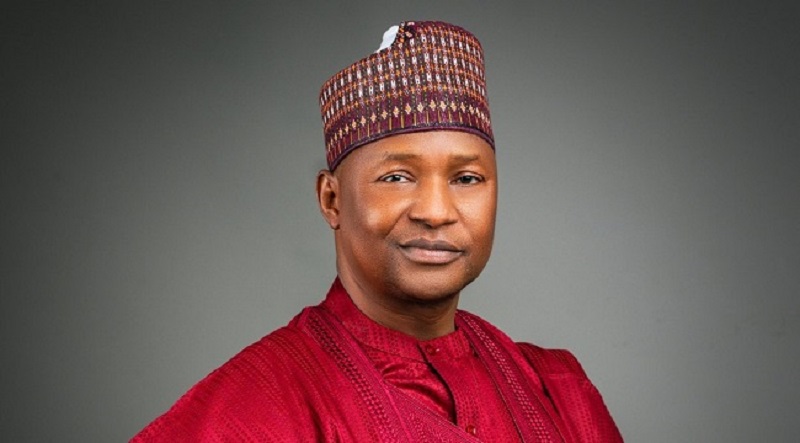
The Department of State Services (DSS) has arraigned the former Attorney General of the Federation (AGF) and Minister of Justice, Mr Abubakar Malami, and his son, Mr Abudlazizz Malami, on a five-count charge of abetting terrorism financing and illegal possession of firearms.
They were arraigned before Justice Joyce Abdulmalik of the Federal High Court in Abuja, where they pleaded not guilty to the charges.
In the charge, the former AGF was accused of knowingly abetting terrorism financing by refusing to prosecute terrorism financiers whose case files were brought to his office as the AGF in the last administration for prosecution.
Recall that the secret police had arrested Mr Malami, shortly after his release from Kuje prison in Abuja more than two weeks ago after Justice Emeka Nwite of the Federal High Court in Abuja granted him and two others bail in the sum of N500 million in another case involving the Economic and Financial Crimes Commission (EFCC).
Mr Malami and his son are also accused by the DSS of engaging in conduct in preparation to commit act of terrorism by having in their possession and without licence, a Sturm Magnum 17-0101 firearm, 16 Redstar AAA 5’20 live rounds of Cartridges and 27 expended Redstar AAA 5’20 Cartridges.
His arrest in January followed weeks of reports of surveillance by the secret police in front of the prison facility since the time Mr Malami, his wife and son were remanded there over the money laundering charges.
As per reports, Mr Malami had gathered that he would be picked up upon regaining his temporary freedom and so decided to wait out the DSS. However, after his eventual emergence, the operatives took the ex-AGF into detention again.
By Adedapo Adesanya
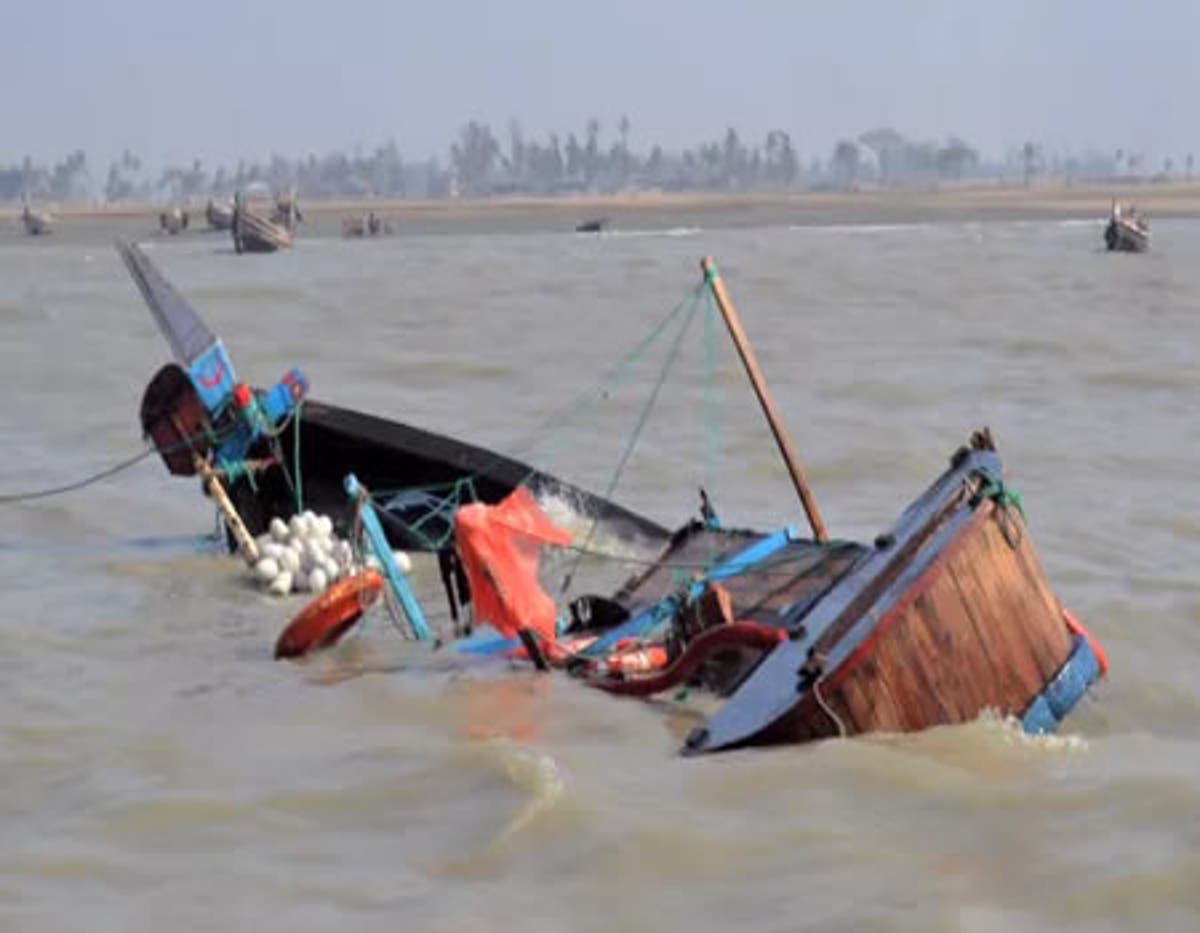
The Lagos State Waterways Authority (LASWA) has initiated an inter-agency partnership with the Centre for Rural Development (CERUD) to establish the Coastal Community First Responder Programme (CCFRP).
The first responder programme is aimed at promoting safe and secure transportation across Lagos waterways.
The initiative was unveiled during a meeting between a LASWA delegation and officials of the Ministry of Local Government, Chieftaincy Affairs and Rural Development at the secretariat in Alausa.
Leading the LASWA team, Mr Olademeji Shittu said the programme is designed to reduce fatalities and material losses on Lagos waterways, particularly in hard-to-reach coastal communities.
According to Mr Shittu, the CCFRP will focus on empowering community volunteers through targeted capacity building for sustainable rural development, while also equipping them with relevant skills that can enhance employability within the maritime sector.
He noted that trained volunteers will serve as community-based first responders, working in close collaboration with LASWA to strengthen search and rescue operations.
Providing the rationale for the programme, Mr Shittu highlighted the recurring cases of marine incidents and fatalities on Lagos waterways, often worsened by delayed emergency response in remote coastal areas.
He explained that residents of these communities are usually the first on the scene during accidents, making it necessary to formalise their role through structured training and partnerships.
He added that the collaboration with CERUD will help create a sustainable framework that aligns community development with safety and emergency response, while fostering a sense of ownership and responsibility among coastal residents.
According to a statement, the Coastal Community First Responder Programme is expected to enhance emergency preparedness on Lagos waterways, improve response times during marine incidents, and contribute to safer water transportation across the state.
By Adedapo Adesanya
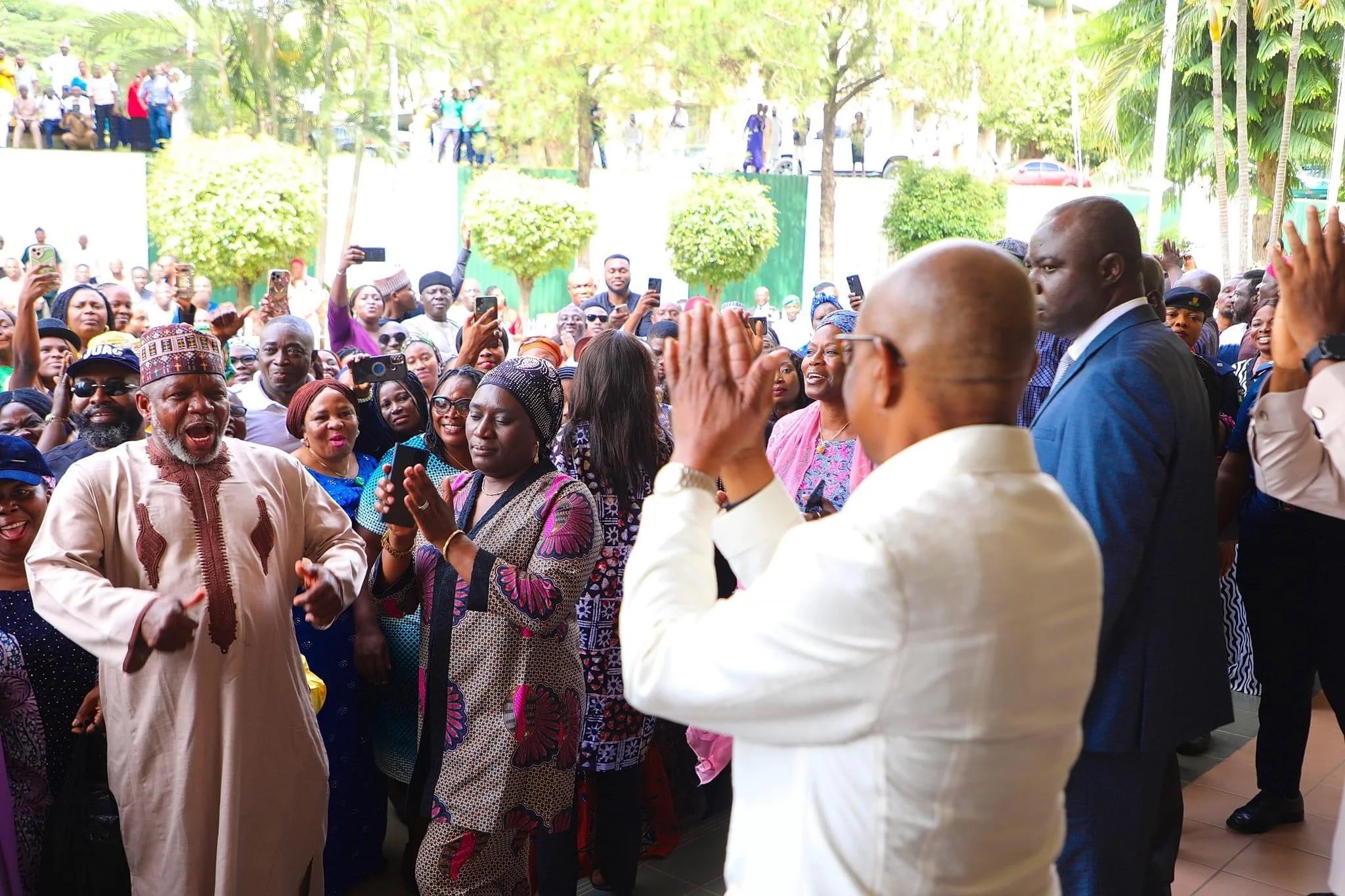
The Nigeria Labour Congress (NLC) and the Trade Union Congress (TUC) have suspended their planned protest in the Federal Capital Territory and instructed workers under the Federal Capital Territory Administration (FCTA) to return to their duties with immediate effect.
The directive followed an overnight engagement involving labour leaders, the Minister of the FCT, Mr Nyesom Wike, and members of the Senate Committee on the FCT.
The meeting, which began late on Monday, stretched into the early hours of Tuesday, culminating in an agreement that led to the unions’ decision to halt the protest action and restore normal activities across FCTA offices.
This comes after Justice Emmanuel Subilim of the National Industrial Court issued an interim order restraining the NLC, TUC, and three others from embarking on any form of industrial action or protest.
Ruling on an ex-parte application filed by the Minister of the FCT and the FCT Administration, Justice Subilim granted an interim order restraining the 1st to 5th respondents and their privies or agents from embarking on strike pending the hearing of the motion on notice, also ordering the 5th-9th defendants who are security agencies to ensure no break down of law and order.
The ex-parte motion, which was filed by the counsel to Mr Wike and the FCTA, Ogwu Onoja, submitted that the Chairman of the FCT council had sent a message of mobilization to members and affiliated unions for a mass protest scheduled for February 3.
This move, he noted, was in violation of the orders of court, adding that after the ruling of the court on January 27, the order of the court was served on the defendants, same day the NLC and TUC issued a statement to all affiliated unions to intensify and sustain the strike.
The statement jointly signed by both unions directed that the striking workers should resume the strike as the unions’ counsel, Mr Femi Falana, has filed an appeal against the interlocutory ruling.
He further pointed out that With the statement, JUAC issued a circular directing all employees to continue the strike.
This position they say is aimed at causing break down of law and order in the Nations capital.
The court subsequently adjourned the case until February 10 for hearing.






-
 Feature/OPED6 years ago
Davos was Different this year
-
Travel/Tourism9 years ago
Lagos Seals Western Lodge Hotel In Ikorodu
-

 Showbiz3 years ago
Estranged Lover Releases Videos of Empress Njamah Bathing
-
 Banking8 years ago
Sort Codes of GTBank Branches in Nigeria
-

 Economy3 years ago
Subsidy Removal: CNG at N130 Per Litre Cheaper Than Petrol—IPMAN
-

 Banking3 years ago
Sort Codes of UBA Branches in Nigeria
-

 Banking3 years ago
First Bank Announces Planned Downtime
-

 Sports3 years ago
Highest Paid Nigerian Footballer – How Much Do Nigerian Footballers Earn