
Economy
$60m Buyout: Shareholders Want Forensic Audit of 7up

By Dipo Olowookere
Both the Securities and Exchange Commission (SEC) and the Nigerian Stock Exchange (NSE) have been urged to urgently to conduct a forensic audit of Nigeria’s 7Up Bottling Company.
This plea was made by Nigerian shareholders in the firm and it followed the planned buyout by Affelka, its parent company of 7Up.
This development is also coming at a time one of the leading indigenous oil firm in Nigeria, Oando Plc is facing a similar crisis, though the firm is preventing the regulator from conducting a forensic audit of its affair.
This issue allegedly led to the suspension of the regulatory chief, Mr Mounir Gwarzo, by the Minister of Finance, Mrs Kemi Adeosun.
The shareholders want the capital market regulators to unravel circumstances surrounding the deal, which they believe is not totally clean.
Speaking with Daily Sun on telephone, the shareholders argued that they were unconvinced that the recent takeover notification of the company was not fraudulent scheme as there was no reason to suggest the firm was doing badly in its sector.
Recall that Affelka, majority shareholder of Seven-Up Bottling Company, had last week offered to pay $60 million (N19.33 billion) to buy out minority shareholders in Nigerian operation. According to the proposal, the buyout is aimed at restructuring the struggling company.
Affelka is the privately held investment firm owned by Lebanese El-Khalil family and it is offering to pay N112.70 per share for the minority stake of 171.5 million shares. This is an 18 percent premium to last Thursday’s share price of N95.50k.
“As of now, we have received an offer from the majority shareholder of the company. It’s a financial restructuring,” said Sunil Sawhney, Vice Chairman of 7Up Bottling Company.
He said the company has been making losses for some time and that the deal was aimed at restructuring the bottler, which distributes PepsiCo’s 7Up, Pepsi and Mirinda-branded drinks.
But minority shareholders in Nigeria rejected Sawhney’s explanation, pointing out that they seriously smelled a rat, and argued that the notification was out to short-change local investors.
According to Mr Gbadebo Olatokunbo, a shareholder activist, the 57 years old company is making good sales and profit with very good price at the NSE with the good result and return on investment in 2014.
“But suddenly, by the first half of 2015, something known only to its few foreign team within the company happened and the company started reporting losses.
“The drift continued and the same powers behind the scenes are now ready to buyout local investors at their price,” Mr Olatokunbo wondered.
He asked, “Why the renewed interest of the majority shareholders in a suddenly sick company? Why are they now interested in the takeover when the company wasn’t growing? How are we sure they weren’t the brains behind the unexpected bad results?”
Mr Olatokunbo stated that, “We are of very strong view that the proposed injection of $60 million is part of our profit on investments in 7Up, which was denied us and now about to be presented as a bailout-fund for a very solid 7Up Company, which we view with serious suspicion. It is a slap on our collective business senses and we hereby ask for a forensic audit of our company, 7Up, from 2014.”
In his own reaction, President of Nigeria Shareholders Solidarity Association (NSSA), Mr Timothy Adesiyan, said the news of the buyout offer was very disheartening.
“We thank God for the life of the former President, Olusegun Obasanjo, who made it possible for Nigerians to be part owners of these multinationals because it was during his tenure that a law was made, which made it possible for Nigerian shareholders to be part owners of these companies.
“But what is happening now is very disheartening because the gimmick is to shut out the local investors.
“The Securities and Exchange Commission (SEC) and Nigerian Stock Exchange (NSE) are not helping matters because most of the people there now don’t know what it took the former president to make Nigerians part owners of these multinationals,” he lamented.
He appealed to the Federal Government to look into the matter to stop foreigners from short-changing local investors because they are making money here.
For his part, Mr Boniface Okezie, National Coordinator, Progressive Shareholders Association of Nigeria (PSAN), blamed SEC and NSE for this issue.
According to him, “we saw it coming. Since SEC and NSE approved the delisting of NBC, we knew that others will follow suit. What are they restructuring?”
He explained that all boils down to short-changing local shareholders, adding that they are just after the buyout to delist from NSE and then, escape from corporate governance code because they are no longer listed.
Mr Okezie, however, urged the capital market regulators to subject 7Up to rigorous test to confirm some of its claims and also not to renege on its regulatory role of protecting minority shareholders.






By Adedapo Adesanya
The NASD Over-the-Counter (OTC) Securities Exchange recorded a loss of 1.13 per cent on Thursday, June 4, shrinking the market capitalisation by N30.03 billion to N2.630 trillion from N2.660 trillion on Wednesday.
Similarly, this brought down the NASD Unlisted Security Index (NSI) by 50.19 points to 4,396.08 points from the 4,446.27 points recorded a day earlier.
The loss was influenced by the overpowering of the bulls by the bears, after the bourse closed with two price gainers and three price losers, led by FrieslandCampina Wamco Nigeria Plc, which slumped by N20.03 to sell at N190.38 per unit compared with midweek’s N210.41 per unit. Food Concepts Plc declined by 25 Kobo to trade at N2.50 per share versus the previous day’s N3.00 per share, and Acorn Petroleum Plc crumbled by 2 Kobo to end at N1.32 per unit, in contrast to the preceding session’s N1.34 per unit.
For the gainers, Central Securities Clearing System (CSCS) Plc added N2.93 to close at N78.34 per share compared with the previous price of N75.41 per share, and Afriland Properties Plc gained 80 Kobo to settle at N16.80 per unit versus N16.00 per unit.
There was a slip in the volume of transactions yesterday by 46.8 per cent to 280,714 units from 527,221 units, as the value of trades dropped 66.5 per cent to N21.8 million from the preceding session’s N64.2 million, and the number of deals fell by 8.7 per cent to 42 deals from 46 deals.
Great Nigeria Insurance (GNI) Plc ended the session as the most traded stock by value on a year-to-date basis with 3.4 billion units worth N8.4 billion, followed by Infrastructure Credit Guarantee (Infracredit) Plc with 2.3 billion units sold for N6.5 billion, and CSCS Plc with 64.7 million units traded for N4.4 billion.
GNI Plc also finished the day as the most traded stock by volume on a year-to-date basis with 3.4 billion units valued at N8.4 billion, followed by Infracredit Plc with 2.3 billion units exchanged for N6.5 billion, and Resourcery Plc with 1.1 billion units transacted for N415.7 million.
By Dipo Olowookere
The domestic stock market crashed by 0.37 per cent on Thursday as a result of the decline in the price of shares of McNichols, Eterna, Aradel Holdings, and others.
Business Post reports that investor sentiment remained weak after the Nigerian Exchange (NGX) Limited ended the session with 25 price gainers and 31 price losers, indicating a negative market breadth index.
McNichols lost 10.00 per cent to trade at N7.74, ABC Transport slipped by 9.88 per cent to N6.20, Eterna shrank by 9.85 per cent to N29.75, Aradel Holdings depreciated by 9.51 per cent to N1,749.90, and NPF Microfinance Bank contracted by 8.45 per cent to N5.20.
On the flip side, International Energy Insurance gained 10.00 per cent to close at N6.60, Omatek improved by 9.73 per cent to N2.03, Abbey Mortgage Bank surged by 9.68 per cent to N8.50, Cutix expanded by 9.66 per cent to N3.18, and John Holt grew by 7.79 per cent to N14.90.
As for the sectorial performance, the industrial goods and banking indices chalked up 0.54 per cent and 0.31 per cent, respectively. But the energy sector depleted by 4.90 per cent, the insurance counter tumbled by 0.58 per cent, and the consumer goods index slumped by 0.03 per cent.
As a result, the All-Share Index (ASI) dipped by 905.30 points to 242,227.31 points from 243,132.61 points, and the market capitalisation stumbled by N581 billion to N155.359 trillion from N155.940 trillion.
During the session, investors traded 588.5 million equities valued at N27.9 billion in 57,352 deals compared with the 923.0 million equities worth N42.3 billion transacted in 69,332 deals on Wednesday, showing a drop in the trading volume, value, and number of deals by 36.24 per cent, 34.04 per cent, and 17.28 per cent, respectively.
The most active equity yesterday was Access Holdings with 109.7 million units sold for N2.6 billion, FCMB traded 35.6 million units valued at N384.2 million, NGX Group transacted 28.1 million units worth N3.9 billion, Zenith Bank exchanged 26.9 million units for N3.3 billion, and Sterling Holdings recorded a turnover of 22.5 million units worth N176.1 million.
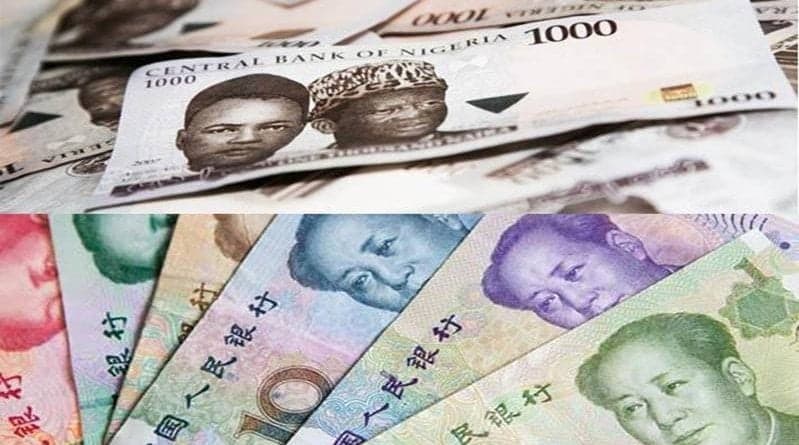
By Adedapo Adesanya
A 0.1 per cent or N1,49 loss was recorded by the Nigerian Naira against the United States Dollar in the Nigerian Autonomous Foreign Exchange Market (NAFEX) on Thursday, June 4, closing at N1,358.75/$1 compared with the previous day’s N1,347.26/$1.
In the same vein, the Naira depreciated against the Pound Sterling in the official FX market during the session by N5.39 to trade at N1,828.06/£1 versus Wednesday’s closing rate of N1,822.67/£1, but gained N6.75 against the Euro to sell at N1,574.83/€1 versus the preceding session’s N1,584.39/€1.
At the black market and GTBank FX desk, the local currency traded flat against the Dollar during the session at N1,375/$1 and N1,372/$1, respectively.
Data from the Central Bank of Nigeria (CBN) showed that NFEM interbank FX turnover contracted to $128.117 million in 121 deals on Thursday from $133.731 million the previous day.
On the positive side, Nigeria’s external reserves moved closer to a 2009 high of $50 billion, enhancing analysts’ confidence about the local currency outlook in the second half of 2026.
This improvement has been helped by heightened global uncertainty, which has reduced the incentive for importers and corporates to demand FX, as cautious trade weighs on import needs. Analysts estimate a $40 billion net FX position for the year, a projection anchored in oil windfall gains.
As for the cryptocurrency market, prices extended steep weekly losses as the broader artificial-intelligence trade that has driven global risk assets since 2026 faltered.
The sell-off was led by equity and currency markets, with semiconductor stocks, Asian indexes and several regional currencies sliding in a broad risk-off shift.
Persistent outflows from US spot Bitcoin ETFs and a rare BTC sale by Strategy have removed a key source of support, leaving markets focused on Friday’s US jobs report for clues on Federal Reserve policy and the fate of the AI trade. The most valued coin slipped 3.6 per cent to $61,914.58.
Cardano (ADA) plunged by 17.6 per cent to $0.1630, Solana (SOL) declined by 7.0 per cent to $65.69, Ethereum (ETH) slipped by 6.9 per cent to $1,666.13, Dogecoin (DOGE) went down by 6.5 per cent to $0.8445, and Ripple (XRP) crashed by 6.5 per cent to $1.11.
Further, Binance Coin (BNB) slumped by 4.3 per cent to $581.45, and TRON (TRX) dropped 1.9 per cent to sell at $0.3261, while the US Dollar Tether (USDT) and the US Dollar Coin (USDC) gained 0.01 per cent each to sell at $0.9990 and $0.9998, respectively.
-
 Feature/OPED6 years ago
Davos was Different this year
-
Travel/Tourism10 years ago
Lagos Seals Western Lodge Hotel In Ikorodu
-

 Showbiz3 years ago
Estranged Lover Releases Videos of Empress Njamah Bathing
-
 Banking8 years ago
Sort Codes of GTBank Branches in Nigeria
-

 Economy3 years ago
Subsidy Removal: CNG at N130 Per Litre Cheaper Than Petrol—IPMAN
-

 Banking3 years ago
Sort Codes of UBA Branches in Nigeria
-

 Banking3 years ago
First Bank Announces Planned Downtime
-

 Sports3 years ago
Highest Paid Nigerian Footballer – How Much Do Nigerian Footballers Earn