
Economy
Bankers, Judges Alert Nigerians on Crypto Currencies’ Risks


By Modupe Gbadeyanka
Nigerians have been warned by bankers and judges to be wary of risks involved in transacting their businesses with virtual currencies like bitcoins and others.
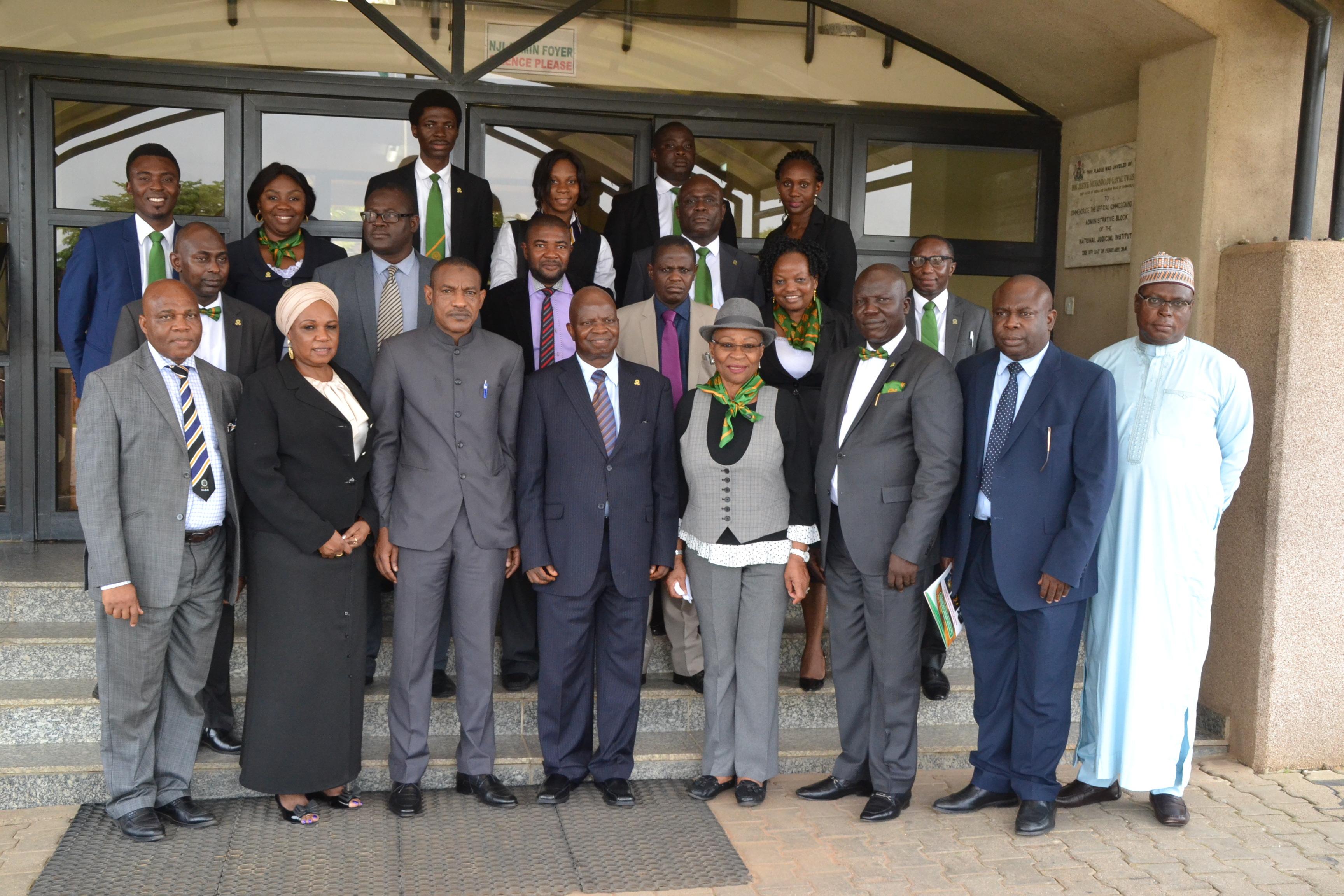
Speaking in Abuja on Wednesday at a seminar organised by Chartered Institute of Bankers of Nigeria (CIBN), the Chief Justice of Nigeria (CJN), Justice Walter Onnoghen, said efforts must be made to protect customers in the banking sector.
At the event tagged ‘17th National Seminar on Banking and Allied Matters for Judges,’ the CJN, represented by a Justice of the Supreme Court, Justice Mahmud Muhammad, said the judiciary will continue to provide support for the banking industry.
He said the programme, which focused on the ‘Emergence of New Frontiers in Banking and its Legal Implications,’ came at the right time.
Mr Onnoghen stressed that the judiciary has a huge part to play in the protection of depositors’ funds and warned members of the judiciary not to truncate the present judicial reforms with technicalities.
The CJN said Nigerians should just be careful of how they are exposed to crypto currencies, which seem to be gaining ground by the day despite warnings.
However, he assured that the judiciary will ensure it plays its vital role in the prompt, speedy and just dispensation of cases to protect depositors’ funds.
On his part, President of CIBN, Professor Segun Ajibola, admitted that virtual currencies have altered the traditional form of banking system in Nigeria, but emphasised that efforts must be made to protest citizens’ funds.
He said efforts are being made to study the new trend with a view to finding ways to minimise the risks.
Prof Ajibola noted that, “One of the side effects of the disruptive technology, artificial intelligence and other new tools is the use of the same technology to undermine the control systems in banks and other financial institutions.
“Unfortunately, fraudsters are usually a step ahead of operators, and operators are usually a step ahead of regulators. This explains why policies and regulations aimed at fighting crimes, albeit cybercrimes, are more reactive than being pro-active.
“We need the judiciary to improve on the speed at which cybercrimes are tried and dispensed with. We need the judiciary to assist in strengthening the statutory framework for fighting cybercrimes in this country.”
He promised that bankers will continue to work closely with the judiciary so as to tackle the issues head-on.
Also at the seminar, other speakers called on the government, especially the National Assembly, to closely look into crypto currencies. They said for now, there is no legal backing for the use of virtual currencies in the country.
A cryptocurrency is an encrypted decentralized digital currency transferred between peers and confirmed in a public ledger via a process known as mining. It is also a digital or virtual currency that uses cryptography for security.
A cryptocurrency is difficult to counterfeit because of this security feature.
A defining feature of a cryptocurrency, and arguably its most endearing allure, is its organic nature; it is not issued by any central authority, rendering it theoretically immune to government interference or manipulation.
Business Post recalls that at a Workshop for Financial Correspondents in December 2016 in Kaduna, Managing Director of Nigeria Deposit Insurance Commission (NDIC), Mr Umaru Ibrahim, disclosed that his commission and the Central Bank of Nigeria (CBN) had set up a committee to look into the trending ‘bitcoin’ scheme.
“On our part, we have constituted a committee together with the central bank to have an in debt study of this phenomenal bitcoin.
“We will look at its advantages and disadvantages, what it means for the payment system and what it means for safety and security of customers.
“We will also look at what it means for money laundering, anti-corruption, crime and measurement of money /near money instrument for the economy.
“But we need a lot of education to do this and I’m calling on you (media) to educate yourselves about all of this so you can educate the public,” Mr Ibrahim had said at the event themed ‘Economic Recession and the Nigerians Banking Sector: Opportunities, Challenges and the way Forward.’
In January 2017, the Securities and Exchange Commission (SEC), in a statement posted on its website, warned Nigerian investors to be very careful of advertisements encouraging them to invest in cryptocurrencies such as Swisscoin, OneCoin, Bitcoin and such other virtual or digital currencies.
The capital market regulator had said members of the public must “exercise extreme caution with regard to digital (crypto currencies) as a vehicle of investments,” noting that “this warning is in consonance with similar warnings issued by capital market regulators and Central Banks across the world over the past few years.”
SEC had said it “wishes to alert the public that none of the persons, companies or entities promoting cryptocurrencies has been recognized or authorized by it or by other regulatory agencies in Nigeria to receive deposits from the public or to provide any investment or other financial services in or from Nigeria.
“The public should also be aware that any investment opportunities promoted by these persons, companies or entities are likely to be of a risky nature with a high risk of loss of money, whilst others may be outright fraudulent pyramid schemes.”
But at crypto currency conference held in Lagos last month tagged ‘Learning to Glow with the Flow,’ Deputy Director/Head, Payments System Policy and Oversight at the CBN, Mr Musa Jimoh, disclosed that the apex bank had commenced arrangement to introduce a digital currency in the country a move to key into the global adoption of crypto currency initiative.
Mr Jimoh was quoted to have said at the event that CBN cannot stop the tide of waves generated by the blockchain technology and its derivatives.
“Currently, we have taken measures to create four departments in the institution that are looking forward to harmonise the white paper on Crypto currency,” he had said at the event.
Also at the event, President of Information Security Society of Nigeria (ISSAN), Dr David Isiawe, had said, “The reality that is before us today, particularly in Nigeria, is that the Distributed Ledger Technology (DLT), blockchain and Crypto currency are facts that we must face, whether we like it or not. We cannot wish this reality away.
“It is made worse when we realise that we are still grappling with current challenges of e-commerce and other electronic payment systems but technology development and advancements are not waiting.
“The impact of the emergence of blockchain and Crypto currency will be felt in the nation just as in the global community.
“Nigerian must be proactive rather than reactive by considering how these technologies would affect and influence our lifestyles and business operations and channel, and thus fashion our rules of engagement for their adoption.”
However, Mr Isiawe also admonished prospective investors to be careful investing in crypto currencies, as every investment has its share of risks.
This month, at the 12th Abuja International Trade Fair, Managing Director of the Nigeria Deposit Insurance Corporation (NDIC), Mr Umaru Ibrahim, warned Nigerians to be very careful of how they embrace digital currencies, especially bitcoins, emphasising that they had not yet be certified okay by the necessary regulatory bodies in the country.
He admitted that in other climes, they have been fully embraced, but warned that anyone in Nigeria involved in the trade do so at their own risk as such currencies were not insured by the NDIC.
“In view of the growing popularity which the phenomenon is gaining in Nigeria, it has become important to state that digital currencies are not authorised by the Central Bank of Nigeria, and they are not insured by NDIC,” he had warned earlier this month.









By Adedapo Adesanya
Brent crude prices fell by $3.05 or 3.37 per cent to $87.33 per barrel on Friday, the lowest level since early March, triggered by expectations of an imminent peace agreement between the United States and Iran.
Also, the US West Texas Intermediate (WTI) crude finished at $84.88 a barrel after it gave up $2.83 or 3.23 per cent. It was its lowest level since April 17.
Reuters reported that a memorandum between the US and Iran to halt the war in the Gulf could be signed as soon as Sunday, citing sources.
The sources indicate that the US would immediately begin releasing billions of Dollars in frozen Iranian assets and waive sanctions on its oil exports, in return for Iran opening the strait.
The proposals also include discussion of possible war reparations for Iran and dropping longstanding US demands for limits on Iran’s missile program, the sources were quoted as saying.
Meanwhile, Iranian Foreign Minister Abbas Araqchi said on Friday that a memorandum of understanding had not yet been signed and could still change.
He also said that management of the Strait of Hormuz would not return to the pre-war era, that sovereignty over the strait belonged to Iran and Oman, and that Iran would secure safe passage for ships through it.
US President Donald Trump called off threatened air strikes against Iran on Thursday, while it was reported that final negotiations on the memorandum would focus on nuclear and economic issues but would exclude discussions about Iran’s missile programme.
On Thursday, Iran announced a complete closure of the Strait of Hormuz, saying it would fire on any ship trying to pass through.
Traffic through the strait, which normally carries a fifth of global oil and liquefied natural gas shipments, has been extremely limited as a result of the war.
The US military, however, said on social media that commercial ships continued to transit the waterway.
Goldman Sachs lowered its 2027 average Brent forecast to $80 a barrel on higher supply and lower demand, but expects prices to exceed the 2025 average on stockpiling of OECD commercial oil stocks and a security premium for disruptions.
The Organisation of the Petroleum Exporting Countries (OPEC) on Thursday lowered its forecast for 2026 world oil demand growth to 970,000 barrels per day from a previous 1.17 million barrels per day, its second straight downward revision.

By Modupe Gbadeyanka
The Lagos-based Dangote Petroleum Refinery has been described by Standard Bank Group as a transformational industrial project with far-reaching implications for Nigeria and Africa.
The company, which is Africa’s largest financial institution, gave this description after a tour of the facility recently.
Standard Bank, the parent company of Stanbic IBTC Holdings, has promised to support the planned listing of the 650,000 barrels per day refinery and expressed readiness to finance future expansion projects across the continent.
The chief executive of the lender, Mr Sim Tshabalala, said, “We are here because the Dangote Group is a large and important global player and a significant force on the African continent.”
“Standard Bank is the largest financial institution in Africa, and we have partnered with Dangote on a variety of initiatives. We are here to lend support, to see this magnificent refinery and to discuss Vision 2030 and how we can continue supporting the Group’s growth ambitions,” he added.
Mr Tshabalala disclosed that Standard Bank intends to play a leading role in the refinery’s planned Initial Public Offering and future growth initiatives.
“As Dangote lists, there is an IPO coming up, and we are a leading player in that process,” he said, adding that, “As the group continues to expand in Nigeria and across Africa, there will be opportunities for financial advisory services and balance sheet support, and we stand ready to provide both.”
He further described the refinery as “a wonder of the world,” noting that its impact is already being felt through stronger foreign exchange earnings, improved balance-of-payments performance and enhanced energy security.
“This is a wonder to behold. It is massive, productive and transformative. It is already making a significant contribution to Nigeria’s economy through its impact on foreign reserves, the balance of payments and the lives of ordinary Nigerians,” he said.
The Group Vice President for Oil and Gas at Dangote Industries Limited, Mr Devakumar Edwin, said the visit represented a significant milestone in a partnership that began during the refinery’s construction phase.
“The bank visited us during construction and understood the scale of what we were building,” Mr Edwin said. “Today, the refinery is fully operational, and they can see what their support has helped to create. It is like nurturing a tree and eventually seeing it bear fruit.”
He added that both organisations are exploring opportunities to deepen collaboration as Dangote expands its industrial footprint across Africa.
Also speaking, the chief executive of Dangote Petroleum Refinery, Mr David Bird, said the visit highlighted the importance of long-term partnerships in delivering large-scale industrial projects.
“Standard Bank has been one of our strongest supporters throughout the history of the refinery and the broader Dangote Group.
“This visit was an opportunity to demonstrate what that support has enabled. Seeing is believing, and it allows our partners to appreciate the scale of what has been achieved,” Mr Bird stated.
The visit also coincided with a major operational milestone for the refinery, which has now exceeded its original design capacity.
Mr Bird disclosed that the refinery recently completed performance test runs at 700,000 barrels per day, above its nameplate capacity of 650,000 barrels per day.
“We have always believed there was engineering flexibility built into the design,” he said. “Achieving sustained production of 700,000 barrels per day is a testament to the technical capability of our people and the strength of the systems we have built.”
By Adedapo Adesanya
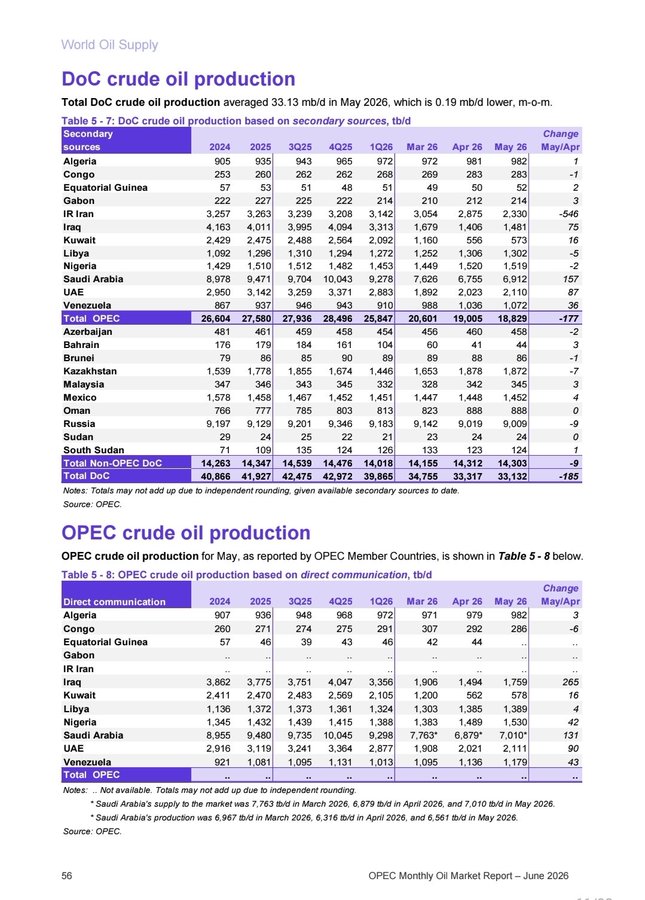
Nigeria produced about 1.530 million barrels of crude oil per day in May 2026, beating its Organisation of Petroleum Exporting Countries (OPEC) quota by 42,000 barrels per day. In the preceding month, the country only produced 1.489 million barrels per day.
In the latest OPEC’s Monthly Oil Market Report (MOMR), it was also revealed that Iraq in April supplied 1.494 million barrels per day while in May, it produced 1.759 million barrels per day, an increase 265,000 barrels per day; Saudi Arabia, 6.879 million barrels per day in April, 7.010 million barrels per day in May, an increase of 131,000 barrels per day; United Arab Emirate (UAE), 2.021 million barrels per day in April and in May 2.111 million barrels per day, an increase of 90,000 barrels per day while Venezuela, 1.136 million barrels per day in April and 1.179 million barrels per day in May, an increase of 43,000 barrels per day.
Using secondary sources, Nigeria’s production decreased from 1.520 million barrels per day in April to 1.519 million barrels per day; Saudi Arabia, 6.755 million barrels per day in April and 6.912 million barrels per day in May; UAE, 2.023 million barrels per day in April, 2.110 million barrels per day in May; and Venezuela, 1.036 million barrels per day in April and 1.072 million barrels per day in May.
Nigerian Upstream Petroleum Regulatory Commission (NUPRC), in a statement by its Head, Media and Corporate Communications, Mr Eniola Akinkuotu, confirmed that Nigeria, in May, met 102 per cent of OPEC quota as production hit an 11-month high.
According to it, Nigeria’s oil production witnessed an upswing in May 2026, averaging 1,530,354 barrels of crude oil and 170,446 barrels of condensates per day, bringing the total combined production to 1, 700, 800 barrels per day and consolidating Nigeria’s position as Africa’s largest oil producer.
It stated that the average crude oil production recorded in May represents 102 per cent of Nigeria’s 1.5mbpd of production quota allocated by OPEC.
It explained that production performance during the review period remained robust, with combined crude oil and condensate output ranging between a low of 1.51 million barrels per day and a peak of 1.86 million barrels per day.
The organisation added that the May 2026 production figures represented the highest recorded by Nigeria since July 2025, when output surged to 1,712,282.
NUPRC said: “In strict crude oil terms (excluding condensates), the 1.53 million barrels recorded in May 2026 represents the highest Nigeria has witnessed since January 2025 when crude oil production hit 1.538 mbpd.”
“On a month-on-month basis, production rose by 2.77 per cent in May 2026 as against 1.48mbpd in April. The broader production trend over the last five months has also remained positive.
“Combined crude oil and condensate output increased from 1.48 mbpd in February to 1.54 mbpd in March, 1.66 mbpd in April, and then 1.7 mbpd in May, underscoring sustained growth in Nigeria’s hydrocarbon production levels.
“Among production streams, Bonny Terminal led the pack with a total blend of 293,870 bpd, closely followed by Forcados Terminal at 289,900 bpd. Qua Iboe ranked third with 173,360 bpd, while Escravos Oil Terminal contributed 135,470 bpd. Odudu (Amenam Blend) completed the top five production streams, accounting for 63,250 bpd during the month under review.”
The commission attributed the rise in production to a sustained positive momentum as operations remained stable throughout the reporting period with no significant pipeline or facility outages recorded.
-
 Feature/OPED6 years ago
Davos was Different this year
-
Travel/Tourism10 years ago
Lagos Seals Western Lodge Hotel In Ikorodu
-

 Showbiz3 years ago
Estranged Lover Releases Videos of Empress Njamah Bathing
-
 Banking8 years ago
Sort Codes of GTBank Branches in Nigeria
-

 Economy3 years ago
Subsidy Removal: CNG at N130 Per Litre Cheaper Than Petrol—IPMAN
-

 Banking3 years ago
Sort Codes of UBA Branches in Nigeria
-

 Banking3 years ago
First Bank Announces Planned Downtime
-

 Sports3 years ago
Highest Paid Nigerian Footballer – How Much Do Nigerian Footballers Earn
1 Comment