

Banking
Gauging Leaps and Bounds of UBA Plc, Lion of Africa’s Banking

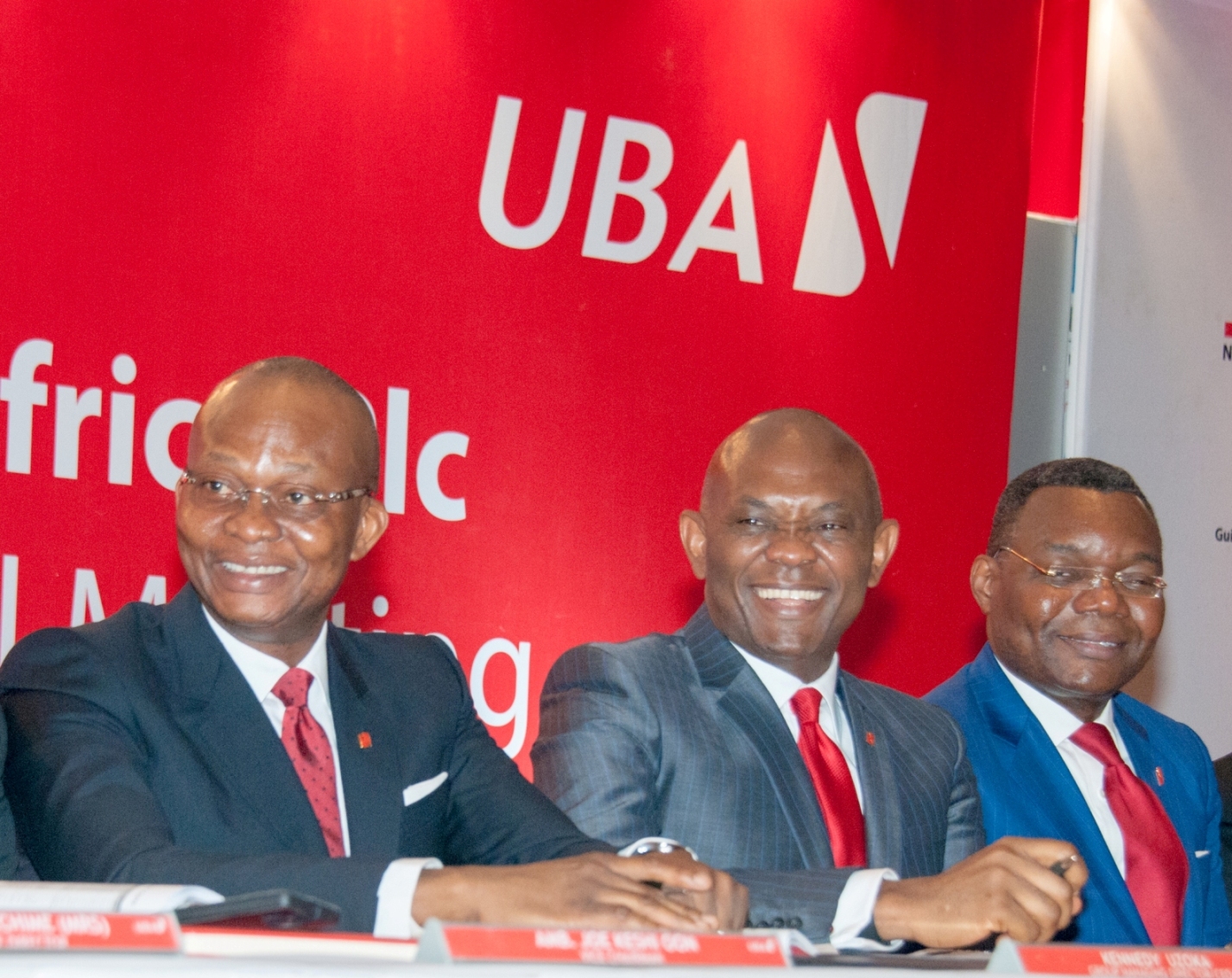
The United Bank of Africa has once again asserted its position as the lion of Nigeria’s banking. Most analysts agree on that, looking at the way it cut through on economic headwinds in the first quarter of 2017.
Quarterly reports, ratings, peer competitiveness, ready shareholders, and a motivated workforce are reasons the UBA will do better as leadership and market share go.
Ending 2016 with N384 billion in earnings, which was 22 percent increase from 2015’s figure, and a 32 percent rise in profit after tax to N91 billion, the bank ramped up N23 billion in the first quarter of 2017. That is 41 percent growth compared to the first quarter of 2016.
“Our performance in the first quarter of the year strengthens our optimism on economic and business recovery in Nigeria and many of our markets across Africa,” said Group Managing Director, Mr Kennedy Uzoka.
“More importantly, this result is evidence of efficiency gains in our pricing, balance sheet management and operations.”
While its Nigerian operations strengthen in terms of bottomlines, the overseas branches are equally faring well.
According to Mr Uzoka, the bank’s external operations contribute 35 percent of its earnings.
“We remained prudent in risk asset creation growing net loans by 2% year-to-date, as we have continued to monitor development in key sectors of the economy to take advantage of emerging bankable opportunities in due time,” he said while commenting on the quarterly report.
The UBA operates in 19 countries across Africa, and has branches in New York, London, and Paris. It serves millions customers in over 1000 business offices and centres where it carries out its retail, commercial and corporate banking, cross border payments and remittances, trade and finance, and other banking services.
Its flying start in 2017 further gets confirmation from Standard and Poor’s early in the month.
According to the international rating agency, the UBA is rated ‘B’ in long-term and ‘B’ short-term global scale counterparty credit ratings.
Analysts at Proshare said S&P’s ‘B’ rating is the highest rating currently assigned to any Nigeria-based financial institution.
“It thus reinforces the respectable quality and strength of UBA, the third largest Nigeria-based bank by total assets, deposits and profits,” the analysts said.
S&P also confirmed that UBA’s earnings will be resilient despite the economic slowdown in Nigeria. “We believe the bank’s capital and earnings under our risk adjusted capital and earnings framework will remain moderate over the next 12-18 months, with its capital adequacy ratio remaining well above minimum regulatory requirements,” the ratings agency noted.
The bank’s capital adequacy ratio was 19.7 percent at year-end 2016, way above the regulatory minimum of 15 percent. S&P believe it will remain stable over the next 12-18 months. Its showings in other indices are also superlative. Its credit losses to decline to about 1.0% in 2017-2018; its average liquidity ratio is doing well, 42 percent as of 2016; it has a stable funding ratio of 143 percent as of last December, thus becoming one of the lowest levels of loan leverage in Nigeria.
It has been a sustained rally for the bank. Which is a mark of its competitiveness in any situation. In the midst of decline Nigeria’s economy experienced last year, UBA still managed to tide over so well that it won five plaques in the Bank of The Year 2016 country awards in Gabon, Congo-Brazzaville, Senegal, Cameroon and Chad at the last annual Bankers Award in London.
Achievement trainers will make us such feat is possible when an organisation has a water-tight philosophy of goal getting. Well, the UBA has one: the three E’s—Enterprise, Excellence, and Execution.
But the GMD thinks that is not all. So he dedicated the awards to the customers whose loyalty, support and patronage, according to him, remain the fountain of the group’s growth and competitive edge in the African continent.
The UBA has over 14 million customers in Africa only. And they are well served by a synergy if technology and an army of highly motivated staff. It means a lot to the bank, especially the GMD, that its human resources remain in high spirits. As the 2016 annual report came out, and shareholders got over N19 billion in dividends, no fewer than 3000 staffers got promotion, too.
“Investment in our human capital is critical to our success,” said Mr Uzoka.
“It is a product of our ability to invest for the long term and create an institution that is built to last. It is the bedrock of our determination to be Africa’s leading customer focused bank.”
All thing being equal, the second quarter reports can only get better.
Source: National Daily










By Adedapo Adesanya
The operating licences of Aso Savings and Loans Plc and Union Homes Savings and Loans Plc have been revoked by the Central Bank of Nigeria (CBN) as part of efforts to strengthen the mortgage sub-sector and enforce compliance with banking regulations.
Mortgage banks are financial institutions that provide home loans and other housing finance products, and so, they are strictly regulated by the CBN to protect customers and ensure the stability of Nigeria’s financial system.
According to a post by the Acting Director of Corporate Communications of CBN, Mrs Hakama Ali, on the apex bank’s X handle on Tuesday, the affected institutions were accused of violating several provisions of the Banks and Other Financial Institutions Act (BOFIA) 2020 and the Revised Guidelines for Mortgage Banks in Nigeria.
The revocation is part of the central bank’s ongoing efforts to maintain a safe and reliable banking sector, protect customers’ deposits, and ensure that only financially sound institutions operate in the mortgage market.
“The breaches included failure to meet the minimum paid-up share capital requirement, insufficient assets to meet liabilities, being critically undercapitalised with a capital adequacy ratio below the prudential minimum, and non-compliance with directives issued by the CBN,” the post noted.
The CBN emphasised that the revocation aligns with its mandate to ensure financial system stability and maintain public confidence in the banking sector, assuring it is committed to promoting a sound and resilient financial system in Nigeria.

By Adedapo Adesanya
A five-member panel of the Supreme Court, led by Justice Lawal Garba, last Friday ruled in favour of Fidelity Bank in its appeal against Sagecom Concepts Limited.
The judgment brings definitive closure to a legacy case that has attracted attention across the financial sector for more than two decades. It also marks a significant victory for Fidelity Bank in a long-running legal dispute.
In a motion dated October 8, 2025, Fidelity Bank sought clarification from the Supreme Court, requesting a consequential order that the judgment debt be paid in Naira. The bank also asked that the interest rate be set at 19.5 per cent per annum rather than 19.5 per cent compounded daily.
It also requested the exchange rate used for conversion be the rate applicable as of the date of the High Court judgment, in line with the Supreme Court’s decision in Anibaba v. Dana Airlines.
Fidelity Bank further requested the judgment debt be fixed at N30,197,286,603.13 and that interest on this amount be payable at 19.5 per cent per annum until full settlement.
In the judgment delivered by Justice Adamu Jauro, the apex court granted the bank’s first three prayers but declined the fourth and fifth. As a result, the judgment sum will be paid in Naira at an annual interest rate of 19.5 per cent, rather than the daily compounded rate previously awarded by the High Court.
The Supreme Court equally affirmed that the applicable exchange rate should be the rate as of the date of the High Court judgment, consistent with its earlier decision in Anibaba v. Dana Airlines.
The dispute originated from a legacy transaction involving the former FSB International Bank, which merged with Fidelity Bank in 2005. It stemmed from a 2002 credit facility extended to G. Cappa Plc and subsequent legal proceedings tied to the collateral.
This ruling provides finality for years of litigation and confirms a significantly lower liability than the N225 billion previously speculated in the review of decisions leading up to the decision.
By Adedapo Adesanya
The operating licences of all legacy Bureau De Change (BDC) operators who failed to meet the new licensing requirements have been revoked by the Central Bank of Nigeria (CBN).
This happened after the central bank streamlined the BDCs to 82 in order to sanitise the foreign exchange (FX) market in the country.
The latest development was revealed by the apex bank in its Frequently Asked Questions document on the current reform of the bureau de change, published on its website on Tuesday.
According to the document, the CBN has now enforced the final cutoff, declaring that any BDC that did not meet the requirements by the end of November is no longer recognised.
“The guidelines provided a transition timeline of six months from the effective date, 3 June 2024, with a deadline of 3 December 2024, for all existing BDCs to meet the requirement of the new Guidelines or lose their licence(s). However, the management of the CBN graciously extended this deadline by another six months, which ended 3 June 2025, to give ample time for as many legacy BDCs desirous of meeting the new requirements to do so.
“Consequently, any legacy BDC that failed to meet the requirements of the new Guidelines as of 30 November 2025 has ceased to be a BDC, as its licence no longer exists. Please visit the CBN website for the updated list of existing BDCs in Nigeria,” the apex bank said.
According to the CBN, before its latest decision, an extended compliance window was granted under the revised BDC Guidelines. Existing operators were initially given six months, June 3 to December 3, 2024, to satisfy the new regulatory conditions.
The CBN later granted an additional six-month extension, which elapsed on June 3, 2025, to allow more operators to align with the updated standards.
The new measures form part of broader efforts by the CBN to strengthen transparency, compliance, and stability within Nigeria’s foreign exchange market.
The new CBN regulatory framework for BDCs, introduced in February 2024, mandated BDC operators to meet higher capital requirements. Tier-1 operators are required to meet a minimum capital requirement of N2bn, while Tier-2 operators must meet N500m as MCR.
The bank added that it would continue to receive applications on its Licensing, Approval and Requests Portal from prospective promoters, and those that meet the criteria will be considered for a license.
However, the CBN said it reserves the right to discontinue the licensing of BDCs at any time.










-
 Feature/OPED6 years ago
Davos was Different this year
-
Travel/Tourism9 years ago
Lagos Seals Western Lodge Hotel In Ikorodu
-

 Showbiz3 years ago
Estranged Lover Releases Videos of Empress Njamah Bathing
-
 Banking7 years ago
Sort Codes of GTBank Branches in Nigeria
-

 Economy3 years ago
Subsidy Removal: CNG at N130 Per Litre Cheaper Than Petrol—IPMAN
-

 Banking3 years ago
First Bank Announces Planned Downtime
-

 Banking3 years ago
Sort Codes of UBA Branches in Nigeria
-

 Sports3 years ago
Highest Paid Nigerian Footballer – How Much Do Nigerian Footballers Earn