
Economy
African Corridor Management Alliance to Strengthen Economic Corridors


By Dipo Olowookere
The Economic Commission for Africa, through the African Trade Policy Centre (ATPC) is holding a meeting in collaboration with the Walvis Bay Corridor Group and other Corridor management Institutions (CMIs) to establish the African Corridor Management Alliance.
The Alliance is expected to coordinate the sharing of best practices and other strategies in support of the development and management of economic corridors on the Continent.
Held against the backdrop of promoting corridors as vehicles for economic transformation and boosting intra-African trade, the inaugural meeting in Walvis Bay, Namibia will also map out a strategy for the new organization.
In his welcoming address, Willem Goeiemann, Permanent Secretary of Works and Transport of Namibia said, “The process of establishing ACMA is a major milestone in defining Corridor Management Institutions’ performance and prospects in the integrated management of economic corridors through enhanced investment in infrastructure.
“With effective management, economic corridors will improve physical connectivity between the Corridor States, thereby enhancing access to markets, while expanding economies of scale for value chain.”
Stephen Karingi, Director of the Capacity Development Division of ECA, in his opening statement highlighted the potential for ACMA to contribute to regional integration and intra-African trade particularly in the area of trade facilitation. He stressed that the establishment of ACMA is timely in view of the 2017 deadline for the conclusion of negotiations to establish the Continental Free Trade Area (CFTA).
David Luke, Coordinator of the African Trade Policy Centre (ATPC) drew attention to ECA’s historic role in helping to create specialized institutions to enhance economic integration on the Continent.
“The African Regional Standards Organization and the African Alliance for Electronic Commerce are examples of ECA’s contribution to institution building in this regard,” he said. He expressed the hope that the establishment of ACMA as an umbrella organization can become a channel through which ECA’s engagement with the CMIs can be further strengthened.
For his part, Johny Smith, Chief Executive Officer of the Walvis Bay Corridor Group and interim chairperson of ACMA noted that through ACMA, CMIs would identify the necessary conditions that should be realized for corridor development initiatives to play a catalytic role in bringing together trade, infrastructure, spatial initiatives, industrial development and other economic activities to foster market integration in the Continent.
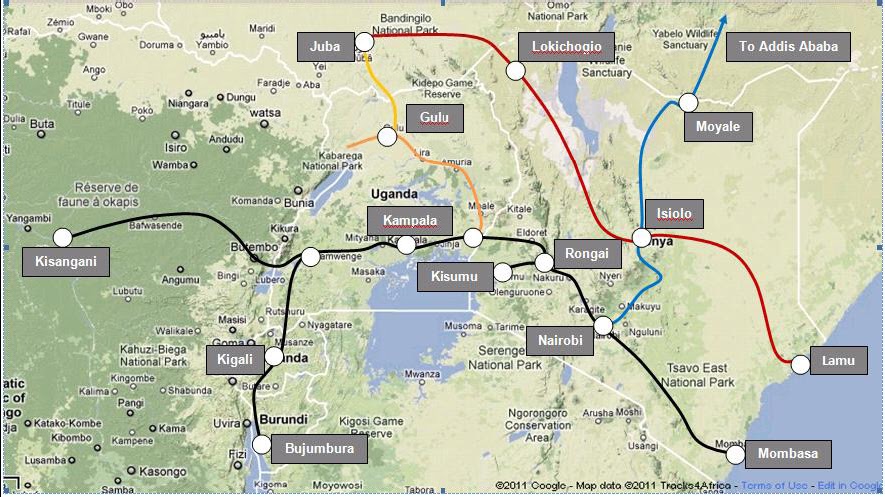
The meeting, which is hosted by the Walvis Corridor Group brought together Heads of several CMIs, representatives from the ECA, the African Development Bank (AfDB), the African Union Commission (AUC), the NEPAD Agency, the African-Export-Import bank (Afrexim Bank) and various other economic integration stakeholders. Among the most prominent CMIs on the continent are the Abidjan-Lagos Corridor, the Northern Corridor that links Mombasa to Kigali and Kampala, the Walvis Bay Corridor with routes to seven southern African countries and the Maputo Corridor connecting Mozambique, Swaziland and South Africa.




By Adedapo Adesanya
Nigeria and the United Kingdom are moving to tackle a long-standing £1.2 billion discrepancy in their trade records, with both countries agreeing to develop a structured data-sharing system aimed at improving transparency and accountability across bilateral commerce.
The agreement was reached during a high-level meeting in London on March 18, 2026, held on the sidelines of President Bola Tinubu’s State Visit, under the Nigeria–United Kingdom Enhanced Trade and Investment Partnership (ETIP).
According to a statement by Nigeria Customs Service (NCS) spokesperson, Mr Abdullahi Maiwada, the talks signal a shift toward deeper operational cooperation between both countries’ customs authorities.
At the centre of the discussions was a persistent mismatch in trade figures. While Nigeria recorded about £504 million worth of imports from the UK in 2024, British records show exports to Nigeria at approximately £1.7 billion for the same period, leaving a gap of roughly £1.2 billion.
To address this, the two countries agreed to explore a pre-arrival data exchange framework that will connect their digital customs systems, with the aim of improving risk management, reconciling trade data, and strengthening compliance monitoring along the corridor.
The meeting was led by Comptroller-General of Customs, Mr Adewale Adeniyi and Ms Megan Shaw, Head of International Customs and Border Engagement at His Majesty’s Revenue and Customs (HMRC), and also focused on customs modernisation and data transparency.
Mr Adeniyi underscored the broader economic implications of the initiative, noting that customs collaboration plays a central role in trade facilitation.
“Effective customs cooperation remains a critical enabler of economic growth and sustainable trade development,” he said.
He added that “customs administrations serve as the frontline institutions responsible for ensuring that trade flows between both countries are transparent, secure, and mutually beneficial.”
The Nigeria–UK trade relationship spans multiple sectors, including industrial goods, agriculture, energy, and consumer products — all of which depend heavily on efficient port and border operations.
Beyond addressing data gaps, the meeting also highlighted ongoing modernisation efforts on both sides. The UK showcased advancements in artificial intelligence-driven trade tools, digital verification systems, and real-time analytics designed to enhance cargo processing, risk assessment, and border security.
The engagement further produced plans for a Customs Mutual Administrative Assistance Framework, alongside technical groundwork for capacity building, knowledge exchange, and a joint engagement mechanism under the ETIP platform.
Mr Maiwada said the outcomes are expected to strengthen Nigeria’s trade ecosystem and support broader economic reforms.
“The NCS has reaffirmed its commitment to deepening international partnerships as part of a broader modernisation agenda designed to promote transparency, efficiency, and competitiveness in Nigeria’s trading environment,” the statement said.
It added that “insights from this engagement will strengthen its operational capacity, enhance trade facilitation, and support Nigeria’s economic reform objectives under the Renewed Hope programme.”
By Adedapo Adesanya
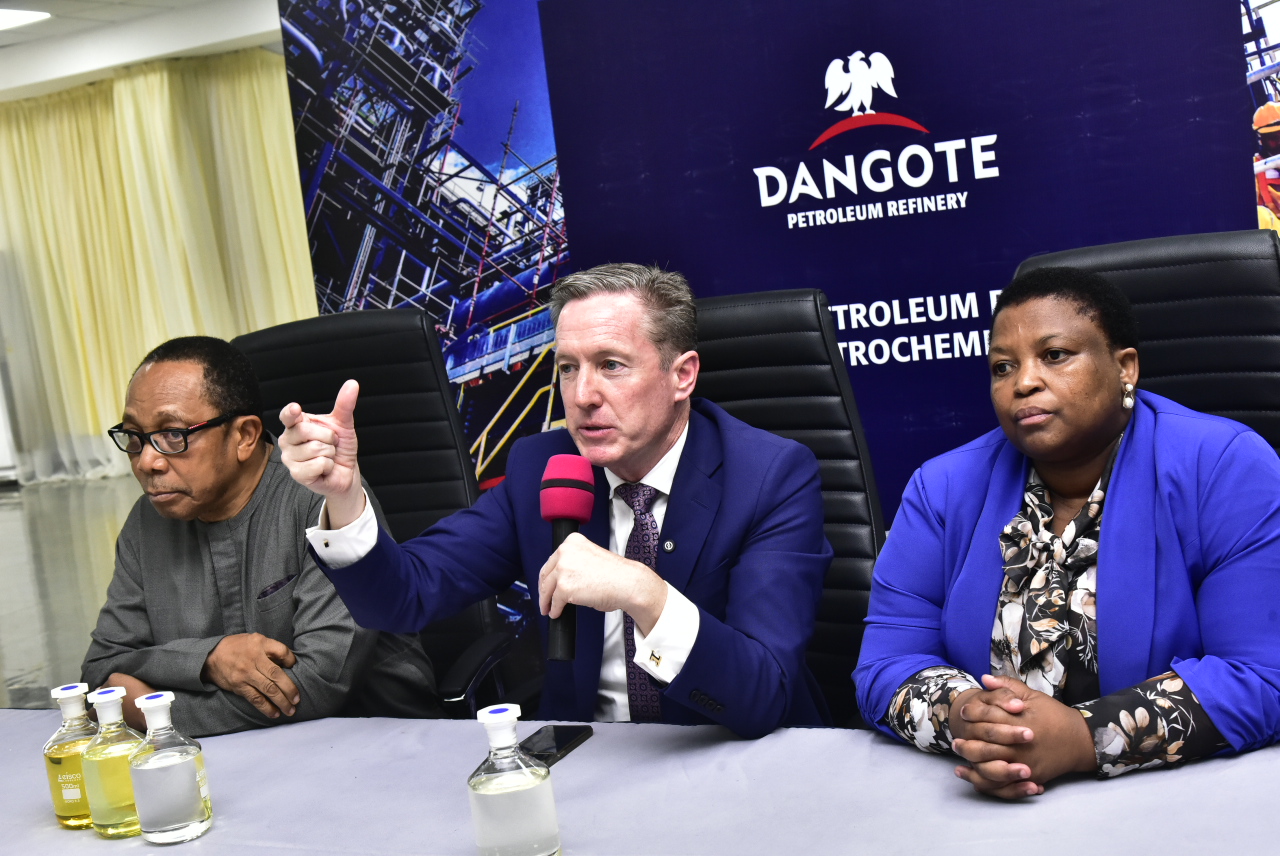
Dangote Petroleum Refinery imported a total of $3.74 billion) worth of crude oil in 2025, to make up for shortfalls that threatened the plant’s 650,000-barrel-a-day operational capacity.
The data disclosed in the Central Bank of Nigeria’s Balance of Payments report noted that “Crude oil imports of $3.74 billion by Dangote Refinery” contributed to movements in the country’s current account position, as Nigeria imported crude oil worth N5.734 trillion between January and December 2025.
Last year, as the Nigerian National Petroleum Company (NNPC), which is the refinery’s main trade partner and minority stakeholder, faced its challenges, the company had to forge alternative supply links. This led to the importation of crude from Brazil, Equatorial Guinea, Angola, Algeria, and the US, among others.
For instance, in March 2025, the company said it now counts Brazil and Equatorial Guinea among its global oil suppliers, receiving up to 1 million barrels of the medium-sweet grade Tupi crude at the refinery on March 26 from Brazil’s Petrobras.
Meanwhile, crude oil exports dropped from $36.85 billion in 2024 to $31.54 billion in 2025, representing a 14.41 per cent decline, further shaping the external balance.
The report added that the refinery’s operations also reduced Nigeria’s reliance on imported fuel, noting that “availability of refined petroleum products from Dangote Refinery also led to a substantial decline in fuel imports.”
Specifically, refined petroleum product imports fell sharply to $10.00 billion in 2025 from $14.06 billion in 2024, representing a 28.9 per cent decline, while total oil-related imports also eased.
However, this was offset by a rise in non-oil imports, which increased from $25.74 billion to $29.24 billion, up 13.6 per cent year-on-year, reflecting sustained demand for foreign goods.
At the same time, the goods account remained in surplus at $14.51 billion in 2025, rising from $13.17 billion in 2024, supported largely by activities linked to the Dangote refinery and improved export performance in other segments.
The CBN stated that the stronger goods balance was driven by “significant export of refined petroleum products worth $5.85bn by Dangote Refinery,” alongside increased gas exports to other economies.
Nigeria posted a current account surplus of $14.04 billion in 2025, lower than the $19.03 billion recorded in 2024 but significantly higher than $6.42 billion in 2023. The decline from 2024 was driven partly by structural changes in oil trade flows, including crude imports for domestic refining, according to the report.
Pressure on the current account came from higher external payments. Net outflows for services rose from $13.36 billion in 2024 to $14.58 billion in 2025, driven by increased spending on transport, travel, insurance, and other services.
Similarly, net outflows in the primary income account surged by 60.88 per cent to $9.09 billion, largely due to higher dividend and interest payments to foreign investors.
In contrast, secondary income inflows declined slightly from $24.88 billion in 2024 to $23.20 billion in 2025, as official development assistance and personal transfers weakened, although remittances remained a key source of inflow, as domestic refineries grappled with persistent feedstock shortages, exposing a deepening supply paradox in the country’s oil sector.
This comes despite the Federal Government’s much-publicised naira-for-crude policy designed to prioritise local supply.


By Aduragbemi Omiyale
An application has been submitted by Sovereign Trust Insurance Plc for its proposed N5.0 billion rights issue.
The application was sent to the Nigerian Exchange (NGX) Limited, and it is for approval to list shares from the exercise when issued to qualifying shareholders.
A notice signed by the Head of Issuer Regulation Department of the exchange, Mr Godstime Iwenekhai, disclosed that the request was filed on behalf of the underwriting firm by its stockbrokers, Cordros Securities Limited, Dynamic Portfolio Limited and Cedar of Lebanon Securities.
The company intends to raise about N5.022 billion from the rights issue to boost its capital base, as demanded by the National Insurance Commission (NAICOM) for insurers in the country.
Sovereign Trust Insurance plans to issue 2,510,848,144 ordinary shares of 50 Kobo each at N2.00 per share on the basis of three new ordinary shares for every 17 existing ordinary shares held as of the close of business on Tuesday, March 17, 2026.
“Trading license holders are hereby notified that Sovereign Trust Insurance has through its stockbrokers, Cordros Securities Limited, Dynamic Portfolio Limited and Cedar of Lebanon Securities, submitted an application to Nigerian Exchange Limited for the approval and listing of a rights issue of 2,510,848,144 ordinary shares of 50 Kobo each at N2.00 per share on the basis of three new ordinary shares for every 17 existing ordinary shares held as of the close of business on Tuesday, March 17, 2026,” the notification read.












-
 Feature/OPED6 years ago
Davos was Different this year
-
Travel/Tourism10 years ago
Lagos Seals Western Lodge Hotel In Ikorodu
-

 Showbiz3 years ago
Estranged Lover Releases Videos of Empress Njamah Bathing
-
 Banking8 years ago
Sort Codes of GTBank Branches in Nigeria
-

 Economy3 years ago
Subsidy Removal: CNG at N130 Per Litre Cheaper Than Petrol—IPMAN
-

 Banking3 years ago
Sort Codes of UBA Branches in Nigeria
-

 Banking3 years ago
First Bank Announces Planned Downtime
-

 Sports3 years ago
Highest Paid Nigerian Footballer – How Much Do Nigerian Footballers Earn