

Economy
Currency Futures Trading Volume Drops as Rates Converge

By Quantitative Financial Analytics
Since the Central bank of Nigeria (CBN) came up with the investor foreign exchange rate window and other actions leading to convergence of rates to around N370 per Dollar, the volume of trade in the Nigerian currency futures market has been recording dramatic decline.
The slowdown in volume has been so apparent that the NGUS MAY 30, 2018, which replaced the NGUS MAY 24, 2017 that matured on May 24, has not attracted a single trade ever, an unusual and unprecedented occurrence.
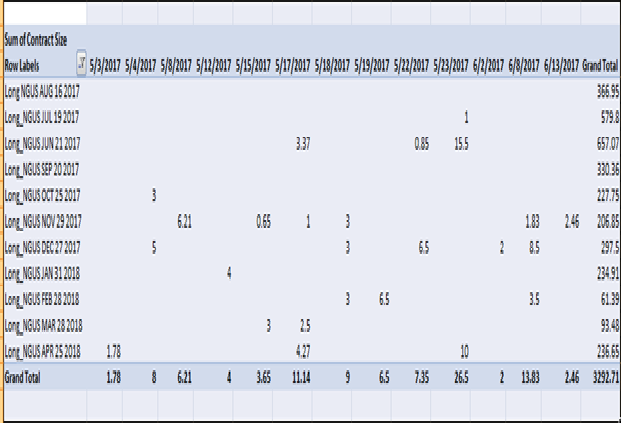
According to analysis of open interest report conducted by Quantitative Financial Analytics, the average daily volume for currency futures in April was 34.955 contracts or $34.95 million.
The corresponding average for March was 14.5 contracts or $14.486 million. That daily average tapered to just 8.41 contracts in May.
On day count basis, the market had witnessed daily activities on at least 15 of each month’s 22 trading days in the past but so far in June, only 3 of the 14 trading days witnessed any activities.
Though average daily volume has fallen since April, if things continue the way they are, June’s trading activity may be the least in the history of the currency futures market in Nigeria.
At the moment, the NAFEX rate is about N368/$, most of the futures open contracts have contract prices of about N374/$ while the parallel market settles at about N370/$, all pointing to a convergence of some sort.
According to a recent report by Fitch, there has been an improvement in FX liquidity in Nigeria following massive interventions by the CBN and the introduction of the NAFEX window.
Good as this improvement is, it does appear that it has or is killing the incentive to use the currency futures market and one wonders if some of the CBN policies are becoming cannibalistic.
The currency futures market should not be allowed to die because such markets play vital roles in both price discovery and risk management, among others.
Source: Quantitative Financial Analytics




By Adedapo Adesanya
The Monetary Policy Committee (MPC) of the Central Bank of Nigeria (CBN) has retained all key monetary policy parameters following the conclusion of its two-day meeting on July 21, 2026, on Tuesday, maintaining its tight monetary policy stance to curb inflation and support macroeconomic stability.
According to the Governor of the apex bank, Mr Yemi Cardoso, who chaired the committee, the Monetary Policy Rate (MPR), which serves as the benchmark interest rate, remains at 26.50 per cent. The MPC also retained the asymmetric corridor around the MPR at +50 basis points and -450 basis points.
In addition, the Cash Reserve Ratio (CRR) for commercial banks was left unchanged at 45.00 per cent, while the CRR for merchant banks remains at 16.00 per cent. The committee also retained the CRR on non-Treasury Single Account (Non-TSA) public sector deposits at 75.00 per cent, with the liquidity ratio at 30.00 per cent.
The decision reflects the apex bank’s continued commitment to containing inflationary pressures through a restrictive monetary policy while safeguarding the resilience of Nigeria’s financial system amid ongoing macroeconomic adjustments.
By keeping all policy tools unchanged, the MPC signalled its intention to continue managing excess liquidity in the banking sector and maintain stability in financial markets.
The move is also expected to provide greater policy certainty for investors and businesses monitoring the country’s monetary policy direction.
The latest decision also means borrowing costs are likely to remain elevated in the near term as the central bank continues to prioritise price stability over monetary easing.
Analysts had expected the CBN committee to retain the rate after Nigeria’s headline inflation came in at 15.91 per cent as of June 2026, marking a slight decline from 15.93 per cent in May.
However, even as overall price growth has moderated significantly compared to previous periods, food inflation remains a persistent challenge, accelerating to 17.52 per cent in June.


By Aduragbemi Omiyale
Shareholders of Unilever Nigeria Plc will receive an interim dividend of N2 per share, the board of the organisation has said.
The cash reward was announced after the company released its financial statements for the first half of the year ended June 30, 2026.
The payment will be made on Friday, August 14, 2026, only to investors whose names appear on the Register of Members at the close of business on Friday, July 31, 2026.
A quick look at the financial performance of the firm in the first six months of this year showed that revenue improved by 22.22 per cent to N119.9 billion from the N98.1 billion achieved in the corresponding period of last year.
A rise in earnings also resulted in a 16.43 per cent surge in cost of sales, though this did not shrink the gross profit, which rose by 29.93 per cent to N54.7 billion from N42.1 billion. The operating profit stood at N24.4 billion in the period under review, higher than N18.8 billion in the same period of 2025, while the net finance income contracted by 9.43 per cent to N4.8 billion from N5.3 billion due to elevated borrowing costs.
Business Post reports that despite higher taxes paid in the first six months of 2026, the net profit grew by 8.33 per cent to N15.6 billion from N14.4 billion, enabling the board to pass on value to shareholders for their faith in the firm.

By Adedapo Adesanya
The NASD Over-the-Counter (OTC) Securities Exchange opened the week with a 0.52 per cent rise on Monday, July 20, driven by renewed buying interest.
The volume of securities traded during the opening session surged by 6,663.3 per cent to 52.6 million units from the previous 777,002 units, and the value of securities rose by 200.9 per cent to N191.2 million from the preceding session’s N104.2 million, while the number of deals depreciated by 15.2 per cent to 28 deals compared to the preceding session’s 33 deals.
Great Nigeria Insurance (GNI) Plc remained the most active stock by value on a year-to-date basis, with 3.4 billion units sold for N8.4 billion, followed by Infrastructure Credit Guarantee (Infracredit) Plc with 2.3 billion units valued at N6.5 billion in trades, and Central Securities Clearing System (CSCS) Plc with 75.4 million units exchanged for N5.3 billion.
GNI Plc also closed the day as the most traded stock by volume on a year-to-date basis, with 3.4 billion units worth N8.4 billion, followed by Infracredit Plc with 2.3 billion units transacted for N6.5 billion, and Resourcery Plc with 1.1 billion units traded for N415.7 million.
Yesterday, there were two price gainers and three price losers, led by FrieslandCampina Wamco Nigeria Plc, which slid by 66 Kobo to end at N141.15 per unit versus last Friday’s N141.81 per unit, Food Concepts Plc lost 24 Kobo to close at N2.31 per share versus N2.55 per share, and Geo-Fluids Plc declined by 17 Kobo to settle at N2.25 per unit compared with the previous closing price of N2.42 per unit.
Conversely, CSCS Plc chalked up N5.19 to close at N99.33 per share versus N94.14 per share, and Mass Telecoms Plc appreciated by 3 Kobo to sell at 35 Kobo per unit from 32 Kobo per unit.
As a result, the market capitalisation increased by N13.57 billion to N2.606 trillion from N2.593 trillion, and the NASD Security Index (NSI) gained 22.6 points to quote at 4,343.27 points, in contrast to the previous 4,320.67 points.
