

General
Politicians Named In New Leaked Offshore Files From The Bahamas


By Ebitonye Akpodigha
Months after some top politicians and personalities from across the globe were linked to offshore companies in Panama, another offshore files leaked few days ago have again linked a new set of politicians to firms in the Bahamas.
According to the International Consortium of Investigative Journalists (ICIJ), which leaked the famous Panama Papers, a former European Union official was named among those operating companies in the Bahamas.
A cache of leaked documents provides names of politicians and others linked to more than 175,000 Bahamian companies registered between 1990 and 2016
For years, Neelie Kroes travelled Europe as one of the continent’s senior officials, warning big corporations that they couldn’t “run away” from the European Union’s rules. The Dutch politician sympathized with average citizens who worried they’d been left to pay the bills “as infringers cream off the extra profits.”
As the EU’s commissioner for competition policy from 2004 until 2010, she was Europe’s top corporate enforcer and made Forbes magazine’s annual list of the “World’s 100 Most Powerful Women” five times.
What Kroes never told audiences – and didn’t tell European Commission officials in mandatory disclosures – was that she had been listed as a director of an offshore company in the Bahamas, the Caribbean tax haven whose secrecy and tax structures have attracted multinational companies and criminals alike.
Kroes was listed as director of a Bahamian company from 2000 to 2009, according to documents reviewed by the International Consortium of Investigative Journalists.
Kroes, through a lawyer, told ICIJ and media partners that she did not declare her directorship of the company because it was never operational. Kroes’ lawyer blamed her appearance on company records as “a clerical oversight which was not corrected until 2009.” Her lawyer said the company, set up through a Jordanian businessman and friend of Kroes, had been created to investigate the possibility of raising money to purchase assets – worth more than $6 billion – from Enron Corp., the American energy giant. The deal never came off, and Enron later collapsed amid a massive accounting scandal.
Emily O’Reilly, the European Ombudsman with powers to investigate alleged breaches of EU rules and procedures, did not comment on the Kroes’ case but said: “When the rules are breached, whether accidentally or otherwise, the negative impression it leaves with the public tends to resonate more strongly than any positive counter steps subsequently undertaken.”
Details of Kroes’ link to the offshore company are among the revelations found in a new leak of documents, received by the German newspaper Süddeutsche Zeitung and shared with ICIJ, that disclose details behind companies incorporated in the Bahamas. The cache of 1.3 million files from the island nation’s corporate registry provides names of directors and some owners of more than 175,000 Bahamian companies, trusts and foundations registered between 1990 and early 2016.
Today ICIJ, Süddeutsche Zeitung and other media partners are making this information available to the public. This creates, for the first time, a free, online and publicly-searchable database of offshore companies set up in the Bahamas. This information has been combined with data from the Panama Papers and other leaked offshore documents to add additional heft to one of the largest public databases of offshore entities in history.
The new information reveals previously unknown or little-reported connections to companies owned or run by current or former politicians from the Americas, Africa, Europe, Asia and the Middle East.
In the Bahamas’ capital, Nassau, company documents can be consulted in person. An online registry, in theory, serves the same purpose. Yet the information in the online registry maintained by the Bahamian government is often incomplete. In addition, retrieving one company’s documents will cost at least $10, in conflict with the recommendation of the international association of company registries, which discourages search fees.
The data released today involve the basic building blocks of offshore companies: a company’s name, its date of creation, the physical and mailing address in the Bahamas and, in some cases, the company’s directors. At a basic level, this information is crucial to day-to-day commerce. In other cases, police, detectives and fraud investigators use registries as starting points on the trail of wrongdoing.
“Corporate registries are incredibly important,” said Debra LaPrevotte, a former U.S. Federal Bureau of Investigation special agent whose work included tracing billions of dollars in bribes and corruption proceeds hidden in tax havens for politicians from Ukraine, Nigeria and Bangladesh. “Offshore companies are often used as intermediaries to facilitate money laundering and, frequently, the companies are only used to open bank accounts, thus the corporate registry documents, which might identify the beneficial owners, are part of the evidence.”
Fresh insights
Unlike the Panama Papers, 11.5 million often-detailed emails, contracts, audio recordings and other documents from one law firm, the information listed in the new Bahamian documents is plainer — if still fundamental — in content. The new data does not make it clear, for example, whether directors named in connection with a Bahamian firm truly control the company or act as nominees, employees-for-hire who serve as the face of the company but have no involvement in its operations.
When paired with the Panama Papers, the Bahamas data provide fresh insights into the offshore dealings of politicians, criminals and executives as well as the bankers and lawyers who help move money.
The new leaked documents include the names of 539 registered agents— corporate middlemen who serve as intermediaries between Bahamian authorities and customers who wish to create an offshore company. Among them is Mossack Fonseca, the law firm whose leaked files formed the basis of the Panama Papers. The firm set up 15,915 entities in the Bahamas, making it Mossack Fonseca’s third busiest jurisdiction. At one point, Bahamian companies were among Mossack Fonseca’s best-sellers.
The Panama Papers show how Mossack Fonseca helped clients use Bahamian secrecy to keep their name out of public filings and how the law firm undermined the global push towards tax transparency.
Beyond Mossack Fonseca and the Panama Papers, the leaked Bahamian files reveal details of the offshore activities of prime ministers, cabinet ministers, princes and convicted felons. It is generally not illegal to own or direct an offshore company, and there are legitimate business reasons in many cases for setting up an offshore structure. But transparency experts say it’s important that public officials disclose their connections to offshore entities.
The political and government figures named in the leaked documents include Colombia’s minister of mines and energy between 1999 and 2001, Carlos Caballero Argáez. He was listed as president and secretary of a Bahamian company, Pavc Properties Inc., between 1997 and 2008. Caballero Argáez also appeared as director of Norway Inc., a company registered in the Bahamas between 1990 and 2015.
Argáez told ICIJ that Norway Inc. held a Miami bank account owned by his father. The account’s assets were distributed to his sons upon his death, Argáez said. Pavc Properties owned an apartment in Miami, Argáez said, and his relationship with the company ended in 2008, when he sold his shares. Argáez said he and others chose the Bahamas on lawyers’ advice. He denied any conflict of interest. He said the company was set in the Bahamas for “tax purposes.”
In the case of Kroes, the former senior EU official, the records show that she was director of Mint Holdings Ltd from July 2000 to October 2009. The company was registered in the Bahamas in April 2000 and is currently active.
In response to questions from ICIJ, the Guardian and Dutch newspapers Trouw and Het Financieele Dagblad, Kroes acknowledged that she did not disclose her connection to this company in her declarations of personal financial interests when she first became competition commissioner in 2004 or in later declarations as she continued serving as a high-level EU official.
Kroes served as competition commissioner from November 2004 to February 2010 and as digital commissioner from February 2010 to November 2014.
EU rules require that European commissioners declare all their economic interests in the previous 10 years, including governing, supervisory and advisory positions in companies devoted to commercial and economic activities.
Mint Holdings’ other directors included Jordanian businessman Amin Badr-El-Din. Badr-El-Din was still listed as holding that position in documents from July 2015. The Bahamas online corporate registry does not list the company’s directors.
Badr-El-Din founded UAE Offsets Group, a company that reinvests proceeds from weapons sales into the United Arab Emirates. UAE Offsets Group previously contracted with the weapons manufacturing giant Lockheed Martin Corp. Kroes worked as a lobbyist for Lockheed prior to being named EU competition commissioner.
When she was appointed EU competition commissioner, Kroes placed her money in a blind trust and promised to avoid adjudicating on companies with which she had a connection. While her opponents worried that she might be soft on the business world, Kroes earned the nickname “Steely Neelie” as she imposed record fines on companies that fixed prices and organized unfair monopolies.
Since stepping away from her EU positions, however, she has criticized her successor as competition minister for a ruling declaring that tech giant Apple owes Ireland €13 billion in unpaid taxes.
Kroes, 75, is currently a director or board member of several companies and serves as an advisor to Bank of America Merrill Lynch and Uber. She remains an influential member of the Netherlands’ ruling People’s Party for Freedom and Democracy.
Kroes rejected any criticism of her business activities. Her lawyer said she denied that “she was ever conflicted by ties to the private sector.”
The declarations to the European Union that omitted mention of Mint Holdings were “made in good faith” and “to the best of her knowledge,” Kroes’ lawyer said. “The assumption was that she was no longer a director after the company was no longer needed.”
“Mrs Kroes will inform the President of the European Commission of this oversight and will take full responsibility for it,” Kroes’ lawyer said.
Badr-El-Din said “Mint Holdings was established as a special purpose vehicle to manage the acquisition of international energy assets, principally from Enron. That deal fell through in late summer of 2000.”
If the deal had gone through, said an attorney for Badr-El-Din, the company was to become “the world’s premier gas company, leading industry away from oil and coal” and reduce Europe’s dependency on Russia’s energy monopoly.
Badr-El-Din’s role in the proposed purchase of Enron’s global assets had been previously disclosed by The New York Times, but Kroes’ involvement in the potential deal apparently had never been reported.
Kroes continued being listed as a director of Mint Holdings until 2009 because the “lawyers involved did not carry out all the instructions and terminate Mrs Kroes’ directorship with Mint Holding,” Badr-El-Din said. “Once these clerical oversights came to light in 2009, they were corrected.”
The Switzerland of the West
The Bahamas is a constellation of 700 islands, many smaller than a square mile. It is one of a handful of micro nations south of the United States whose confidentiality laws and reluctance to share information with foreign governments gave rise to the term “Caribbean curtain.”
For nearly a century, the Bahamas has been on the radar of tax officials around the world.
In the 1930s, the U.S. Internal Revenue Service investigated Americans who avoided taxes in Switzerland and the Bahamas, which once sold itself as the “Switzerland of the West.” The focus intensified in the 1960s when U.S. investigators noticed an uptick in the use of the Bahamas by organized crime bosses. U.S. bank assets in the Bahamas, meanwhile, ballooned eight times between 1973 and 1979. By the end of the 1970s, one study reported that the “flow of criminal and tax evasion money” into the Bahamas was $20 billion a year.
The Caribbean nation was not easy to penetrate.
To peek behind the curtain, a clandestine U.S. government project named “Operation Tradewinds” used IRS agents who paid an informant to enter the bedroom of a Bahamian banker visiting Miami and to remove his briefcase. At a nearby restaurant, another IRS informant provided the oblivious banker with “female entertainment.”
The briefcase held a goldmine of information from one Bahamian bank on 308 U.S. account holders, including mafia kingpins, celebrities and corporate moguls, who reportedly held as much as a quarter of a billion dollars.
Although the operation led to criminal prosecutions and $100 million in tax penalties, it was scrapped in 1975 after congressional outcry into the IRS’s use of informants. A U.S. court later declared the briefcase search “flagrantly illegal.”
In 2000, the Organisation for Economic Co-operation and Development, the world’s leading tax policy forum, placed the Bahamas on a blacklist of countries that aid tax dodging. After the Bahamas hurriedly introduced nine new laws, the OECD removed it from the blacklist in 2001. In 2009, though, the OECD put the Bahamas on the organization’s “gray list,” a less severe categorization that nonetheless signified nonconformity with international standards.
The Bahamas is a staple of U.S. tax evasion investigations. Walter C. Anderson, a Washington, D.C., telecommunications executive who disguised his ownership of companies through shell entities in the British Virgin Islands and the Bahamas, was sent to prison in 2007 for evading more than $200 million in income taxes. In 2007, billionaire real estate developer Igor Olenicoff pleaded guilty to a federal tax felony relating to misleading tax returns and the quiet transfer of $196 million into the Bahamas. Olenicoff, who chaired two Bahamian companies with bank accounts on the island, told Forbes earlier this year “that his offshore law firm of choice was in the Bahamas.”
Years later, the Bahamas emerged as a common thread in the U.S. Department of Justice’s crackdown on Swiss banking giant UBS. Between 2009 and 2014, the agency took criminal actions against U.S. citizens and residents with offshore dealings in the Bahamas, including a consultant from California, a steel executive from Illinois, a computer executive from Ohio, a Texan oil industry consultant, a Florida hotel developer and a New Mexico farmer.
In many cases, U.S. investigators struggled to know where to begin. Bahamian law requires the names of directors, who have complete power over offshore companies, to be filed with the national registrar. Yet the names are not always available online and directors’ names cannot be searched individually or without preexisting knowledge of the Bahamian company’s name. That makes it difficult to check whether a public official or a corporate executive is linked to companies chartered in the Bahamas.
In the new documents, for example, Exxon Azerbaijan Caspian Sea Limited, the energy giant’s company in the repressive yet oil-rich nation Azerbaijan lists no directors in the Bahamas registry. Yet there are 19 directors listed in the documents seen by ICIJ. The Bahamian company Equatorial Guinea LNG Holdings Limited shows no directors in the Bahamas’ public registry but, in files reviewed by ICIJ, six well-connected Equatorial Guineans appear, including the First Lady’s brother and four current and former ministers of energy.
Jason Sharman, who co-authored a survey of information from 40 corporate registers around the world, said the names of offshore company directors are basic information that should be easily accessible to the public.
These days, the Bahamas, a one-hour plane ride from Miami to the capital, Nassau, claims to be cleaner than ever. Yet doubts persist.
In 2014, the most recent review of the Bahamas’ anti-money laundering systems by the OECD faulted the country on half of the core measures used to judge countries’ compliance with international standards. This included no requirement for banks or financial institutions to know the real identity of a company or trust owner. Although the OECD now considers the Bahamas compliant, in June 2015, the European Union listed the Bahamas and 30 other countries as uncooperative tax havens.
Nicholas Shaxson, author of Treasure Islands: Tax Havens and the Men Who Stole the World, said the Bahamas is one of the handful of tax havens with a riskier and wilder reputation than bigger offshore jurisdictions such as Switzerland.
The Bahamas is “on a par with Panama in terms of its thirst for and tolerance of dirty money,” said Shaxson.
Recently, Shaxson said, as governments push tax havens to share banking and financial information with national tax agencies concerned about offshore evasion by citizens, the Bahamas has pushed back.
“They are saying ‘While everyone else is being transparent, your secrets are safe with us,’” said Shaxson. “Bahamas has also long taken an attitude of selective noncompliance with its own laws, and it is now pushing out this message with a nudge, nudge, wink, wink.”
Bahamian authorities told ICIJ that the country honours its international obligations and cooperates with international authorities. The Bahamas “does not tolerate dirty money,” authorities said, noting it “has in many areas been rated as ‘largely compliant’ with international standards.”
Authorities did not comment on specific cases and defended the Bahamian corporate registry. “Fees for online registry searches covers the cost and upgrading of the online system,” said authorities.
Regarding the sharing of tax information, authorities said: “The Bahamas negotiates in good faith with all appropriate partners of the Global Forum for transparency and exchange of information for tax purposes, subject to…international confidentiality and data security standards.”
Rulers, kleptocrats and yachts
Bahamian companies, trusts and bank accounts have appeared in numerous cases involving the seizure of dictators’ and politicians’ money. The son of former Chilean dictator Augusto Pinochet used a Bahamian company, Meritor Investments Limited, to move $1.3 million to his father.
Pinochet’s son, Marco Antonio, dismissed the allegations as “lies” and declared no wrongdoing through the Bahamas.
Pinochet himself owned another Bahamian company, Ashburton Company Limited, set up in 1996.
Abba Abacha, the son of former Nigerian president, Sani Abacha, had $350 million frozen in Luxembourg and the Bahamas as part of a global asset hunt into the estimated $3 billion stripped from Nigeria during his father’s five-year rule.
Bahamian companies and bank accounts have also played key roles in graft schemes involving former politicians from Greece, Ukraine, Kuwait and Trinidad and Tobago and in illegal kickbacks to Saddam Hussein’s Iraqi government under the United Nations Oil-for-Food program.
The Bahamas was also linked to the dealings of five politicians and public officials revealed in the Panama Papers.
They include Sheikh Hamad bin Jassim bin Jaber Al Thani, Qatar’s former prime minister and foreign minister until 2013, who owned Trick One Limited, a Bahamas company.
In January 2005, when foreign minister, Al Thani signed a loan agreement with a bank for $53 million as collateral on the loan, Al Thani signed up the Al Marqab, a 133-meter, prize-winning yacht worth $300 million.
An attorney for Al Thani declined to comment.
Argentina’s president, Mauricio Macri, his father Francisco and brother Mariano, directed Fleg Trading Ltd, set up in the Bahamas in 1998 and dissolved 11 years later. Macri did not disclose his connection to Fleg Trading in asset declarations in 2007 and 2008 when he was mayor of Buenos Aires.
Following the release of Panama Papers, an Argentine prosecutor sought information from authorities in Panama and the Bahamas as part of an investigation into whether Macri “maliciously” omitted his connections to the company.”
Macri’s spokesman told ICIJ that the Argentine president didn’t disclose Fleg Trading Ltd. because he held no financial interests or shares in the company.
The Bahamas was also where meetings and documents were held for Blairmore Holdings Inc., the investment fund directed by Ian Cameron, father of former British Prime Minister David Cameron. Ian Cameron died on September 8, 2010.
After the release of the Panama Papers, David Cameron was forced to admit that he financially benefited from the fund, which managed tens of millions of pounds on behalf of wealthy families. Through the offshore structure, incorporated in Panama but run from the Bahamas, the fund avoided paying tax in the United Kingdom.
Mossack Fonseca did not reply to ICIJ’s request for comment. The law firm previously told ICIJ: “As a registered agent we merely help incorporate companies, and before we agree to work with a client in any way, we conduct a thorough due-diligence process, one that in every case meets and quite often exceeds all relevant local rules, regulations and standards to which we and others are bound.”
Happy with status quo
Mossack Fonseca pushed the Bahamas’s confidentiality laws as a selling point and echoed the country’s own defense of the offshore industry in the face growing global calls for transparency.
In 2003, as the country recovered from its money-laundering blacklisting, a Mossack Fonseca employee met with a client to discuss the need for “an aggressive public relations campaign … to try to change the bad perception people have about the Bahamas when it comes to privacy.” Information was “not exchanged often or extensively,” the two reassured one another, according to internal notes from the Panama Papers.
In 2009, a Mossack Fonseca employee proposed transferring a U.S. customer’s assets to a trust in the Bahamas to ensure confidentiality during a bankruptcy.
In 2014, Mossack Fonseca suggested to a New Zealand client that he use a Bahamas bank to obscure his ownership of a company. In 2015, a Spanish client used the Bahamas to bank half a million dollars she did not wish to declare back home. Another Spaniard used Mossack Fonseca’s in-house directors for a company to avoid listing his name in public registers.
Tax reform advocates have criticized tax havens, including the Bahamas, for trumpeting transparency while signing exchange agreements with other tax havens or with small countries unlikely to yield much information of use to poor, tax-starved governments.
It signed one such agreement in 2010 with Greenland, which has a population of 57,000. A Mossack Fonseca employee and a Swiss client “joked” during a meeting in 2014 about a similar agreement between Greenland and another tax haven, Switzerland, according to internal meeting notes.
Today, in advertising material, the Bahamas promotes a “unique approach” that purports to respect international rules yet protect its offshore clients. The Bahamas reassures potential investors that it will share tax information later than most other countries and, even then, only with selected governments that meet stringent technical and confidentiality requirements.
In line with this approach, the Bahamas has not signed the global treaty that helps countries share tax information.
The OECD, the treaty’s governing body, calls it the “most powerful instrument against offshore tax evasion and avoidance.” In August, the number of participants hit 103, which includes tax havens and some of the world’s poorest countries.
The Bahamas argues that the cost and administrative burden of automatically exchanging tax details is too high and that client privacy could be jeopardized. The Bahamas claims it will instead uphold international rules through bilateral, or one-to-one, agreements.
“I am very doubtful that jurisdictions that seek to maintain bilateralism on this issue are serious about meeting their commitments even under bilateral agreements,” said Reuven Avi-Yonah, professor of tax law at the University of Michigan and former consultant for the United States and the OECD.
The multilateral convention “is the new global standard,” said Professor Avi-Yonah, “and jurisdictions that are serious about exchange of information sign on to it. I worry that money will flow to the bilateral jurisdictions and no information will be forthcoming.”
The Bahamas, however, has reason to be happy with the status quo. In 2016, the Bahamas expects to earn $17.7 million from offshore company fees.
Recently, when countries met to forge an agreement on swapping tax information between nations, organizers declared that soon tax cheats would have “nowhere left to hide.” The Bahamas’ minister of financial services struck another note with reporters, concluding: “We got everything we wanted.”
Contributors to this story: Mar Cabra, Rigoberto Carvajal, Miguel Fiandor Gutiérrez, Juliette Garside, Gaby de Groot, Michael Hudson, Carlos Eduardo Huertas, Frederik Obermaier, Bastian Obermayer, David Pegg, Martijn Roessingh and Vanessa Wormer.




By Adedapo Adesanya
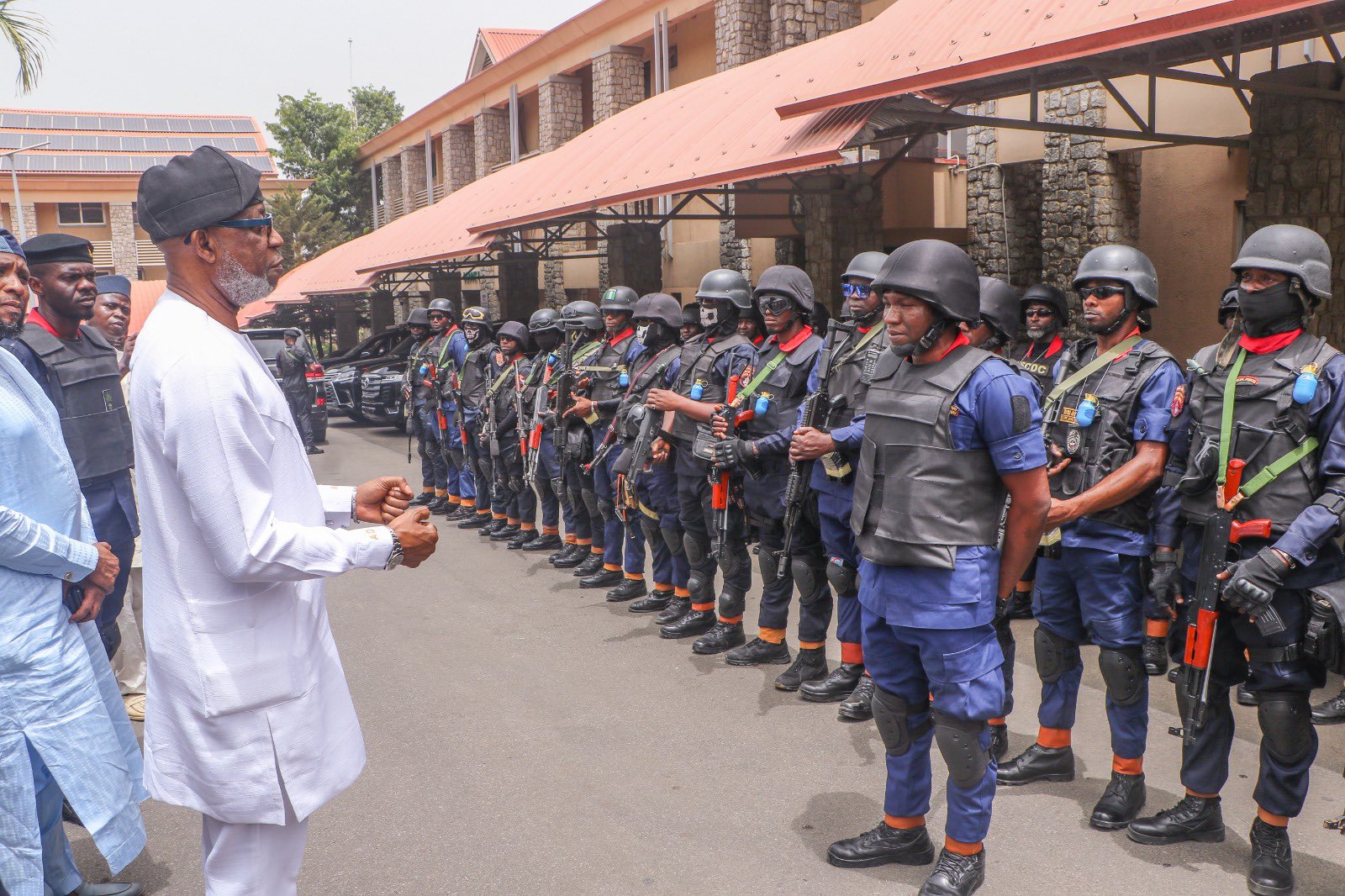
Over 90 illegal mining sites have been reclaimed and 300 offenders prosecuted since the deployment of the Mining Marshals, a specialised task force established to secure Nigeria’s mineral assets.
This information was disclosed by the Minister of Solid Minerals Development, Mr Dele Alake, at the South West Leaders Conference held recently in Akure, the Ondo state capital.
He described the crackdown as a turning point in the battle against mineral theft and insecurity in mining communities.
“We created the Mining Marshals to tackle insecurity and illegal mining head-on. I’m proud to say that peace is returning to our mining fields,” he said.
According to Mr Alake, the initiative has strengthened investor confidence and improved government revenue.
“When you protect the minerals, you protect national wealth. That’s exactly what we’ve done with the Mining Marshals,” he stated.
He noted that beyond arrests and reclamations, the Marshals have restored safety in key mining corridors and curbed the activities of illegal foreign operators. “We are taking back control of our natural resources from criminal networks,” Mr Alake emphasised.
The minister reiterated the government’s commitment to maintaining the momentum through digital surveillance, stronger local intelligence, and inter-agency coordination.
“Our success proves that security is the bedrock of sustainable mining. We will keep refining this model until every site in Nigeria is safe, legal, and productive,” he added.
Launched last year, the marshals were given the mandate to stem theft and all nefarious activities around the nation’s minerals so that benefits are not extracted by the wrong people.

By Aduragbemi Omiyale
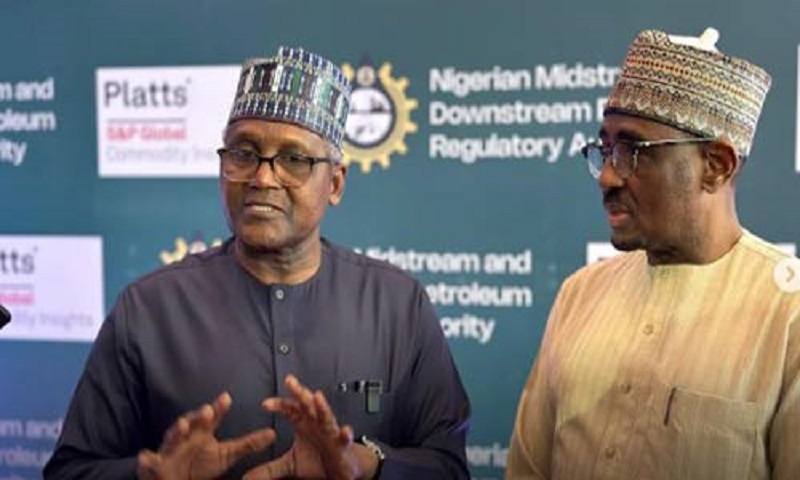
A petition has been filed against the chief executive of the Nigerian Midstream and Downstream Petroleum Regulatory Authority (NMDPRA), Mr Ahmed Farouk.
The petition was written by the president of the Dangote Group, Mr Aliko Dangote, to the Independent Corrupt Practices and Other Related Offences Commission (ICPC).
Mr Dangote asked the agency to look into the finances of the head of the petroleum industry regulator, alleging the man is living far above his legitimate means as a public officer.
In the protest letter filed by his legal counsel, Mr Ogwu Onoja (SAN), the businessman claimed the NMDPRA chief spent over $7 million to educate his children, four in number, in Switzerland.
The petition, dated and submitted on Tuesday, December 16, 2025, and received by the office of the ICPC Chairman, also claimed that Mr Ahmed paid upfront for a six-month period, without any lawful source of income to justify such expenditure.
It also alleged that NMDPRA boss used his office to siphon and divert public funds for personal gain and private interests, actions which he claimed had fuelled public outrage and recent protests by various groups.
“That Engr Farouk Ahmed has grossly abused his office contrary to the extant provisions of the Code of Conduct for Public Officers and, in doing enmeshed himself in monumental corruption and unlawful spending of Public funds running into millions of dollars.
“That Engr Farouk Ahmed spent without evidence of lawful means of income humongous amount of money of over 7million dollars of Public funds, for the education of his four children in different schools in Switzerland for a period of six years upfront,” a part of the petition read.
“It is without doubt that the above facts in relation to abuse of office, breach of the Code of Conduct for public officers, corrupt enrichment and embezzlement are gross acts of corrupt practices for which your Commission is statutorily empowered under Section 19 of the ICPC Act to investigate and prosecute,” another part added.
“Any public officer who uses his office or position to gratify or confer any corrupt or unfair advantage upon himself or any relation or associate of the public officer or any other public officer shall be guilty of an offence and shall on conviction be liable to imprisonment for five (5) years without option of fine,” it reminded the ICPC, urging it to act decisively by investigating the allegations against Mr Ahmed and prosecuting him if found culpable, stressing that the matter is already in the public domain, as this would help uphold justice and protect the image of the administration of President Bola Tinubu.
Mr Dangote promised to provide evidence to substantiate his allegations of corrupt enrichment, abuse of office and impunity against the NMDPRA chief when required.
By Adedapo Adesanya
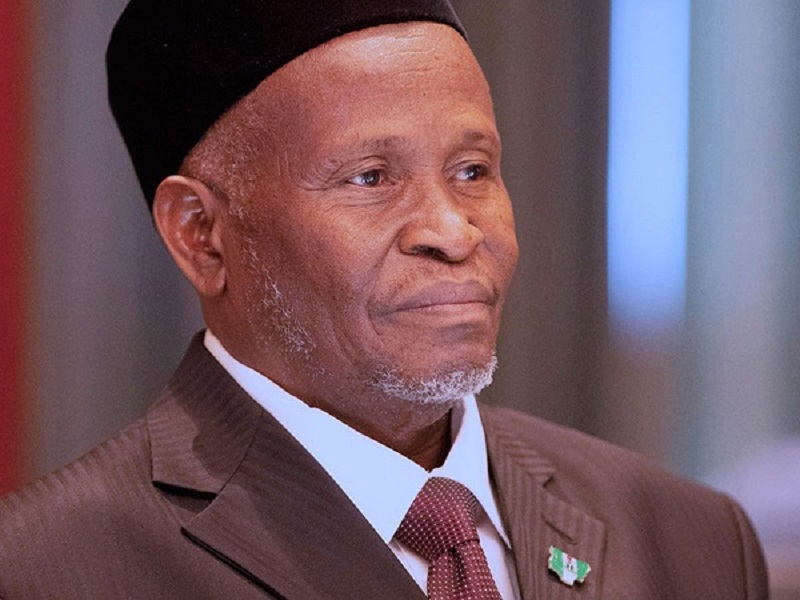
A former Chief Justice of Nigeria (CJN), Justice Ibrahim Tanko Muhammad, has died at the age of 71.
Justice Muhammad reportedly passed away at a hospital in Saudi Arabia, about two weeks before his 72nd birthday, which would have fallen on December 31.
His death was confirmed on Tuesday in Abuja by the Bauchi State Governor, Mr Bala Mohammed, in a condolence message issued on Tuesday by his Special Adviser on Media and Publicity, Mr Mukhtar Gidado.
Governor Mohammed noted that Justice Muhammad was a distinguished son of Bauchi State whose life and career were marked by dedication, integrity, and an unwavering commitment to the rule of law.
“The late jurist was a venerable and accomplished legal icon who rose through the ranks of the judiciary with diligence and distinction, serving as a Judge of the High Court, Justice of the Court of Appeal, Justice of the Supreme Court, and ultimately as Chief Justice of Nigeria from 2019 to 2022,” he said.
According to the governor, Justice Muhammad was widely respected for his legal acumen, discipline, and immense contributions to the growth and development of Nigeria’s judicial system.
He added that the conferment of the national honour of Grand Commander of the Order of the Niger (GCON) on the late jurist was a testament to his outstanding service to the nation.
Mr Mohammed extended heartfelt condolences to the family of the deceased, his friends, colleagues in the legal profession, and the people of Bauchi State and Nigeria as a whole.
Also, the Nigerian Association of Muslim Law Students (NAMLAS) lauded the former jurist in its condolence message.
In the statement titled NAMLAS Condolence Message on the Passing of Hon. Justice Ibrahim Tanko Muhammad, GCON, Former Chief Justice of Nigeria, the association described his death as a monumental loss to the Nigerian judiciary and the nation.
“The Nigerian Association of Muslim Law Students receives with profound sorrow the news of the passing of Justice Ibrahim Tanko Muhammad, GCON, former Chief Justice of Nigeria. His demise is a monumental loss to the Nigerian judiciary, the legal profession, the Muslim Ummah, and the nation at large.”
NAMLAS described the late jurist as a towering figure of integrity, humility and unwavering commitment to justice, noting that throughout his judicial career, he exemplified fairness, courage and fidelity to the rule of law.
The association said that as Chief Justice of Nigeria, Muhammad discharged his responsibilities with wisdom and restraint, leaving behind a legacy that would continue to guide generations of legal practitioners.
Beyond his judicial service, NAMLAS highlighted his role as a mentor to young Muslim law students across the country, describing him as a fatherly figure and a source of encouragement.
“To NAMLAS, the late Chief Justice was more than a jurist; he was a fatherly pillar and a source of encouragement to Muslim law students nationwide,” the statement said.
The association extended its condolences to the family of the deceased, the Nigerian judiciary, the Federal Government and the Muslim Ummah, while praying for the repose of his soul.
Justice Ibrahim Tanko Muhammad served as Chief Justice of Nigeria from 2019 until his retirement in 2022.






-
 Feature/OPED6 years ago
Davos was Different this year
-
Travel/Tourism9 years ago
Lagos Seals Western Lodge Hotel In Ikorodu
-

 Showbiz3 years ago
Estranged Lover Releases Videos of Empress Njamah Bathing
-
 Banking7 years ago
Sort Codes of GTBank Branches in Nigeria
-

 Economy3 years ago
Subsidy Removal: CNG at N130 Per Litre Cheaper Than Petrol—IPMAN
-

 Banking3 years ago
First Bank Announces Planned Downtime
-

 Banking3 years ago
Sort Codes of UBA Branches in Nigeria
-

 Sports3 years ago
Highest Paid Nigerian Footballer – How Much Do Nigerian Footballers Earn